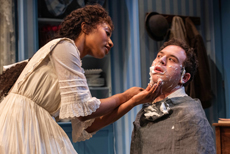
Theatre in Review: Zack (Mint Theater Company/Theatre Row)Zack is a romantic comedy with an accountant's heart; it's a strategy that worked for playwright Harold Brighouse when he penned the early twentieth-century classic Hobson's Choice, about the rebellious daughter of a Manchester bootmaker who commandeers her father's meek assistant, marrying and making a man of him, while seizing control of the family business. (Except for a delightful 2002 revival with David Aaron Baker, Brian Murray, and Martha Plimpton, it has been sadly absent from our stages; check out the celestial David Lean film version with Brenda de Banzie, Charles Laughton, and John Mills). What worked so brilliantly in Hobson's Choice comes up short in Zack, written a few years later; the dramatic ledger reveals a significant deficit of comedy and charm. If the plot of Hobson's Choice is driven by an unusually strong-willed, business-minded (for 1880) woman, Zack, which unfolds some years later, in the Edwardian era, has two such creatures: Mrs. Munning, dissatisfied with the returns from her late husband's joinery, runs a catering service with the assistance of her son Paul, possessed of a mind like an abacus. Profits are declining, however: "It's the same old tale. They'd heard our weddings aren't as pleasant as they used to be," grumbles Paul; given his grasping nature and his mother's transparent airs, the falloff isn't hard to understand. Meanwhile, Mrs. Munning is atwitter about the arrival of Virginia, a young relation, coming for some country air after an illness. Virginia has 500 pounds a year, a fortune in those days, and Mrs. Munning wants to keep it in the family by marrying her off to Paul. But Virginia is rather more intrigued by Zack, Mrs. Munning's feckless other son, an untidy, childlike layabout. Like Maggie, the heroine of Hobson's Choice, she knows a fixer-upper when she sees one. But is her confidence misplaced? An embarrassment to his family, who can find no use for him, Zack is kept on the QT as much as possible, saddled with grunt work for which he receives no salary. Lacking a will of his own, he gets ensnared in a shotgun marriage situation with a local girl, Martha, whose father is a disgruntled former employee of Paul's. Seizing an opportunity to write off his brother as a bad debt, Paul schemes to export Zack and Martha to Canada after the wedding. It looks like a done deal until Virginia steps in, making a counteroffer that upsets everyone's plans. Your enjoyment of Zack is likely to depend on how you feel about Zack. As played by Jordan Matthew Brown as an indulgent, overgrown kid terrified of the adults around him, he seems oddly disengaged, quite possibly an inhabitant of the autism spectrum. The play gives him few opportunities for interaction with Virginia, leaving one to wonder what she sees in him. Paul and Mrs. Munning are stunned to hear from their customers that Zack's "gift for jollifications" is central to their business success, and, frankly, one is a bit surprised to hear it, too. Jollification is largely missing in Britt Berke's production, and the title character often seems to be missing in action. Berke and her cast seem to be searching for the key to the play's humor. Least successful are David T. Patterson, who overplays Paul's villainy, and Melinda Maxwell, who can't find a comic slant on Mrs. Munning's social-climbing ways. Grace Guichard, a tear-stained hankie forever at the ready, is rather better as Martha, who is rather pleased to be thought of as a scarlet woman. As her vengeful father, the imposing, rangy Sean Runnette dominates in his scenes, neatly stepping over a table to make a forceful point. As Virginia, Cassia Thompson makes something interesting of the final scene, in which, a Delilah in reverse, she shaves off Zack's luxuriant beard by way of freeing him from his tyrannical relatives. Just when the play gets interesting, it is over. (It also seems strange not to employ British accents; Brighouse, after all, was a regional writer with a detailed understanding of Northern English life. This decision robs the play of some of its specificity.) The production looks good, thanks to Brittany Vasta's blue-striped parlor set, aided by Mary Louise Geiger's lighting. Kindall Almond's costumes include several attractive ensembles for Virginia. Jane Shaw's sound design includes various effects and some jaunty period tunes for the scene changes. I have no idea why the preshow playlist includes songs by The Beatles and The Velvet Underground featuring Nico, but it makes for pleasant listening. The Mint has given us so many fine and interesting things that the sheer law of averages dictates the odd misfire, and Zack is it. Without a plausible romance blooming anywhere onstage, the action is entangled in the characters' mercenary machinations, amounting to an unimportant shuffling of marital arrangements. At the play's climax, a kind of giant valentine makes its appearance, but, under the circumstances, it feels half-hearted. Virginia makes an enormous investment in Zack, who remains oddly absent in the comedy bearing his name; let's hope her risk pays off. --David Barbour 
|