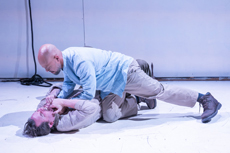
Theatre in Review: Othello (Bedlam/West End Theatre)I know the fashion is for stripped-down productions of classic plays, but Bedlam's take on Othello is so bare bones as to be positively nude. The set, by director/cast member Eric Tucker, consists of a white wall on which are painted (in white) lyrics or lines of verse -- I couldn't tell which, as there wasn't enough lighting to reveal them. (Cheyenne Sykes' lighting doesn't always privilege the actors' faces, either.) Given the style of Sam Debell's costumes, one imagines the designer raiding the actors' closets. And a play with a dozen or more speaking roles features only four actors, frantically juggling characters. From time to time, they end up mashed together in a kind of group hug. I don't blame them; it must be lonely onstage. To be sure, Tucker has taken a razor to William Shakespeare's play, both to pick up the pace and to eliminate the pesky clowns and Gratianos who, to his mind, I suppose, clog up the action. This approach creates some procedural challenges. Because Susannah Hoffman plays Desdemona and her father, Brabantio, she is forced, in effect, to introduce herself. Hoffman also plays Michael Cassio, meaning that, once or twice, when Cassio and Desdemona confer, she is left talking to herself. (She is one busy actress.) One minute, Hoffman and Susannah Millonzi are on the floor, as Cassio and Roderigo, wounded from a fight; a second later, they leap up and assume other roles. Don't be surprised if you occasionally find yourself two or three lines behind the action, trying to identify which character is speaking. There's a method behind this approach, I think, and it is to reframe Othello as a taut, fast-moving psychological thriller. Fair enough; as Walter Kerr once noted, when William Shakespeare evoked the "two hours traffic of our stage," he wasn't kidding. By all accounts, those productions at the Globe moved at a lively pace, and many Shakespeare revivals these days could do with more matter and less art. This is also a notably lucid reading of the text, rendering its most abstruse passages as everyday conversation; all four actors have solid classical technique. At its best, the production delivers lightning flashes of drama and insight: Trying to reduce Cassio's punishment, Desdemona bargains with Othello, a back-and-forth that, despite their smiles, simmers with an underlying tension that hints at the violent break to come. In the title role, Ryan Quinncarefully tends Othello's growing jealousy, holding it back until it surfaces in a single shattering eruption that sends shock waves through the theatre. Driven to the breaking point by Iago's insinuations, he falls on his lieutenant in a terrifying rage, nearly strangling him while demanding incriminating evidence of Desdemona's infidelity. The climactic murder scene is as horrifying as anyone could wish, a descent into perdition from which there is no return. Hoffman makes Desdemona a strong, yet pitiable, figure, a good woman baffled and heartbroken by the disastrous turn her marriage has taken; she pours vast reserves of sorrow into a single brief line ("O, these men, these men!"). Millonzi is solid as the easily gulled Roderigo and a cagey, cynical Emilia. Tucker's Iago, however, is more a small-time criminal than an avatar of evil, lacking the chilling core of sociopathy found in the best portrayals (in my experience, Corey Stoll and Daniel Craig). Also, some of the doubling is questionable -- Quinn's appearances as Bianca, Cassio's sluttish girlfriend, aren't very effective -- although in these reduced circumstances, everyone has to pull his or her weight. There are also long stretches when the staging feels uncertain, marking time until the next big effect. Many choices stand out for their strangeness or seeming irrelevance: What's with the cheesy voiceover promotions for Venice and the Mediterranean? Why is the playing area reconfigured between the first and second half? (This is a Tucker specialty, and it seems more and more like an affectation.) Why does Roderigo's attack on Cassio unfold in near-total darkness, save for three flashlights? And why does a production that has little or nothing to say about race end with James Baldwin on the sound system? Like other Bedlam treatments of classic works, Othello has intriguing elements yet a sense of no one at the steering wheel. At times, it feels like a workshop staging, in which everyone is trying out ideas to see what works. This no doubt adds a raw quality that some may find gripping. But, to my mind, this production isn't so much stripped-down as only partially realized. --David Barbour 
|