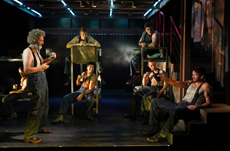
Theatre in Review: The Hairy Ape (Irish Repertory Theatre)"We live in hell!" shouts one of the coal-stoking seamen in Eugene O'Neill's parable of lives ground up in the machine age's gears. Ciaran O'Reilly's revival of The Hairy Ape -- his second pass at the property -- is well-poised to demonstrate this proposition in tableaux of shirtless, dirt- and sweat-stained men feeding the fiery furnaces of an oceangoing vessel. One of them, Yank, feels overweening pride in his hard labor until a brief, profoundly destabilizing encounter with a slumming heiress shatters his sense of self, sending him on a downward spiral that ends at, of all places, the Bronx Zoo. The Hairy Ape is a true paradox, a theatrical antique with an alarmingly up-to-date message: O'Neill, a one-man bomb squad, was bent on blowing up what he called the "Broadway Show Shop" and its picked-over dramatic goods, forging a new, dynamic, and more presentational style; today, some of his techniques, especially the use of masks, feel like souvenirs of another era. (O'Reilly throws in a few touches of his own, including a marching line of the downtrodden right out of Fritz Lang's Metropolis.) But the playwright's language is as muscular as his characters, and his vision of technological disruption and stark economic inequality can make modern audiences squirm in their seats. And, at the Iris Rep, the title role, aka Yank, gives Jon Beavers the chance of a lifetime, which he doesn't squander. Yank is the outlier among the ship's boiler crew, lying back and glaring in distaste at his shipmates' boozing and roistering. Their official father figure is elderly, half-in-the-bag Paddy ("I'm never too drunk to sing"), brought to irrepressible life by the great John Keating. Slumping and wasted from years of hard work, his Brillo-pad streaked with gray, the grizzled Paddy authoritatively pays tribute to the sailing ships of the past, "driving through the gray night, her sails stretching aloft all silver and white, not a sound on the deck, the lot of us dreaming dreams, till you'd believe 'twas no real ship at all you was on but a ghost ship like the Flying Dutchman." It was, he insists, a life of spiritual satisfaction: "'Twas them days a ship was part of the sea, and a man was part of a ship, and the sea joined all together and made it one." Pushing back against such lyrical memories, which he dismisses as "a dope dream," is Yank, who worships speed ("twenty-five knots an hour!"), insisting, "I'm part of the engines!" Dismissing Paddy's assertion that they are collectively choking to death in the stokehole, he asserts, "He can't breathe and swallow coal dust, but I kin, see? Dat's fresh air for me! Dat's food for me! I'm new, get me? Hell in de stokehole? Sure! It takes a man to work in hell. Hell, sure, dat's my fav'rite climate." Next, in a dramatic U-turn, O'Neill introduces Mildred, the neurotic, neurasthenic daughter of a steel tycoon, and her cold-eyed Aunt Mildred. The playwright is much less at home with the leisure set, and Elizabeth Teeter and Joanna Glushak push their overripe dialogue to the edge of camp. "I would like to be sincere, to touch life somewhere," Mildred muses. "But I'm afraid I have neither the vitality nor integrity." She adds that she is "a waste product" of the family's Bessemer converters. A practiced thrill-seeker, she convinces the ship's captain to grant her a guided tour of life below the ship's hold; there she meets Yank, and their brief eye contact, followed by her expression of disgust, leaves him all but unmanned. Reeling from a toxic mix of rage and eros, suddenly terrified that he is little more than a beast of burden, he embarks on a violent search for revenge. Taking O'Neill as he finds him -- the only sensible approach -- O'Reilly stages each of the play's eight scenes with all stops out, refusing to apologize for such over-the-top effects as Yank, trapped in a tiny jail cell, tormented by members of the one percent in their finery and glittery face masks; the director stages the final, fatal encounter with a gorilla in the zoo for its full melodramatic horror. He can do so because he has a pair of aces in the hole: O'Neill was not yet the master psychologist of his later plays, but he could turn out astonishing arias: Yank's speeches are like being grabbed by the lapels and thrown against a wall, and what he says has a disturbing currency; as the program notes indicate, The Hairy Ape is an almost frighteningly apt portrait of a disenfranchised working class, their lives stripped of meaning, howling into the darkness. "Tree square a day, and cauliflowers in de front yard -- ekal rights -- a woman and kids -- a lousy vote -- and I'm all fixed for Jesus, huh?," asks before concluding, "Aw, hell! What does dat get yuh?" Yank is surely one of the more exhausting roles in the theatrical canon, but Beavers attacks it with unfailing vigor, savagely insisting that he belongs to the class of men who drive the world and, later, charting Yank's disintegrating personality, his furious self-assertion battling with the fear that his life has no meaning. A desperate reckoning with a gorilla, the only creature he believes can understand him, has a strange poignancy, and his final speech makes for a wrenching sign-off. A busy actor in video and film, Beavers has power and technique to spare; let's hope he sticks around and is offered more challenging roles. The rest of the cast is more than solid, with Adam Petherbridge standing out as the secretary of the International Workers of the World, who can't get past the notion that Yank, looking for fellowship, might be a police plant. Finding a suitable style for an expressionist piece like this surely isn't easy, but O'Reilly has the Irish Rep's top design team at his disposal. Charlie Corcoran's set is surely the most ambitious ever seen there, a mechanical contraption that raises, lowers, or functions as a split-level stage. Michael Gottlieb fills the below-decks area with satanic floods of red, uses backlight to silhouette the gorilla against a large-scale banner, and effectively evokes a chilly atmosphere on demand. Orla Long's costumes suit characters from all social levels, from laborers to society swells. Ryan Rumery's mechanistic original music sets the right tone; he and co-sound designer Florian Staab produce ship's horns, gulls, traffic, church bells, breaking bones, and a scream magnified to room-rattling effect. Compared to Richard Jones' epic 2017 staging at Park Avenue Armory, one imagines that this ingenious, more compact approach may be closer to the 1922 original at Provincetown Playhouse. O'Neill remains a playwright whose apparent flaws are inseparable from his virtues, but the intelligence of O'Reilly's staging, the invention of his design team, and, most of all, the coiled intensity of his cast give it a contemporary relevance that can't be ignored. The Hairy Ape remains a dramatic nightmare with lingering after-effects, a portrait of society moving too fast for its own good. --David Barbour 
|