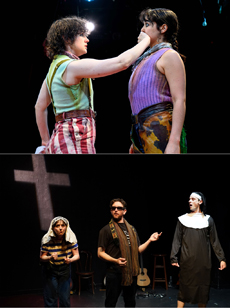
Theatre in Review: And Then the Rodeo Burned Down (Ars Nova)/Catch of the Day (59E59)On the red carpet at the Tony Awards last week, Bernadette Peters particularly praised the comedy musicals Schmigadoon! and Titanique because, she noted, people really, really need the chance to laugh right now. Well, never argue with a diva, although I might question her choices; comedy is a fragile thing, deeply personal, and everyone's mileage may vary. The truth of this proposition became blazingly clear at two attractions I attended in recent days, each of which left me baffled. I am late to this rodeo: And Then the Rodeo Burned Down has been greeted effusively by many reviewers following a prize-winning run at the Edinburgh Fringe Festival; in addition, the show's creators, Xhloe Rice and Natasha Roland, took home the Sam Norkin Award at this year's Drama Desk. As a topper, the show's initial run has been extended into July. About all this, I dwell in mystery. In this high-concept entertainment, Rice and Roland play rodeo clowns -- or, rather, one of them is Dale, a clown, and the other is Dale's "shadow" (whatever that means), named Dilly. The latter also takes on the roles of Barnaby, a cowboy, and Arnold, a bull. (Telling the two performers apart is an impossibility; you'll get no help from the program.) The largely plotless piece's first two-thirds consist of routines that rely on redundancy and/or stating the obvious to an allegedly laugh-provoking effect. For example, trying to get rid of the pesky shadow who has intruded backstage, Dale says, "Rodeo personnel only." "Oh, I don't take anything personally," the Shadow replies. At the performance I attended, this actually got a laugh. Then there's this: "Try bein' a shit shoveler, could be so much worse," Dale announces by way of offering advice. "What's a shit shoveler?" wonders the Shadow. "They shovel the shit," Dale answers. "The shit from the bulls, and the horses, and they get shit on, and they're treated like shit, and they smell like shit." The Shadow, laughing, comments, "Now that is a shit job." This got a laugh, too. Or this: Dale tells Arnold the Bull, "I pulled you out of your mother. I was there when you were born." "I was inside my mother?" Arnold asks, stunned. "How did I get in there? Were you inside my mother?" All these bits had at least part of the audience in stitches, but such hijinks left me in an active state of pain. I gather that the show intends to deconstruct the myths of masculinity and the Wild West long been embedded in our culture, but to what end? And why the attitude of pervasive silliness? What is it trying to say? An aren't-we-clever undertone to these antics quickly becomes grating. A passage about brutality to animals is briefly touching, and the piece becomes fitfully amusing near the end, when, more or less playing themselves, the performers struggle to complete their script on a shoestring. ("We can't afford a B-plot," we are told. "And meta theatrics are out of the budget entirely." Sentiments many a theatre maker can identify with!) Tom Costello stages these desperately thin proceedings with precision, especially a running gag in which sticks drop in from above, and both performers are bursting with energy, loaded with good cheer, and adept at synchronized movement. (The scenario features several versions of the old vaudeville mirror routine, of which Harpo Marx was the absolute master.) I also detected bits of staging that recalled other classic comic routines, including a salute to Waiting for Godot's benighted tramps. But the gags have no meaningful context, resulting in a self-referential entertainment coasting on a smile. Once again, the set designer Emmie Finckel impresses with her visual imagination and deft hand with a difficult space, filling the auditorium with a circular stage surrounded by old-fashioned circus-tent drapery and images of Victorian-era audiences. Angelo Sagnelli's fluent lighting creates a distinctive look for each of the play's many realities. Christopher E. Ford, listed as "co-costume designer," puts the stars in appropriate outfits, and "co-sound designer" Carsen Joenk provides a circus parade of effects, many of them fire-related (don't forget that title!), in addition to a delightful playlist of tunes that includes Beyonce's "Texas Hold 'Em," Chappell Roan's "Pink Pony Club," and Dolly Parton's "9 to 5." Much talent is involved, but, to my eyes, this is comedy in a vacuum, a lot of fooling around for no clear reason. If anything, Catch of the Day is even thinner: If you've even been to Ireland's delightful Dingle peninsula, you'll know that this fishing village-turned-tourist-haven is famous for two things. One is Fungie, the dolphin, who, alas, has seemingly disappeared after a nearly forty-year run in the surrounding waters. The other is the David Lean film Ryan's Daughter, which was shot there in 1970, and which originally brought the town to the world's attention. Catch of the Day backdates that claim a bit, noting that the capture, in 1966, of an extremely rare sturgeon (not typically found near Ireland) set off a brouhaha that dragged in, among others, the then-president Eamon de Valera and a convent full of nuns. But the story behind Catch of the Day barely qualifies as an anecdote. Basically, for reasons not fully explained, the fish must be given to a head of state -- it's a "royal" sturgeon -- although in the end, after considerable wrangling, it ends up earmarked for the good sisters. A couple of very minor twists later, and the whole thing is over. It's a blink-and-you'll miss-it entertainment, most notable for the fact that nobody, least of all the playwright/director Megan Jenkins, seems to have wondered why the story is worth telling. The one glaring exception is a song, performed by the exceptionally poised and appealing Anna McCormick, offering a brief history of the thorny relationship between Ireland and Great Britain. The show stops cold for a sequence that pitches it in another, much more serious direction. Other bits, especially those about de Valera's checkered reputation as his nation's leader, make me wonder if the piece's political subtext is richer and more involved than a US viewer, only moderately schooled in modern Irish history, can grasp. Still, the cast is affable, and to reach the sixty-minute point, the action is padded with folk tunes that are far more engaging than the narrative on offer. On the downside, the actors indulge in more "funny" voices than the law should allow; the bits with the nuns are especially dire. On the whole, however, they seem a talented and charming lot. This is the most bare-bones production I've seen in months, to the point of no design credits, but whoever did the lighting handles the space with skill. Catch of the Day -- which, like And Then the Rodeo Burned Down, won plaudits at the Edinburgh Fringe -- is a production by the Anglo-British company, Red Fox. It may simply be a good example of a piece developed for a local audience that doesn't travel well. Anyway, if you get the chance to visit Dingle, pounce. --David Barbour 
|