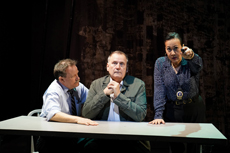
Theatre in Review: Not Nobody (Twilight Theatre Company/59E59) The preshow music for Not Nobody includes "This is Not America," by David Bowie and Pat Metheny; it's a smart choice by sound designer Ariana Cardoza for a play that wrestles with an American justice system that, in the eyes of many, seems to be becoming unglued, thanks to policing unfettered by legal guardrails. To prove the point, playwright Brian Dykstra entraps his protagonist, McAlester Daily, a retired academic, in an ugly situation that spirals into tragedy, leaving many unanswered questions. McAlester is stopped by a pair of cops who want to know why a timid, easily spooked white man is wandering through a crime-ridden urban neighborhood. The answers are not forthcoming. McAlester is a mass of tics, twitches, and hesitations; he is also prone to subjecting the simplest query to such extended analysis that the words' meaning crumbles away. Don't even think of interrupting him; as he notes, "There are people, in my life -- this is not always the best idea, me talking, getting started, started talking. It's, it's hard for me to stop. Sometimes." Well forewarned is forearmed. Such endless tergiversation infuriates Ricketts, the cop leading the interrogation, who asks if McAlester is on the spectrum. "If it's a spectrum, who's not on it?" he wonders, not unreasonably, but also not helpfully. This halting Q&A, which is potentially as irritating for the audience as it is for Ricketts, is interrupted by an offstage incident involving real criminals, which ends in gunfire. Amazingly, if not entirely in character, McAlester intervenes, saving the wounded Ricketts from bleeding to death. At first, McAlester is hailed as a hero. But when Ricketts dies, due to complications from his shooting, McAlester is reframed as a potential criminal accomplice. At first, he insists he has no memory of the incident; later, taken to court and pressed to make a statement, he offers an elaborate denunciation of a justice system that, in its brute exercise of power, can no longer be trusted. He even attempts to graft a Black Lives Matter aspect onto his argument, a gambit that feels more opportunistic than meaningful. It's the first hint that Not Nobody is mostly interested in functioning as a pep rally for angry liberals. Dykstra is getting at something important, but the setup is weak, and the plot is packed with rickety contrivances. Not Nobody would have you believe that McAlester blithely strolls at night through crime-ridden neighborhoods; that anyone looking at him would see a homicidal criminal, and that the judge overseeing his case would drop F-bombs on a variety of targets, including the Supreme Court. The script is a polemic that fails to make its case: McAlester, who pursues ethical points to the nth degree, comes off as unpleasantly finicky, unable to game out the consequences of his thinking. He makes many good points, but a rigorous playwright would allow another character to push back just as forcefully, noting McAlester's seemingly callous indifference to Ricketts' murder. Also, anyone with McAlester's apparent breadth of learning should know that if citizens like him refuse take their part in the justice system, it will only collapse that much faster, leading to outright anarchy. Still, even if Not Nobody often seems divorced from the real world, it has a cast, under Margarett Perry's vigorous direction, that tucks into their roles with gusto. Sheffield Chastain is persuasive as the alternately bellicose (and, later, weakened) Ricketts; a no-nonsense detective; and an assistant district attorney out for blood on the witness stand. He spars especially well with Kathiamarice Lopez, as McAlester's lawyer, especially in a furious joust over a video that may or may not prove incriminating, depending on who is doing the lip-reading. Lopez, who shines here, is also good as Rickett's more reasonable partner, who curiously feels out McAlester about his fear of law enforcement, and as a police department spokesperson. Kate Siahaan-Rigg has a zesty time as a wisecracking judge overseeing McAlester's case who invokes Herman Melville's "Bartleby" and then shames anyone who isn't familiar with the text. The mostly solid production design, featuring an upstage drop by Tyler M. Perry, that I couldn't quite make out, is dominated by Jen Leno's lighting, which includes red-and-blue police-car washes, a rapid-fire sequence that artfully picks out each member of the cast, and convincing fluorescent-style effects. Daniel Lawson's costumes also feel right for the play's milieu. Dykstra also stars as McAlester, and while his performance is thought through to the last detail, fleshing out each of the character's eccentricities, he can't quite make him into the provocative, polarizing figure the play needs. His fussy ways become grating, and his motives are sometimes murky. We never learn if McAlester genuinely has no evidence to offer, or if he is grandstanding to make a point. Nor do we ever find out for certain what happened on that fateful night. The audience is denied the chance to reach its own conclusions while the protagonist pontificates. Indeed, it's hard not to feel that the delivery of the play's theme is something of a force-feeding. Dykstra certainly makes the most of his climactic aria, and the audience at my performance cheered him on. But Not Nobody suffers a form of dramatic confirmation bias, reassuring viewers that what they already feel is true rather than challenging them to look deeper into one of the most vexing issues of our time. A pity; it's a missed opportunity. --David Barbour 
|