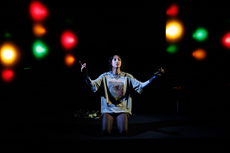
Theatre in Review: I'm Not Even Half (Bushwick Starr)S, the heroine of Layla Khoshnoudi's solo play -- who, to be clear, seems an awful lot like Khoshnoudi -- begins flat on her back, having been rear-ended by a car. It's a true tale of our times: She failed to look up from her smartphone. In an even truer tale of our times, it is 2022, and she is riveted by news coverage of Iranian women protesting the death of Mahsa Jina Amini, who, she notes, "was not wearing her hijab properly and was thus beaten to death by the morality police." There's something so right about being caught up in the dreadful news of the day that one fails to notice an approaching vehicle. Aren't we all in this situation, more or less? This show's oddball comic note is extended as, in the ambulance, S flirts with the EMT ("I'm an actress and a director. I'm trying to emerge as a director.") and ponders asking Harry, her sort-of boyfriend/sort-of ex, to meet her at the hospital. Alas: "He has to meet some people that are crucial connections, so obviously he can't come," she notes, in the first of many statements that should set off alarm bells about Harry. Following her CT scan, her first question is, "How long 'til I can drink?" Up to this point, I'm Not Even Half, which is paced by amusing phone calls from S' alarming Iranian mother, is a quirky, modestly engaging account of a young woman adrift in Brooklyn's boho landscape. Other salient details include S' taste for vaping, her deep familiarity with the Nick and Vanessa Lachey reality series The Ultimatum, and her wisecracking attitude toward her religious heritage. ("Guess you're really one of those cherry-picking Muslims," she tells a store clerk listening to secular music.) Meanwhile, she keeps turning back to the news: "Watching this battle in Iran, between the women and the guards, I saw something I recognized from the world of my childhood: a kind of denial, or even hate, driven by fear of female sexuality." Does S identify a little too strongly with these embattled women? Next, her friend Julianne -- who has, shall we say, a more solid grip on reality -- shows up to keep her company and, more importantly, disabuse her about Harry, who is at best a cheating dog and, more likely, a sexual predator. This news sends S, now blotto from inhaling THC, running to Harry's apartment where her intended confrontation becomes a seduction; as she gives way to his sexual ministrations, she pulls out an enormous religious veil that covers most of her body. The implication is staggeringly clear: S is a victim, too. Just like the women in the old country. Cooler heads prevail, and S recovers herself, getting away from Harry thanks to a couple of well-landed stomach punches. Breathless from freedom, she notes that truth-telling Julianne "saved me in this horrible way." Taking note of the day's news, she adds, "So did the girls in Iran." I'm sure they'll be gratified to hear it. Does Khoshnoudi really think her protagonist's problems, as agonizing as they may feel, are on a par with the systematic oppression of a nation's female population? The idea makes me blanch, but there you are. I kept waiting for the penny to drop, indicating that S is yet another American so wrapped up in her elastic definition of trauma that she is blind to the world's darkest evils. Yet the moment never came. Instead, the playwright busily forges links between S' situation (including being raised in a traditional family where she has been taught to please men) and the pathologies of a society ruled by ayatollahs, where the slightest breach of protocol can be fatal. On its own, S' journey of discovery might make for a perceptive, if necessarily small, piece. Placing her story against the background of a major global crisis does it no favors. The director, Machel Ross, might have done more to soften Khoshnoudi's herky-jerky vocal delivery, which, I guess, is meant to show how fun and kooky she is. She has a sly way with a laugh line, but as she moves into deeper waters, she can't muster the necessary conviction; at times, she almost seems to be reciting her text. And no matter how much she tries to make a martyr out of S, the character comes across as little more than blindly self-involved. Anyway, set designer Emmie Finckel provides a sensible ground plan for a piece that moves across several locations; they also collaborate with lighting designer Cheyenne Sykes on an attractive effect involving colorfully backlit scrims, adding some welcome visual variety. Chris Hynds dresses the star suitably. Christopher Darbassie's sound design includes sirens, Arabic music, and the Ariana Grande song "God is a Woman." "I took their pain very personally," S says about the women of Iran. I'll say she does, but some perspective is in order. I'm Not Even Half is a play about faith, we are told, and, near the end, S offers a potted version of the quote, made famous by Martin Luther King, about the moral arc of the universe bending toward justice. It's a weighty thought, much too heavy for this slight piece to bear. --David Barbour 
|