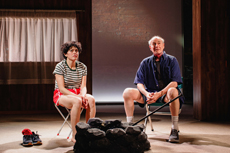
Theatre in Review: You Got Older (Cherry Lane Theatre) I don't know why we're getting Clare Barron's 2014 family tragicomedy once again, but it's good to have it back, especially in Anne Kauffman's sharply observed production. It constitutes Exhibit A in the argument that the choice of dramatic material matters much less than how it is handled: This is the stuff of dozens of domestic dramas, many of them crushingly banal or lachrymose. In contrast, You Got Older is bracingly realistic, filled with idiosyncratic details usually found only in fine literary fiction. It also has a fine appreciation of how laughter and loss move hand in hand through life. It's a play of sensibility, and the sensibility is first-class. Barron, a true playwright, is immune to editorializing, preferring to let audiences figure things out for themselves. The action begins with Mae Hardy, in her thirties, at home with her father (identified only as Dad) in a town near Seattle. The early scenes are filled with lightly amusing generational skirmishes over issues like technology, for example, when Dad expresses astonishment that Mae receives text message updates from her pharmacy; given his tone of voice, you'd think she was receiving radio signals from Mars. But look closer, and you can't help but notice that they are studiously avoiding talking about something. Also, note the angry scar on Dad's neck and the way he repeatedly dabs his mouth with a handkerchief. It isn't until two or three scenes that we learn that a "weird, mysterious cancer" has "spread all over his body." We also learn that Mae has hit a catastrophic rough patch, resulting in the loss of her boyfriend, apartment, and job (as a lawyer) in one fell swoop. Dad, it seems, isn't the only one with big problems, and Mae isn't charmed by his occasional nagging about putting her life back together. Father and daughter are living in a kind of hideout, marking time against the hope of better days to come. But, rather than beg for sympathy, Barron reveals her characters in all their oddball glory. Mae, who is feeling a little sex-starved following her breakup, has erotic, lightly sadomasochistic dreams about cowboys that merge with her anxieties about Dad. She and Mac, a half-forgotten elementary school classmate, flirt over their joint fascination with gross physical ailments like (her) rashes and (his) infected hairs. And then there's the discussion among Mae and her siblings about the Hardy family smell, which gets dissected with the acuity one expects to find at a convention of perfumers. The above exchange unfolds in Dad's hospital room following what everyone hopes will be his final treatment. While Dad struggles to emerge from anesthesia, Mae and her siblings -- the put-upon Matthew, overbearing Hannah, and girlish Jenny -- continue with the same battily amusing sniping that surely has kept them occupied for a quarter century or more. Barron has a rare appreciation for the inside jokes, embarrassing memories, and thrice-told tales that make up the Hardy family mythology. (Hannah imagines telling her young son, "Mommy's giving you bad skin, cancer, Alzheimer's, Parkinson's, and male pattern baldness.") That all this happens in front of the semi-conscious Dad is the point: You Got Older understands that tragedy often unfolds in slow motion, yet daily life, with all its trivialities, annoyances, and small joys, keeps pulling us along. Kauffman's production relies on the anchoring performances of Alia Shawkat's Mae, practical, unsentimental, and evasive about her feelings, and Peter Friedman's Dad, bravely bearing each setback yet retaining a strange sense of wonder, especially when admitting, "In some ways this has been one of the most wonderful years of my life." He is also a Hardy through and through, shocking even his children with the mocking "family birthday song," which wonders why we were born. The role of Dad was created in 2014 by the great Reed Birney, but Friedman brings a stoic acceptance of life's cruelest curveballs that allows him to make it thoroughly his own. But everyone in Kauffman's cast is on Barron's oddball wavelength: Misha Brooks as Matthew, with his knack for hairsplitting arguments; Paul Cooper as the Cowboy of Mae's dreams; Caleb Joshua Eberhardt as Mac, Mae's genial, feckless, would-be lover; Nadine Malouf as Hannah, busy dispensing bizarre bits of folk wisdom like "the curse"("You knit someone a sweater, they break up with you, unless you've been together five years or longer"); and Nina White as Jenny, who gifts everyone with baseball caps because, "if you need to cry You pull the cap down over your eyes And you can cry in private." Like many other things in You Got Older, it's a gesture both poignant and sneakily amusing. The play requires a highly flexible design, which it gets here. Arnulfo Maldonado's unit set swiftly transforms from Mae's bedroom to a bar, hospital room, kitchen, and other locations. Isabella Byrd's lighting takes in institutional washes, colorful sunsets, and rock-out party looks. Asta Bennie Hostetter, costume designer for the 2014 production, returns with a series of closely observed styles for character. Daniel Kluger's sound design blends well-executed effects (birdsong, cicadas, a shocking thunderstorm) with several pop tunes in various genres and his plaintive original compositions. Kauffman's handling of the script provides plenty of revelatory moments: An erotic dream that takes a sinister turn when the fantasy lover displays his lesions; Dad entering, obviously weakened by surgery; a wittily staged bit of hospital room crosstalk; a midnight tryst for Mae and Mac derailed by an anguished Dad, knocking on her bedroom door; and a final, foot-stomping dance at Jenny's wedding, a defiant gesture of joy, that ends in a stark recognition of loss. You Got Older looks like a delicate piece, but don't be fooled: It captures the evanescence of life, and the grief we leave behind as a parting gift for those who love us. It's a remarkable piece. --David Barbour 
|