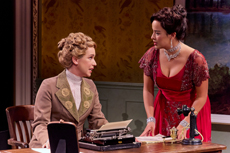
Theatre in Review: Reunions (City Center Stage II) It's a heterodox opinion, I know, but not everything needs to become a musical. This proposition is proved in duplicate at City Center with Reunions, which musicalizes two notable one-act plays. Indeed, it is an ideal lab: The production is well-cast, beautifully designed, and cleanly staged (by Gabriel Barre). It benefits from writing that never falls below a minimum level of craft. (These days, that's high praise,) Everything is tastefully, even elegantly, executed. And yet excitement, a sense of emotional engagement, is missing. The first act, based on J. M. Barrie's 1911 comedy The Twelve-Pound Look, which provided Ethel Barrymore with an early vehicle, is a sturdy piece of work. Bryan Fenkart, jutting his chin in self-satisfaction, is Harry Sims, a social-climbing businessman about to be knighted, an event that he clearly views as the singular triumph of his life. He keeps his trophy wife, Emmy (Courtney Reed, looking suitably beautiful yet slightly downcast), in check, stating that her duty is to be "the ornament of our household." He adds, "You host your teas. You greet our friends. You accompany me in public. You approve Cook's menus and Nanny's lessons for the children." Not relishing the prospect of becoming a Real Housewife of Kensington, Emmy nevertheless dutifully submits. Disruption arrives in the person of Kate, a typist hired to answer Harry's voluminous load of congratulatory notes. In the sort of twist that only happens in drawing-room comedies, Kate (Chilina Kennedy, brisk, businesslike, and suffering not fools) is Harry's ex-wife, who abandoned him for a life of work and independence. This cues a dissection of their marriage, revealing the true depths of Harry's fatuous, materialist philosophy and its killing effect on the women he professes to love. The original play is a trim, taut, sharp-eyed comedy, devoid of sentiment, and, for the life of me, I can't figure out why it needs music. I'm not sure that Jeffrey Scharf (book and lyrics) and Jimmy Calire (music) have figured it out, either. To be sure, they leave no stone unturned. They provide a chorus of servants kvelling over their newfound social status, asserting, "The day that we're in service to a nob/We'll no longer slum among the mob." Harry coldly informs Kate, "You Might Have Been Lady Sims," ("You might have been resplendent/But you chose to be descendent"). Kate has a self-assertion anthem, "I Had to Give Us Up" ("I had to open up my eyes/Break the spell and recognize/What you were, you would always be.") But none of these add anything to the original play; indeed, they tend to overexplain points that Barrie made more subtly. All three leads are fine, especially dressed in Jen Caprio's smashing costumes. (When Harry, in a moment of pique, announces that Emmy needs more jewels, one wants to laugh; she is more brightly decked than a theatre marquee.) The result is a piece of smooth professionalism that feels entirely unnecessary. I am unfamiliar with A Sunny Morning as, I suspect, are most modern theatergoers, but its authors, the brothers Serafin and Joaquin Quintero, were popular Spanish playwrights around the turn of the last century. (All I can say is, when even the Mint Theater Company hasn't produced you, you're obscure.) The play is a mildly charming, if thoroughly predictable, piece about an elderly gentleman and lady, squabbling over possession of a Madrid park bench and gradually coming to realize that they were once lovers. At first, they pretend to be other people, but such deceptions give way to fond memories and an autumnal rekindling of affection. It's a very sweet piece, but we're one step ahead of the characters all the way, and taking time to elaborate each point in song only drags things out. Your feeling for it may rise or fall on your affection for the Broadway veterans Chip Zien and Joanna Glushak; to my mind, they are rather busily acting "old," and a little less fussiness would help. (There's an amused glint in Glushak's eye, a ripe appreciation of life's outrageous plot twists, that keeps things watchable, however.) The score in this act could use a shot of sophistication; some sharper humor and a real twinge of regret might help us to forget the overfamiliar plot: At one point, I half-expected the characters to break into Lerner and Loewe's "I Remember It Well." After a while, I began to wish they would. It's all meant to be as comforting as a nice cup of Earl Grey tea, and while you're sitting there, you can admire Edward Pierce's set, which neatly shifts from a posh London sitting room to a sun-filled municipal park. The lighting, by Ken Billington and Mitchell Fenton, is unfailingly lovely. Megumi Katayama's sound design is crisp and clear. And Caprio's stunningly detailed ensembles are completed by J. Jared Janas' hair and wig designs. Still, the whole point of adapting an existing property to the musical stage is to give it a new attitude, a fresher point of view. You have to add something to justify all that effort. In the case of Reunions, the creators have mostly just added a bunch of songs. --David Barbour 
|