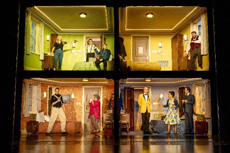
TiMax Localizes Voices and Sound Effects for The Comedy About SpiesFor the West End run of The Comedy About Spies, TiMax SoundHub and TiMax TrackerD4 helped audiences focus on the action by localizing voices and sound effects across the stage. Set during the 1960s Cold War, the show recently completed its run at Adelphi Theatre. Its brisk pace made it important that its one-liners landed clearly. Sound designer Jon Fiber and sound system designer Michael Woods used TiMax to direct attention to the characters speaking. "It really helped pull the audience's focus to every important moment," Woods explains "It was as powerful as lighting the subject to guide the audience's gaze." TiMax also brought sound effects onto the stage. During the show's 2025 run at the Noel Coward Theatre, the proscenium speakers were key to providing certain sound effects. At the Adelphi, Fiber wanted sounds to feel more closely connected to what the audience could see. This time, small speakers sat behind cutouts on set pieces, flying pieces included, each with its own image definition. "On the main hotel lobby flat, you've got two lifts, one on each side. Whenever the lift indicator would illuminate, you'd also hear the ding from those locations." One scene, unfolding across four hotel rooms, featured numerous diegetic sound effects that were integral to the storytelling. "We had a speaker in each room to locate a whole heap of sound effects from hair dryers to dart guns. Each of these speakers also had its own image definition in TiMax2 so that the sound could be reinforced whilst preserving the location of the source." Gunshots also benefited from being positioned as individual sound objects so they could be placed onstage. "Previously, audience members in the side seats would have heard the gunshots from the nearest proscenium speaker. With TiMax, even though we didn't have a dedicated source speaker for the gunshots, it felt like they were coming from the stage because the level and timing differences across the system steered their perceived location in that direction." Woods chose TiMax for vocal localization and tracking in one system. Two features particularly attracted him. The first was the freedom to adjust timing and level once image definitions were placed. "Other spatial systems don't allow you to do that. You're pretty much locked into their algorithm." The second came from the set, where the performance areas sat at different heights. "The ability to work in 3D in TiMax2 when positioning speakers and image definitions and with object placement and tracking was very attractive." The remount called for discreet tracking. "There wasn't scope for putting tags on actors' shoulders and that sort of thing in costumes. So, all the tracking tags were on their mic belts, and that worked really well for us." Most TiMax TrackerD4 sensors were on stage in side and rear positions, with one out front. The TiMax production workflow moved much of the setup into software before the team arrived at the theatre, making work on-site faster and more efficient. Setting up speaker positions and image definitions replaced walking the venue and timing multiple zones by ear. "You're very close from the outset as long as you plan well... It's a much less stressful experience on site, and especially when tech periods can be quite condensed." Soloing outputs and groups helped too. "This proved really useful during our tuning session when we needed to hear how groups of speakers were working with or against each other, enabling us to make good decisions on EQ in particular...It's quick and easy to selectively listen to parts of the system with TiMax2." The custom vocal system ran to 56 loudspeakers on 53 amplifier channels, each with its own TiMax SoundHub send for individual level and timing. Three main clusters of d&b audiotechnik AL90 and Y7P sat across two trusses in front of the proscenium, with EM Acoustics R Series fills and delays across the auditorium. Woods had wanted to use TiMax since his student years at Guildhall, where he first heard about it through a visiting sound designer, "The Comedy About Spies was my first opportunity to use TiMax on a show, and it's definitely my go-to system now." 
|