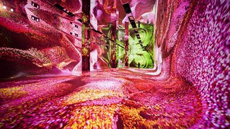
Powering DATALAND: Epson Projection Helps Bring the World's First "Museum of AI Arts" to LifeInternationally renowned media artist, director, and pioneer in the aesthetics of data and machine intelligence, Refik Anadol has spent years redefining what's possible at the intersection of technology and art. His most ambitious project to date, DATALAND, is the world's first Museum of AI arts. Opened in Los Angeles in June 2026 and founded by Anadol and Efsun Erkilic of Refik Anadol Studio, the museum is a living canvas where multisensory experiences lie at the convergence of art, architecture and audience. DATALAND spans 25,000 sq. ft. of exhibition space across five galleries, the largest of which -- Gallery A -- is powered by 84 synchronized Epson large-venue laser projectors. "From the early days of our collaboration to today, my relationship with Epson has always been much more than working with a technology provider -- they've been a true creative partner," says Anadol. "At DATALAND, every projection is part of a living artwork, where visuals, sound, scent, touch and even taste, work together to tell a single story. Epson's projection technology has given us the confidence to push the boundaries of immersive storytelling, and today our vision is being brought to life with the precision, reliability, and scale needed to create an omni-sensory experience that feels truly alive." The inaugural exhibition at DATALAND, Machine Dreams: Rainforest, is an immersive journey across the museum's five galleries where visitors influence ever-evolving artworks inspired by live data from 16 rainforest locations, fostering a deeper connection to nature and its inherent intelligence. Powered by Refik Anadol Studio's Large Nature Model (LNM) -- one of the world's most advanced AI systems -- the exhibition opens a dialogue between human presence and the memories of Earth. Continuously interpreting live environmental signals, the LNM transforms them into evolving visual, sonic and multisensory experiences, creating a single responsive environment in real time. Anadol says, "It's unlike any other museum experience; it's a living artwork that continually evolves through the collaboration of human creativity, artificial intelligence and nature. By connecting visitors to live rainforest data, every visit becomes uniquely responsive and immersive." Before entering the Data Pavilion, visitors are introduced to the experience and fitted with wearable biosensing wristwatch and scent emitters. As they descend into the gallery, shapes, colors and patterns are already in motion, flowing seamlessly across the walls, floor, ceiling and mirrored columns as the entire room becomes the canvas. To realize the vision for this gallery, the team at Refik Anadol Studio collaborated closely with Epson throughout the creative process. "Epson provided projectors early on in the design phase, allowing us to explore how imagery would interact with mirrored ceilings, reflective columns and the gallery's mirrored entrance," says Anadol. "Every surface became part of the canvas, requiring meticulous planning to ensure the reflections enhanced the experience rather than distract from it." Projection was fundamental to the design because the technology needed to disappear, allowing the artwork, not the display, to take center stage. Powered by 84 Epson EB-PQ2220B 20,000-lumen 4K laser projectors, the gallery transforms into a living sculpture where towering walls, mirrored surfaces and continuous imagery immerse visitors in an ever-evolving environment. Delivering nearly 700 million pixels and over 1.5 million lumens, the scale and architectural integration would have been extremely challenging to achieve with a traditional display solution. The installation dramatically increases brightness, delivering remarkably sharp, edge-to-edge imagery. Epson's interchangeable lens portfolio allowed every projector to be tailored to the gallery's unique geometry, ensuring consistent brightness, accurate colors, and image quality across its complex architecture. Camera-assisted software continuously calibrates, aligns and edge blends all 84 projectors into a single, unified canvas. The result is a seamless environment where art, architecture and projection become one. "Despite the extensive use of mirrors, we are able to create a seamless visual experience through precise projector alignment, exceptional image quality and our team's technical expertise," adds Anadol. "Visitors often can't tell where the architecture ends and the projected imagery begins, which allows for full immersion in the artwork." "The entire Epson team -- from our optical engineers in Japan to product managers and global leadership -- is incredibly proud to see DATALAND open its doors," says Gavin Downey, group product manager, Epson America. "For nearly a decade, we've collaborated with Refik and his team as they have pushed the boundaries of art, AI and display technology. DATALAND demonstrates what's possible when visionary creativity is paired with purpose-built projection technology." For more information on Epson's large venue laser projectors, visit www.epson.com/largevenue. 
|