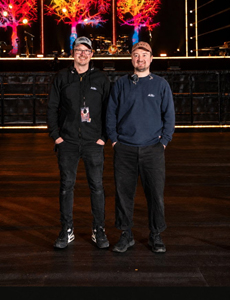
Snow Patrol Takes on Sennheiser Spectera In September, Northern Irish-Scottish rock band Snow Patrol played three nights at the Royal Albert Hall in London. Utilizing Sennheiser's Spectera SEK bodypacks for IEMs and the new Spectera SKM handheld microphones for vocals. Jamie Hickey, the band's long-standing monitor engineer, explains, "I genuinely think Spectera is the best thing that's happened to live IEMs." "I originally came to Spectera thinking about what it could do for IEMs," Hickey says. "But once you have IEMs, handheld microphones and potentially instrument inputs all existing inside the same wideband environment, you realize that it isn't simply a different way of doing in-ear monitoring. It's a different way of thinking about wireless. You start thinking about Spectera as the wireless platform for the production." Max Taylor, Hickey's monitor tech, says, "Three SKM handhelds were used for the lead vocal, a guest/spare vocal, plus a tech talk microphone. All of the band's IEMs were on Spectera; we were running 24 packs for the show, carrying 14 unique stereo mixes. This was a mix of five band packs, five band copy packs, two guest packs, a load of tech mixes, a few management mixes, PFL, and a monitor tech pack." Hickey adds, "The copy packs are particularly clever. We can have duplicate packs for band members and guests, plus additional copies of tech mixes, without those receivers consuming additional channel capacity. They're simply receiving an existing mix." Taylor ran three Spectera DAD transceiving antennas, one on stage left and one on stage right, utilizing a cross-stage CAT cable that he had loomed in with other signal looms for the inputs coming off stage right. The base station and main system were located underneath the choir stalls, so a third antenna was positioned there for additional coverage for some of the backline techs who were out of line of sight of the main stage left and stage right antennas. "Being able to add another antenna seamlessly and direct it towards those members of the crew, gave us additional coverage in an area that might have been difficult to cover with just the two main antennas we were using for the stage," Taylor says. "We also had a large video wall that, on a scan of the RF environment, showed low-level artefacts. Although the signal was so low that it didn't cause us any issues, it was great to be able to monitor it in real time through the scan, and also the Spectera antenna readings." "We managed to fit the whole show into a single wideband channel," Taylor says. "This allowed us to utilize all the antenna ports on the Base Station within a single RF channel, giving us enormous flexibility in how we wanted to run our antenna layout for the show. The ability to add extra antennas to supplement the system so easily is incredibly useful." Fitting the whole IEM package into one 8MHz RF carrier was important for Hickey to give the team flexibility when travelling. "When you're bouncing around the world through very different RF environments, that's brilliant," Hickey says. "With a conventional narrowband system carrying that number of stereo IEM mixes, you could easily end up effectively block-booking a similar amount of spectrum. Here we can find a suitable 8MHz channel, put the whole Spectera IEM system inside it, and we're done." Hickey and Taylor mostly used the Live Stereo audio link mode for in-ears, with a few in Live Link Density for some crew members. The mics ran in Live mode, with the Tech microphone running in Live Link Density. "Once that's decided, it's as simple as putting our coordinated frequency into the Base Station unit, and we're good to go," Taylor says. "Not having to sync 24 packs every day has freed up a lot of time in the day-to-day workflow." Hickey was surprised by the bottom end of the IEM audio, enabling him to lower some of the high-pass filters and let more of the fundamental through on kick drums, bass and toms, for example. "At one point during rehearsals, I genuinely had to check that there wasn't a sub running in the room, because of the amount of low end I was hearing through the IEMs," says Hickey. "But it doesn't feel hyped. There isn't some enormous EQ bump creating artificial bottom end. It's just this lovely, pure extension downwards. 'Natural' is probably the word I keep coming back to with Spectera. It feels incredibly natural. "What's really interesting is that I think it has actually affected the way they play," he adds. Gary [Lightbody, lead singer] in particular has been exploring a much greater dynamic range. There have been moments where he's singing incredibly quietly and intimately, and the whole performance feels very personal. He seems incredibly in tune with what's happening around him. I've been with Snow Patrol for years, and I've never really heard them play quite like this before. That's when you know this isn't the Emperor's new clothes. When the musicians themselves hear the difference, and it starts affecting the dynamics of their performance, then something meaningful has changed." The transition to a new handheld transmitter was completely "uneventful," as Hickey puts it. He introduced the handheld during rehearsals, and it never became a conversation with Lightbody, who has been using a DPA capsule for a long time. "Gary loves and knows this capsule, and being able to use an adapter meant we could bring that familiar capsule straight across to the Spectera handheld. Tonally, I immediately thought it sounded more open than the wireless systems we'd previously used. There seemed to be more natural extension in the top end. I wouldn't describe it as 'brighter', because that implies something has been boosted. It wasn't that. It was familiar, but somehow elevated - we had the sound and behaviour of a capsule we know extremely well, but it felt as though more of what it was producing was getting through." Hickey and Taylor mainly used SoundBase Pro for RF management, allowimg them to coordinate all wireless seamlessly, including the other wireless brands that were used for the guitars. "SoundBase Pro made it simple to have the systems running alongside each other, as well as coordinate and send frequencies to those units and monitor the guitars as well," notes Taylor. Taylor likes the ability to connect on a web browser over IP: "For this show, Jamie was in a remote position, with the racks around 15' [approximately 49'] away from his monitor desk, so he could monitor and change settings via the IP control; it made everything quick and straightforward." The remote view options that SoundBase Pro offers proved very handy as well. While Taylor has configured SoundBase to give him the detailed view he wants for managing and monitoring the whole system, Hickey uses a customized remote view, containing only the band's IEMs and handhelds while mixing the show. "I don't need every parameter of every device filling a screen next to me while I'm mixing," says Hickey. "I want the important information immediately visible, and Max can simultaneously have his own SoundBase view configured with all the information he needs. And rather than the microphone system being another separate island of information, the SKMs are simply part of the same environment we're already monitoring. That combination of Spectera, SoundBase and the additional things we've built around it is beginning to change the way I think about monitoring the whole RF system." One of these extras the team built is an exact copy of the artist IEMs using Companion and Open Sound Control: "That's one of my favorites," Hickey says. "Spectera allows us to see the headphone output level of each individual SEK. We've used that information so that when I solo an artist from the console, my PFL pack can automatically match the headphone output level of that artist's pack. So, for the first time, I can genuinely listen to their mix on the same earphones, through the same type of pack, at the same listening level as the artist, in real time. That is a total game changer for me. It's the most accurate monitoring of an artist's IEM mix I've ever had." 
|