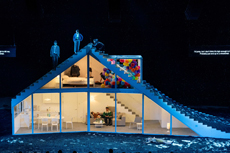
Theatre in Review: The Cherry Orchard (Park Avenue Armory)With a Russian playwright, a British adaptor/director, and a Korean cast, one approaches this Cherry Orchard with fear and trembling: Are we about to scale a theatrical Tower of Babel? Far from it: The fascinating thing about Simon Stone's reworking of Anton Chekhov's final play is how well it adapts to twenty-first-century realities. In recent seasons, we've had many Chekhov adaptations, and too often the original texts have been pulled and twisted like so much saltwater taffy. Stone's version, performed in Korean with English surtitles, is notable for its remarkably clear vision. Or should I say double vision? The production, blessed with an adept cast and striking design, transposes the play's Russian melancholy, its sense of a world slipping away, into a modern Korea shaped by a tumultuous history of war, occupation, and rampant capitalism. This is still The Cherry Orchard, but with a strikingly modern twist: The estate will be sold, and the cherry trees of the title will be chopped down, but at least one will be preserved in the lobby of a new luxury hotel. In Stone's update, Chekhov's landed gentry are members of a failing, family-owned chaebol along the lines of Samsung or LG. CEO Song Jae-Young is driving the business into the ground through neglect and an addiction to caution. His sister, Song Do-Young, has fled to New York following the deaths of her husband and son, anaesthetizing herself with booze and a string of lovers; accompanying her is younger daughter Kang Hae-Na, a cinema studies major at NYU whose only work so far is an arty study of dead birds on the city's streets. Adopted elder daughter Kang Hyun-Sook, the conglomerate's vice-president, tries to stanch its fiscal hemorrhaging and labor troubles. She has feelings for Hwang Doo-Sik, son of the family's former chauffeur; he is the play's Lopakhin figure, a self-made entrepreneur who presents them with a sensible liquidation plan to be implemented ASAP, before word gets out about the company's disastrous financials. Among the family's entourage is Jung Doo-Na, the housekeeper, theoretically affianced to Shin Ye-Bin, the current chauffeur, a sad sack with squeaky shoes and a taste for lachrymose guitar ballads. (When he asks her if she is rejecting him, she replies, "Not yet.") She is two-timing him with Lee Joo-Dong, Song Do-Young's personal assistant, who figures he needs someone to sleep with while his boss is in Korea. Standing in for Chekhov's Trofimov is the perpetual student Byun Dong-Lim (he's on his third Ph.D.), the former tutor to Song Do-Young's son, offers a scorching denunciation of a society rife with corruption and mammon-worship. Hanging out, or hanging on, is poor cousin Kim Young-Ho, who occasionally fills in for Firs, the servant, who has been eliminated. The production is packed with the heartbreakingly comic and tragically amusing moments that constitute Chekhov's stock in trade as Stone deploys his company on both levels (and roof) of the summer house, stunningly designed by Saul Kim. (Stepping onto familiar ground she deserted in grief, Song Do-Young looks around in wonderment (and not a little nervousness), asking, "What have I missed?" A few minutes later, she recalls having lost her virginity there, mortally embarrassing Kang Hyun-Sook. (She scorchingly puts a stop to Song Do-Young's self-image as a loving, selfless adoptive mother.) Song Jae-Young's speech about his beloved vintage record player, which he sees as a silent witness to history, neatly sums up a life defined by ease and fecklessness. At the same time, some of the play's signature sequences acquire new force when placed in a contemporary context. Trofimov's denunciation of a sclerotic Russia, ripe for revolution, becomes Byun Dong-Lim's unsettlingly up-to-the-minute excoriation of a dystopia in which "big tech rules the world," informed by "a kind of amorality introduced to the world with the Industrial Revolution." As he grimly notes, we are "rocketing into outer space, but our brains are still in the swamp." (Startlingly, he views the unseen orchard, Chekhov's symbol of a lost past, as a reminder of those who died during the years of Japanese occupation.) In Stone's most striking invention, the play's devastating denouement is reframed as a mordant comment on runaway real estate development. The new hotel, we are told, will "redefine luxury for a new generation. We're talking New York, Florence, Paris-style decadence. Tasteful design, great restaurants, the kind of place people want to be seen at but at the same time they can disappear." It's a vision right out of a developer's prospectus. Under Stone's direction, everyone delivers incisive characterizations, but three stand out Jeon Do-Yeon's Song Do-Young isn't the figure of overripe romance often of Chekhov's Ranevskaya; instead, she's a distinctive mix of selfishness and disappointment, born to privilege and baffled that life could hand her so many tragedies. (She is not without a certain self-knowledge, however. New York, she notes, is "a city to be an alcoholic in. Impossible buildings. Impossible feelings. Impossible lovers.") Nam Yun-Ho gets full value out of Byun Dong-Lim's fury at the self-involved basket cases surrounding him, even while copping to his own life of inaction. Park Hae-Soon's Hwang Doo-Sik regards the others with a faint servility that turns to mounting fury as his urgent advice is repeatedly ignored. He strides through the last act both triumphant and resigned, especially in a brutal confrontation with Song Do-Young, who refuses to take the tiniest shred of responsibility for the disaster that has unfolded. Kim's set design, featuring an immaculate interior, a glass facade, and a stepped roof over which the cast climbs like mountain goats, is a visually arresting concept; hang on for the final act when it is ruthlessly stripped bare, inside and out. James Farncombe floods the kitchen with moonlight and devises a sunset look ("the sky is on fire") that stops everyone cold. Mel Page's costumes are eminently suited to each character. Jang Young Gyu's sound design is at its most effective when bulldozers are heard approaching. As should be clear by now, this Cherry Orchard, rather like Robert Icke's Oedipus of last season, is a semi-original based on a classic text, retaining its essence while reshaping it to the contours of a different place and time. Increasingly, this approach seems more fruitful than the exertions of directors who tried to force classic texts into production concepts that fit like cheap suits. Here, Stone exerts his imagination while honoring Chekhov. "Holding onto the past is dangerous," we are reminded late in the play. This Cherry Orchard embraces the past, leaving room for new ideas to grow. --David Barbour 
|