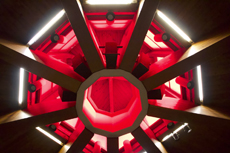
Restoring Sightlines and Sound Clarity in a Mid-Century Modern Sanctuary with EM AcousticsCompleted in 1967 during Canada's Centennial year, All Saints Roman Catholic Church in Toronto stands as a distinguished example of mid-century modern architecture. Its sweeping, semi-circular sanctuary was designed to emphasize spiritual clarity and architectural symmetry, providing an unobstructed visual focus for congregants. When OMS Canada was invited to modernize the church's sound system, the mandate was not simply to install more loudspeakers. The stated aim was to deliver exceptional speech intelligibility, provide even and natural coverage across the large open sanctuary and integrate the technology without interfering with the building's architectural character. EM Acoustics' Reference series, supplied by Contact Distribution, proved to be instrumental in achieving this vision. The sanctuary seats approximately 800 people and is arranged in five triangular seating "wedges," each accommodating around 150 worshippers. "Speech intelligibility is absolutely critical for worship spaces, and this is a very live, reverberant space," explains Jeff Shorthouse, co-founder of OMS Canada. "It wasn't about increasing the volume; the audio needed to be clearer, more natural and provide completely even coverage across the congregation." Historically, the church relied on a system of around 15 distributed loudspeakers, which suited an earlier era of sound reinforcement but created challenges for today's services. Visually, the previous system disrupted the sanctuary's clean mid-century sightlines. Acoustically, the multiple loudspeakers produced inconsistent coverage, with competing, confused arrival times and compromised clarity. The church leadership, who are all technically knowledgeable themselves, had high expectations for the project. Before any final design decisions were made, OMS Canada and Contact Distribution arranged on-site demonstrations of EM Acoustics loudspeakers directly in the sanctuary so that the parish leadership could evaluate their performance in the actual worship environment. "The two onsite demos helped the parish leadership to make a confident and informed decision," continues Shorthouse. "We put in the EM Acoustics R8s, powered them up, and honestly, they sounded incredible right out of the box. We didn't even feel the need to EQ them." The staff, many of whom had backgrounds in recording and audio production, immediately recognised the exceptional natural voicing of the system which reinforced EM Acoustics' reputation in a very acoustically demanding room. Initially, the client believed that they would require a secondary ring of delay loudspeakers, following the precedent set by the previous system. Instead of simply agreeing and adding unnecessary cost, OMS Canada took a different approach. "Adding an additional delay ring wouldn't have been the right solution," confirms Dave Misener, co-founder of OMS Canada. "Instead, we took the approach of 'let's see what the R8s can really do before we add more sound sources.' It's not about how much you can sell. It's about giving the client what they actually need." This approach aligned perfectly with the philosophy shared by OMS Canada and EM Acoustics of favoring fewer loudspeakers, precisely placed to deliver high-quality and natural-sounding audio. The structural realities of the church added further complexity to the installation. The sanctuary contains no vertical columns, instead featuring four major overhead beams at varying heights, ranging from sixteen to twenty-five feet high. The client was concerned about preserving the room's aesthetics and made it clear that any sound equipment needed to integrate into the environment rather than dominate it. "They wanted the loudspeakers mounted above the congregation and tied in visually with the beams, without disrupting sightlines," continues Shorthouse. "The room is too beautiful to clutter, so the goal was to have the technology disappear into the background as much as possible." EM Acoustics Reference Series, and in particular their R8s, provided the perfect balance of performance and compact form factor, the company says. The loudspeakers blended in naturally with the wood finish of the beams, while their output is powerful enough to eliminate the need for extra reinforcement in the form of more loudspeakers. The frequency response and controlled pattern of the R8 allow it to deliver natural, full-range audio, all while remaining unobtrusive to the eye. OMS Canada redesigned the sound system entirely rather than reusing any of the previous loudspeaker locations. The new system is based around five EM Acoustics R8s mounted in a semi-circle above the sanctuary, each carefully oriented to serve one of the five wedge-shaped seating zones. Uniquely, Reference Series enclosures ship with two interchangeable rotatable waveguides. OMS Canada utilized the 110- by 50-degree option to achieve optimal coverage for each audience section. Initially confirmed through EASE modelling, real-world implementation gave the team the confidence that an extra line of delay loudspeakers was not necessary. The system is powered by EM Acoustics' Di20 installation amplifier, whose proprietary FIR filters provide precise tuning and exceptional phase coherence. Supporting EMS-51X loudspeakers for the choir organist and choir monitor, and an EMS-41 for the dais complete the audio system. A Soundcraft Si Performer console provides intuitive day-to-day control for clergy members, musicians and trained volunteers. Given the sacred nature of the space, the installation required careful planning and thoughtful execution. OMS Canada removed the previous fifteen-speaker infrastructure, rerouted wiring through existing structural pathways and maneuvered heavy-weight equipment through the sanctuary without the need to remove any pews. The team also ensured that any wood surfaces previously covered by the old loudspeakers remained visually consistent, preserving the integrity of the mid-century design. All of this was completed with minimal disruption to services, ensuring that the parish church could continue its work uninterrupted. With the EM Acoustics system, the congregation at All Saints now enjoy audio with clarity and warmth without the visual intrusion of bulky equipment. "At the end of the day, this wasn't about making the system any louder. It was about making it right," confirms Shorthouse. "The EM Acoustics solution fits the architecture, respects the worship experience and gives the church exactly what they need in terms of the character of the voicing." Misener echoes these sentiments, stating, "When you walk into the room now, you don't see the sound system. That's exactly what you want in a house of worship." 
|