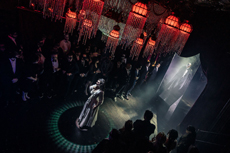
Theatre in Review: Masquerade Welcome to the latest stop on the Andrew Lloyd Webber Reinvention Tour. Whatever new projects the composer may or may not have in the hopper -- no more Bad Cinderellas, please -- he is busily allowing others to repurpose his greatest hits. Last season -- and soon to make a return -- we had Cats: "The Jellicle Ball," which "queered" the famous musical, setting it in Harlem's ballroom scene. (Spoiler alert: However chicly dressed, it was still Cats.) Then came Jamie Lloyd's berserk take on Sunset Boulevard, a modern dress version featuring Nicole Scherzinger's diva-on-a-rampage performance and plenty of live capture video, including the notorious company march up 44th Street. The talk of London last summer was Rachel Zegler in Lloyd's revival of Evita, with crowds lining up outside the theatre to catch the star's rendition of "Don't Cry for Me, Argentina," delivered from a balcony and transmitted via cameras back to the audience, many of whom may have wondered why they weren't at home, watching a nice streaming series. Now comes the most outrageous gambit of all: Masquerade is a walk-through version of The Phantom of the Opera, Lloyd Webber's longest-running success. The exceptionally irritating show program offers no detailed credits, just a "production team," running to roughly eighty-five or so names, but we may divine that it is the brainchild of director Diane Paulus: Each night, six small audience groups (consisting of roughly fifty or sixty people) meet outside the old Lee's Art Supplies store on West 57th Street; they are admitted at fifteen-minute intervals and guided through rooms on several floors, often riding out-of-period escalators. The overall effort requires six actors playing the Phantom and six Christines, the object of his deranged affections. There are only three Raouls, so those stalwart young men must double up, rescuing two leading ladies in distress each night. On a visceral level, it doesn't disappoint. We are greeted by waiters bearing trays of champagne and are introduced to Madame Giry, the sinister, Mrs. Danvers-like ballet mistress, who, in this production, acts as narrator. Then we are swept into another, much larger room, for a rousing company rendition of the song "Masquerade." Filled with performers dressed for an opera performance, prowling light beams, and storms of bright confetti falling on everything, it's rather like attending a raucous Beaux-Arts ball of another century. Across an intermissionless evening, we follow the characters up and down several levels, even going outdoors on the roof at one point. For thrill-seeking fans of the musical, the production offers an up-close view of many signature moments: The Phantom abducting Christine, by way of gondola, into his lair, hidden in the depths of the Paris Opera House; Christine and Raoul's love debut atop the same building; and the three-way confrontation that forms the melodramatic finale. Rest assured, the famous chandelier makes a potent cameo appearance. Overall, this is more like the "highlights" edition of Phantom, however, with not much regard for continuity. It is not the ideal way for neophytes to experience this property. The prologue, featuring the elderly Raoul at an auction of opera house memorabilia, has been cut. The supporting roles of Monsieur Andre and Monsieur Firmin, the opera house managers, and Carlotta, the vengeful diva, have been severely reduced. The entire Il Muto sequence, a kind of Mozart parody during which Carlotta is deprived of her singing voice, has been eliminated. A flashback, focusing on the Phantom's tormented boyhood in a freak show, is the occasion of many audience-participation gags and a fire-eating routine. The score has also been revised. The opener, "Masquerade," has been appropriated from Act II. "Poor Fool, He Makes Me Laugh" (the centerpiece of Il Muto) has been cut, "Notes," a plot-heavy sequence sung by Andre and Firman, is reduced to a fragment, "Prima Donna," in which the managers flatter Carlotta, has been moved to much later in the show, and "Learn to be Lonely," written for the film version, has been interpolated, creating a poignant moment for young Erik (the Phantom to be) and Madame Giry. Many sequences are done with a flourish, including Christine's impromptu opera debut singing the lovely "Think of Me," the gondola trip, the murder of the stagehand Joseph Buquet, and the rooftop love duet, "All I Ask of You," with the Phantom spying on Christine and her lover. There are also plenty of cornball, audience-baiting tactics, including a sing-along sequence, some frivolous gags, and the way the principals break character at the end of each scene, urging us to follow them into the next room. Most of all, Masquerade struggles with the same problem that haunted Love Never Dies, the snakebit Phantom sequel: The mystery is gone. The success of the original hinged on the Phantom being a shadowy, elusive presence with a strange hold over Christine. Seen up close and at length, he is reduced to a stalker boyfriend with severe dermatological problems. A demon lover becomes something of a pest. Then again, I'm sure nobody involved cares about such matters; the intention was to whip up a night of elaborate dumb fun, a multi-tier funhouse of horrors, packed with earworms and enough special effects to keep party-minded audiences in a bubbly mood. As someone who, at a tender age, was terrified by the words "immersive" and "audience participation," I managed to soldier on bravely; others are more likely to have a good time. If you want to be transported to another world and are willing to suspend your disbelief, this is the show for you. To be sure, the production isn't a cheat. Scenic designer (I assume) Scott Pask, who trained as an architect, has constructed a cunning rabbit warren of dressing rooms, rigging rooms, louche boudoirs, and tiny stages, all of them swagged and draped with a flourish. Ben Stanton's noirish lighting fills each space with carefully wrought beam arrangements; his work is equally important for what one does and doesn't see. Their combined work has a Gothic, Technicolor quality that suggests one of film director Roger Corman's early-sixties Edgar Allan Poe adaptations. Emilio Sosa's elaborately detailed costumes provide plenty of spectacle by themselves. Sound designer Brett Jarvis can't keep the recorded music from sounding rather tinny, but he creates plenty of room for the exceptional voices. Is it too loud? Yes, but that's standard practice these days. For the record, at the performance I attended, the Phantom was powerfully sung by Cooper Grodin, well-matched with the Christine of Eryn LeCroy. An understudy, Nkrumah Gatling, was appropriately stalwart as Raoul, also singing beautifully. Maree Johnson had an enigmatic, Gale Sondergaard quality as Madame Giry. Both monumental and monumentally silly, Masquerade may or may not be a sign of the times, although I'm not sure how many existing musicals would respond to such a format. Still, it is a masterpiece of crowd control: Imagine steering six distinct audiences through the building over a couple of hours. And think about the coordination of sound, lighting, and automation cues; I'm sure they have it all down pat, but getting there must have been a nerve-wracking experience. LSA readers, who can swing the high cost of tickets, will find much to discuss. And Andrew Lloyd Webber's comeback continues. --David Barbour 
|