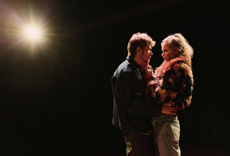
Theatre in Review: Blackout Songs (The Susan & Ronald Frankel Theater/Robert W. Wilson MCC Theatre) In Blackout Songs, love and addiction are so inextricably linked that they come to seem like the same thing. The play, by Joe White -- well-known in the UK, less so here -- throws together a young couple at an AA meeting and then tracks their up-and-down progress through a years-long pub crawl. Mismatched lovers, they are united in self-destruction, riding a carousel of hangovers and recriminations, one or the other constantly skidding toward ruin. The longer they remain together, the clearer it seems that only one is likely to survive. You may feel you have already seen this story when it was titled The Days of Wine and Roses. Although both plays share a similar dynamic, the entirely original Blackout Songs (which, despite the title, is not a musical) is notable for its casual, caught-on-the-fly quality. It is also oddly circular, using a series of plot motifs -- a stolen bouquet, two distinct works of art titled Children of the Moon -- to suggest that the characters are caught in a feedback loop of ever-intensifying sadness. It's a tough narrative strategy, one that potentially alienates the audience, and White doesn't make it any easier by employing a jittery, time-jumping structure. When Alice and Charlie first meet, he is wearing a neck brace and appears to be in the grip of delirium tremens. She is bemused to be carrying around a tooth in her pocket, unable to remember where and who it came from. (Both it and the brace will return in different contexts.) One scene later, he is in robust shape and denies ever wearing a brace. He implies they had a great night of sex, which she doesn't remember. Recall the play's title, if you will. And off we go through a series of alcohol-fueled escapades: They break into a church to sample communion wine. (She dumps a chalice of it on his head after he urinates on the altar.) Grabbing all the little bottles they can find, they mix it up, making their own special home-brew poison. She vanishes occasionally, turning up again with, say, an invitation to her father's funeral. They exist on parallel tracks, often heading in opposite directions. After one of her disappearances, he finds someone else and launches a successful art career; still, he can't resist her vortex-like pull, ending up more her caretaker than her lover. They both climb on the wagon, but the dullness of sobriety has a killing effect, especially on his creativity. At times, Blackout Songs comes precariously close to suggesting that only the tormented and self-destructive can succeed as artists. The play has many flashes of insight and colorful writing, but its patchy, episodic storytelling is sometimes confusing, making Alice and Charlie seem less like coherent characters than figures buffeted by their creator's whims. It's not a full portrait of a relationship; it's the highlights reel, and one longs to get a sense of what (if anything) other than addiction keeps them together well past the point of sanity. Indeed, for all its chilling realism about alcohol's dire effects, Blackout Songs never puts much flesh on its characters' bones. The writing is lyrical but not revelatory; it also lacks the connective tissue that might help explain why Alice and Charlie often appear so wildly different from scene to scene. This puts enormous pressure on Rory McGregor, the director, and his cast. Owen Teague, best known for starring in the film Kingdom of the Planet of the Apes is a natural for the stage, getting one's attention from his first entrance, having gone cold turkey and trembling like an aspen. His direct, open-hearted manner goes a long way toward explaining why Charlie clings to Alice, who all but freezes up when the L word gets mentioned. Teague also renders Charlie's physical decline in harrowing detail, making vividly clear the awful waste of a human life. Abbey Lee, an Australian model turned film and television actress, has a natural presence, a throwaway wit, and a quicksilver charm, but her rushed, indistinct delivery makes Alice seem even more opaque than she already is. Although Charlie, an American art student in the UK, has a roughly understandable outline, White provides only scanty details about Alice, making this love affair mysterious in ways that aren't helpful. The production design is solid: Scott Pask's unit set, seemingly depicting a church hall, adapts reasonably well to other locations, with Stacey Derosier's flexible lighting design sketches in locations that include a church, a club, a cafe, and an art gallery; she also paces the many scene changes, aided by sound designer (and composer) Brian Hickey. Avery Reed's costumes are filled with incisive character observations: The cheap, multicolored fur jacket that Alice favors tells you as much about her as anything in the script. It seems obvious that a lot of thought and care has gone into this production, yet the result is curiously contrived and lifeless. Near the end, one gets a strongly poignant sense of an affair that might have gone right but ends in wreckage. But getting to that point requires a lengthy and sometimes dullish spree. Like many a drunk, Blackout Songs isn't as captivating as it thinks it is. --David Barbour 
|