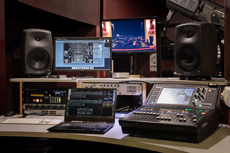
Opera de Rennes Enters the Era of Spatial Sound with HOLOPHONIX and AmadeusOpera de Rennes, one of the leading opera houses in western France, has taken a new step in the evolution of its sound infrastructure with the permanent installation of an Amadeus loudspeaker system driven by HOLOPHONIX. HOLOPHONIX develops an advanced real-time immersive audio environment optimized for the performing arts. Created by Gaetan Byk in coordination with IRCAM and CNRS research institutes, it offers a global solution including software, plugins, hardware processors, electronic devices, and loudspeakers. In operation since the opening of the 2025-2026 season under the supervision of Marie Guerin, head of audiovisual services at the Opera de Rennes, the installation reflects a broader shift in the way historic opera houses are approaching sound reinforcement, spatialization, and immersion today. "At the Opera de Rennes, the challenge was especially complex: integrating sound reinforcement into an Italian-style theatre with four levels, an orchestra pit and strong physical constraints liked to the architecture, materials and aesthetics of the venue," Guerin explains. "We chose an Amadeus solution integrating the HOLOPHONIX system because this approach enables much finer spatialization and more even sound distribution, using more compact loudspeakers that could be integrated more discreetly into the architecture," Guerin continues. The main front system comprises three Amadeus C15 loudspeakers, including two installed in stage-side boxes covering the stalls and lower balconies, while a third forms a central cluster suspended above the pit. Six Amadeus C12 loudspeakers positioned in the proscenium boxes and throughout the auditorium provide coverage for the upper balconies. This approach maintains tonal and directivity consistency across the venue while limiting the visual impact of the system within a listed heritage building with significant architectural constraints. Four Amadeus ABB 12 low-frequency extension units, each incorporating a 12" driver, are installed on the first and second balconies to complete the stereo configuration and ensure each loudspeaker pair operates as a full-range system. For infra-low-frequency reproduction, two Amadeus ABB 18 subwoofers are positioned in the side boxes near the stage, delivering precise extension below 40Hz without upsetting the venue's natural acoustic balance. At the center of the installation, 11 Amadeus SR730 ODR modules form a custom-designed front-fill ramp angled at 17 degrees to match the orchestra rake. Their role is crucial in maintaining spatial coherence for the stalls and first balcony, where the relationship between visual and sonic images is most perceptible to the audience. Dedicated rigging hardware was also developed specifically to accommodate the opera house's three orchestra pit configurations, with a quick-release mounting system simplifying changeovers. "The Amadeus ramp handles the spatialization for the stalls and first balcony. It changes everything, because the sound comes from where the musicians are," says Arthur Paichereau, sound engineer at the Opera de Rennes. The system is driven by HOLOPHONIX Native running on an Apple Mac Mini M4. An RME Digiface Dante interface handles 128 simultaneous channels across Dante and MADI networks; amplification is provided by four Powersoft Ottocanali DSP+Ds. HOLOPHONIX Native processes sound sources as spatialized objects, enabling each instrument to be reproduced from its actual position on stage. This approach fundamentally changes both audience perception and the way sound reinforcement itself is conceived within an opera house. "In a classic left-right system, the brain constantly has to compensate: it hears an instrument from one side while seeing it somewhere else. With this system, the piano is exactly where you see it. That cognitive effort disappears, and you can fully enter into the music," Paichereau says. The installation fully reveals its potential during hybrid productions such as the recent collaboration between the Orchestre National de Bretagne and Paris-based jazz collective In Waves. The challenge lay in integrating five heavily amplified and processed soloists into an acoustic orchestral environment without disturbing the venue's natural listening balance. The solution involved treating each orchestral section as an independent sound object within HOLOPHONIX and adjusting its spatial position throughout the hall until the right balance between support and transparency was achieved. The work was carried out in close collaboration with Benoit Briere, sound engineer for the soloists, whose direct-to-master mix complemented the spatial orchestral layer processed by HOLOPHONIX. In total, 28 sound objects, including 24 stereo objects, were active simultaneously. "The goal was to give the audience the feeling that the orchestra wasn't reinforced, even though it was," Paichereau says. "Because without reinforcement, the soloists would have been far louder. We managed to make the sound system disappear and give the audience the impression that the orchestra remained entirely acoustic." "This spatial perception does not rely solely on the HOLOPHONIX processor, but also on the diffusion work carried out with the Amadeus loudspeakers. The precision, distribution, and consistency of the loudspeaker deployment fully contribute to this sensation of immersion and spatial localization throughout the auditorium," concludes Guerin. 
|