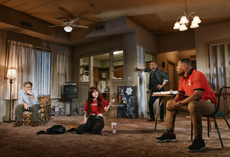
Theatre in Review: Downstate (Booth Theatre) Bruce Norris is the theatre's top demolition man, armed with a pickaxe, always ready to hack away at received ideas about race (Clybourne Park), attitudes about sex (Domesticated, The Qualms), and capitalism (The Low Road). If he happens to strike at some society's rawest nerves, so much the better. Downstate, his most assured and hair-raising work to date, practically dares the audience to reject his four protagonists, a quartet of sex offenders drawn to the underage. Further stirring the pot, he subjects their group home -- a halfway house for parolees -- to several interlopers, each with an axe to grind or chaos to spread. The sad, dilapidated living room designed by Scott Pask becomes an arena for confrontations that demolish received ideas about restorative justice, closure, and reconciliation. Downstate has an appalling vitality that keeps you watching, riding the audience's nerves with unholy glee. The roommates make a diverse bunch. Fred is a woolly-minded, wheelchair-bound old duffer who, in his long-ago career as a piano teacher, molested at least two young male students. Dee, an ex-actor and choreographer, had a years-long relationship with a teenager. (In a gesture typical of Norris's bleak humor, they met in a touring production of Peter Pan, starring Cathy Rigby; Dee was one of Captain Hook's henchmen, and his victim/lover was one of the Lost Boys.) Felix, a Latino immigrant, yearns to reunite with the daughter to whom he did unspeakable things. Gio, who works at a Staples outlet, plotting a career as an entrepreneur, explains, in the first of many scalding, hilarious rants, that his one-off conviction for statutory rape was merely a mix-up (the girl had a fake ID); a devotee of sacred scripture, he enjoys envisioning the hellfire awaiting the others. The interlopers include Andy, one of Fred's victims, now a middle-aged financier; and Em, his chilly, censorious wife. Andy keeps trying to read a statement testifying to his lifelong suffering, an effort comically undermined by a barrage of interruptions; he also comes bearing a "reconciliation contract" for Fred to read aloud and sign, certifying his crimes. Also coming and going is Effie, Gio's airheaded Staples colleague, a fresh-mouthed, heavy-vaping ADHD case who thinks she can talk her way out of any situation. Then there's Ivy, a probation officer, who, in a scene expertly mixing sympathy with a touch of sadism, confronts Felix with evidence of his visit to a public library, forbidden under the terms of his parole. Ivy's skillful cornering of the increasingly desperate Felix would be unbearably pitiable if we didn't know about his crimes. Norris treats all his characters with a murderous understanding. Whatever their sins, the men live in a state of siege: The house is regularly pelted with rocks and eggs -- note the cardboard taped over the broken window at stage left -- and the phone remains unanswered to avoid death threats. A new municipal redistricting plan, designed to keep them twenty-five hundred feet from the nearest school, cuts them off from their local grocery store, turning shopping into an onerous task. The house is alive with internal conflicts, too. Felix is desperate to see his dying sister in Mexico (or so he says), a pipe dream with Ivy overseeing his case. Gio and Dee are locked in a long-running feud, with exhibit A being Dee's vandalized, collector's-item poster for Diana Ross in Lady Sings the Blues. Of course, money is tight: Fred is on foot stamps and, as Dee notes, "The job market is somewhat limited for the elderly black homosexual ex-convict." Then again, as Norris scathingly notes, being victimized does nothing to elevate one's character. Andy is a walking encyclopedia of platitudes about recovery and healing, none of which have brought him a minute's peace. He and Em are frozen in poses of condemnation, angrily seeking an increasingly elusive satisfaction. Andy, lashing out at Fred, inadvertently exposes his still-active longing for approval, bitterly noting that one of Fred's seductive endearments ("You are special") was also given to another boy. It's a terrible, revelatory moment -- not that Andy can expect much sympathy among this crew. When, practically begging to be seen, he furiously asserts that seventy-six percent of predators were abused in childhood, Dee, giving him an icy look, murmurs, "Your child better lock his door tonight." Such a pitiless attitude is central to Downstate's bracing effect. The characters are profoundly damaged, the dialogue is scalding, and the action moves remorselessly to a climax that adds to the already high number of shattered lives. Joe Mantello's impeccable staging includes two holdovers from the play's 2022 Playwrights Horizons production, which also featured a different director and design team. Francis Guinan's Fred is a vague, soft-voiced, semi-invalid (his paralysis the result of a horrific act of revenge), fond of Chopin and utterly unable to grasp the damage he has done. K. Todd Freeman's Dee, steeled by a hardscrabble upbringing and a fifteen-year prison sentence, clings tenaciously to the notion that his crime was really a proper relationship, never mind his lover's tragic demise. Mixing in for the kick of it, he turns the business of Andy's reconciliation contract into an unseemly haggling about the details of Fred's abuse. Among the newcomers, Thomas Sadoski adds new emotional notes as Andy. Tim Hopper, his predecessor in the role, made the character pole-axed by grief and grievance; Sadoski fills him with a molten anger that can't stop bubbling up. Frustrated at his inability to get through to Fred, he slides into a tearful fury that lays bare his unshakable grip on the past. In a production that includes Cassie Beck's grim, businesslike Em; Al'Jaleel McGhee's on-the-hustle Gio, with his blatant disregard for the rules; Adrian Martinez's pitiful, reclusive, disingenuous Felix; and Ivy Wolk's supremely bratty Effie, the standout is Liza Colon-Zayas as Ivy, who ruthlessly applies the law to her charges at no small cost to herself. ("How can I be so tired?" she mutters after another disciplinary encounter.) The scene in which she ferrets out Felix's lies is equally gripping and agonizing, a testament to Norris' refusal to pull punches. Pask's set, with its water-stained ceiling, dreary carpeting, and old-fashioned television, is lovingly treated by Heather Gilbert's subtly detailed lighting compositions. Ann Roth's costumes accurately note each character's personality and social status. Mikaal Sulaiman's sound design includes Chopin's "Raindrop Prelude" and a couple of Diana Ross cuts. Downstate is more than a canny examination of human wreckage; it challenges our ideas of justice. Whatever they have done, the men are still human beings, yet rehabilitation seems impossible, at least in a system that only knows how to warehouse them. Then again, Norris never forgets that each has left behind a trail of ruin that never seems to end. It's a situation with urgent demands and no easy answers. It's fascinating that Downstate opened the same week as Here There are Blueberries, which, in a very different way, asks us to think long and hard about the meaning of evil and culpability. These probing, exciting pieces came to Broadway from resident theatres and Off-Broadway companies, racking up numerous awards on the way; it's great to see them getting even more prominent showcases. --David Barbour 
|