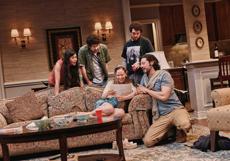
Theatre in Review: Birthright (MCC Theater) Something is going on: By now, we should be deep in the theatre's silly season, those summer months marked by ex-sitcom stars in flimsy comedies, and musicals that should never have seen the light of day. Instead, everyone is laboring overtime to deliver substantial work. This week alone has seen Erica Murray's powerful comic drama The Loved Ones at Irish Rep and NAATCO's switchblade-sharp Henry VI: A Trilogy in Two Parts at the Public. Now MCC brings us Birthright, which, in its epic scale (including a running time of three-and-a-quarter hours) and its engagement with some of today's thorniest political problems, has the potential to be a season-defining success. For a play this scintillating, it's never too darn hot. We already know that the playwright Jonathan Spector barges in where others fear to tread, winning a Tony Award for Eureka Day, which converted the rancorous national debate about vaccination into sparkling comedy. His follow-up piece, This Much I Know, is a Tom Stoppard-style puzzle about cognition, eugenics, conspiracy theories, and confirmation bias, with a special guest appearance by Svetlana Stalin, daughter of you know who. No one who writes like that lacks confidence, but in Birthright, he attempts nothing less than a twenty-year history of the American Jewish community's shifting, contentious politics, from the War on Terror to the aftermath of October 7. This astonishingly accomplished endeavor is embedded in a sharp-eyed comedy about six friends struggling into adulthood amid nonstop and tumultuous social changes. Don't worry about the play's length; the three acts pass in a flash, leaving you with plenty to think about. In Act I, it is 2006 and the friends, just out of college (or about to be), have returned from a Birthright trip to Israel. (The organization sponsors a free, 10-day heritage trip to Israel for young Jewish adults.) Only home for three weeks, they reassemble in the Annadale, Virginia home of Chaya, their informal ringleader, to convince one of them, Alona, not to relocate to Israel. (Alona has starry notions about romance with one of the group's military escorts, which won't last long.) But Alona isn't the only one trying to map out a future: Noah is already a political junkie with a blog. Chaya and Izzy are tossing around the idea of law degrees. Lev, the grandson of kibbutzniks, has fallen under the sway of the historian Yosef Hayim Yerushalmi and is eyeing rabbinical school. Then there's Emerson, an indie musician, already halfway to a falling-down drunk, recently fired by his bandmates. They're a jittery, garrulous bunch, full of wisecracks, bursting with opinions, and already mapping out tangled sexual histories that include a quickie in the hot tub located offstage left. Act II takes place ten years later, on the eve of Alona's wedding to an Israeli, with the presidential election looming. (In one of a dozen cringe-inducing, had-but-we-known touches, everyone is convinced that the Democratic Party will take the White House in a walk.) Some characters are getting ahead; others are lumbered with personal sorrows -- divorce, custody issues, the death of a parent -- and less-than-fulfilling careers. The wedding has everyone on edge, especially when, at the rehearsal dinner, the groom's uncle offers a toast, averring that "a vote for Hillary is a vote for the Ayatollah of Iran." Chaya, employed by the Obama Administration, has plans to launch a Jewish non-profit dedicated to domestic issues; at the same time, her friendship with Izzy is coming unglued, partly because of personal slights and partly over politics. Izzy, who works for an anti-AIPAC Jewish lobby that sounds like its real-life counterpart J Street, is running out of optimism. bitterly noting, "The whole idea was it's a new moment, the Obama generation, ready to break with the past and what have we accomplished? The six years I've been there, like if we're being honest? Nothing. Less than nothing." The third act unfolds in 2024, just after a funeral, with the animus between Chaya and Izzy exploding into open warfare, allowing Spector to conjure one furious, full-throated aria after another, laying bare the near impossibility of achieving a nuanced point of view amid Internet flame wars and careers incinerated by cancelations. The arguments are red-hot, the conclusions savage, the ability to find middle ground nonexistent, and yet the source of the play's power is Spector's willingness to let everyone have his or her say. The writer Lawrence Winner recently wrote a powerful essay (https://shorturl.at/aubkD) about the agonizing paradox of being an American Jew at this moment, believing in Israel and a two-state solution; being deeply rattled by the savage, inhuman violence of Hamas; disgusted by the abuses of the Netanyahu Administration; horrified by the genocide or ethnic cleansing (take your pick) in Gaza; and possessing the double vision to understand that denunciations of Israel can be both accurate and antisemitic, depending on who is talking. Birthright takes all these points and argues them with unchecked ferocity. Teddy Bergman's crackling, flawlessly paced production is filled with actors who can seize the stage while remaining part of a tightly knit ensemble. Zoe Winters' Chaya progresses from a lip-gloss-wielding queen bee to a woman personally and professionally marooned at forty, her not-for-profit destroyed by internal politics and purity tests. ("Fucking interns," she growls, earning a knowing laugh.) Molly Bernard's Izzy, a dedicated shredder of received opinions, is especially acute when trying to incorporate politics into Alona's wedding toast, and arguing that, having founded Israel, its Jewish citizens forgot the humanizing effects of exile, throwing them over for a militant, colonial state. Chaya has some choice words in rebuttal, noting the Jews expelled from the other countries of the Middle East. In many ways, their increasingly rancorous relationship is the play's main event, and each is a skilled infighter, unafraid of spilling psychological blood. The others are equally fine, beginning with Eli Gelb as Noah, who rises from blogger to star journalist to famed podcaster even as he gets everything wrong; hanging on for his announcements that the Baby Boomers are experiencing their last gasp, with a better world coming, or his willingness to bet the farm on a 2016 Clinton victory. He is also a touching figure, given his frustrated desire for Chaya and his determined attempts at interjecting a bit of nuance into her battles with Izzy. Hale Appleman's charismatic Lev is a bright-eyed spiritual seeker -- in another era, he might be a hippie -- worn down by life and forever looking for somewhere to belong. Nate Mann's Emerson is the least connected to his heritage ("I mean my grandma definitely took me to a Passover thing once when I was like seven"), spiraling down into alcoholism before making a stunning midlife U-turn. Molly Ranson's Alona, increasingly fed up with being patronized and mischaracterized by the others, delivers a riveting report on the psychological after-effects of October 7 on everyday Israeli citizens. Dropping in for a trio of show-stopping cameos is Liz Larsen as Chaya's mother Deborah, a cheerful buttinski with a special knack at mortifying her daughter. ("I mean her boyfriends! You line them up, you'd think you're at a Hitler Youth Meeting"). She also offers a paean to the importance of community that can bring one to tears. Bergman's designers have provided exactly the slick, naturalistic production that the play needs. Scott Pask delivers two different versions of the living room, twenty years apart, and the backyard patio complete with that hot tub, which gets a substantial workout. Costume designer Clint Ramos and wig and hair designer Robert Pickens endow each character with multiple looks that track their progress through life. Natasha Katz's subtle, modulated lighting design also makes room for a running gag in Act II about a backyard floodlight with a built-in motion sensor. Lee Kinney's sound design keeps track of time, using a playlist of pop tunes ranging from Gnarls Barkley to Harry Styles. David Bengali, a veteran of Eureka Day, which featured a crucial, hilarious sequence during a Zoom meeting, delivers more of the same here, principally in years-spanning montages of emails, Facebook pages, X posts, and WhatsApp messages. Bengali's work is central to the finale, in which the characters, psychologically bruised after an epic argument, tentatively come together for a recitation of Kaddish featuring everyone onstage and another group on Zoom. A relatively small video image expands until it embraces the stage, making a striking visual analog to Spector's central point: We're in this mess together, and clarity is never what you think it is. --David Barbour 
|