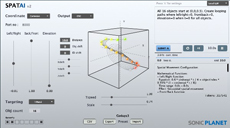
TiMax Extends its Pioneering Spatial Audio Capabilities, Adding Native SpatAI V2 IntegrationTiMax has announced a new native integration for TiMax SoundHub, which builds on the September 2025 overhaul of the TiMax OSC implementation, designed to enable rapid, native third-party development of this kind. The latest comes from sonicLAB, whose newly released SpatAI v2 now addresses TiMax SoundHub directly over OSC, bringing AI-driven, prompt-based object motion into the TiMax workflow. SpatAI uses Large Language Models to translate natural-language descriptions of sound movement into real-time 3D motion data. Users describe motion in plain text, such as, "distribute objects randomly in space and move each around the elevation axis in circles." SpatAI converts the text into the mathematical equations driving each object's position. Following the launch of SpatAI V1 in early 2026, sonicLAB founder Sinan Bokesoy met Robin Whittaker of TiMax at Tileyard Studios to review the application. The conversation informed a focused set of updates now shipping in V2. At the heart of the update is native TiMax OSC integration. SpatAI implements the TiMax-specific OSC protocol directly, so TiMax SoundHub appears as a selectable output target with no intermediary layer. External network targeting has been added too, with general IP configuration enabling SpatAI to communicate across machines for larger setups. Alongside the TiMax-focused work, V2 introduces support for local LLMs hosted via Ollama or LM Studio, alongside the existing cloud-based option. This action removed concerns around token consumption, latency, or data privacy, the company says. Sinan Bokesoy, founder of sonicLAB, comments, "SpatAI lets sound designers describe motion the way they actually think about it. Meeting Robin at Tileyard was a turning point and his feedback shaped the whole V2 update. SpatAI users can now go straight into a TiMax system without any workarounds." Robin Whittaker of TiMax adds, "The addition of SpatAI as a new native integration is a super interesting glimpse into the future of AI in object-based workflows. The use of LLMs to interpret human descriptors to realize an outcome demonstrates the future of enhanced creativity and gives and increased accessibility to sound creators. Enabling this kind of rapid, native integration was precisely the intention behind the September 2025 OSC overhaul." Dan Higgott, product and software manager at TiMax, concludes, "When we overhauled the OSC framework, the intent was to make TiMax SoundHub the easiest spatial platform to integrate with -- whether from a large-format console like SSL, a show control platform like Atlas, a DAW plug-in like Grapes 3D, or a genuinely new creative tool like SpatAI. Sinan's work is exactly the kind of forward-looking integration we hoped would follow." SpatAI V2 is available now for macOS and Windows as VST3, VST2, AU, and standalone at www.sonic-lab.com/spatai.html. TiMax SoundHub OSC support is included in V6.11 and above, available from timaxspatial.com. 
|