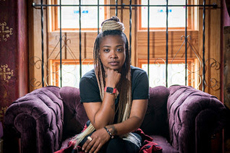
Amanda Davis Mixes Moonchild on the Waves LV1 ClassicWhen alternative R&B band Moonchild rolled into metro Atlanta's Cobb Energy Performing Arts Center on April 9, the audio engineer standing at the front-of-house position wasn't just running a show; she was also coming home. Amanda Davis -- front-of-house engineer and production manager for the band's 2026 tour -- started her audio career and began honing her craft in Atlanta nearly two decades ago. Since then, Davis has established herself as one of the industry's most sought-after live sound professionals, serving as front-of-house engineer for artists including Janelle Monae, Ella Mai, and Tegan and Sara, and working productions featuring Doja Cat and Jon Batiste, to name a few. As a child, Davis grew up in Memphis -- "the home of the blues, Stax Records, Royal Studios," she notes. She remembers walking around the house with Anita Baker and Chaka Khan in her ears, the legacy artists who built the city's sound. Her mother put her in piano lessons at three or four. She found her singing voice in seventh grade, took it through high school and into college as a classically trained vocalist studying opera. It was there she realized performance wasn't the path. Audio engineering was. "I didn't want to sing anymore, but I still wanted to pursue music," she recalls. "I literally took a leap of faith and went to audio school at SAE in Atlanta." At first, she thought she'd become a studio engineer. Long sessions taught her otherwise. A church gig changed the trajectory, and live sound became her passion. Years later, after finding her footing as a self-described "late bloomer" in the craft, Davis stands at front-of-house with the confidence of someone who has earned every fader move. "I trust God and go after what I want," she says. "Nothing more, nothing less." Davis' approaches to mixing is simple: It's gotta feel good. "Being a singer created the space for me to figure out my approach to being a [front-of-house] engineer and what things are supposed to sound like altogether. I consider myself the last member of the band," Davis says. It sounds modest until you hear what she's actually doing behind her Waves LV1 Classic Console. She continues, "I'm always looking around at the audience at shows," she says, "and if everyone is jamming, then I'm doing my job well." That perspective shapes everything about her mix -- particularly with Moonchild, a band whose sound lives in layered nuance, dynamic restraint, and the soft, intimate texture of lead singer Amber Navran's voice. "The unique challenge with this band is keeping the vocal above the band while maintaining a full mix," Davis explains. "And I have to pat myself on the back, because I've been successful at that -- thanks to some specific Waves plug-ins." Translating that vision night after night happens at the console -- and Davis's LV1 Classic setup is built to keep her in the music. Her show file is built the way she'd build any console session -- inputs to groups, groups to L/R, FX sends for vocals and instruments, and a custom show layer that puts every fader, plugin, and user key exactly where she needs it. Because Moonchild is a band of multi-instrumentalists, she opts for user keys over snapshots, giving her quick punch-in control when the show breathes in new directions. Her vocal chain tells the story of her taste: R-EQ -> CLA-2A -> F6 -> PSE -> Feedback Hunter. "Amber has a very unique voice," she says. "I want to make sure the audience gets what they're used to hearing on the record." To keep that vocal in its rightful place, Davis runs a Waves C6 multiband compressor on the band bus, side-chained from her vocal group, so the band gently dips in Amber's frequency range whenever she enters the mix. On the same band group, she runs the Waves S1 Imager to widen the ensemble, keeping the vocal centered and present. One plug-in in particular has become essential to Amanda's workflow: "Waves' Feedback Hunter has been my lifesaver. It's there on my vocal chain to make sure the vocal mic doesn't feed back even when I get the gain up way high." Her approach to tone is as direct as her workflow. "I like to keep a natural sound," she says. "If I walk up to this kick drum and I hear how it sounds acoustically, that's how it needs to sound out front. The plugins are the sauce." When the LV1 Classic arrived, offering a classic tactile console build while opening the door to the Waves plug-in library that Davis had been building her sound on for years, she took it seriously. "I'm an analog girl in a digital world," she laughs. "The LV1 Classic gave me a comfortable workflow where I'm not hitting too many buttons to get where I need to go." What "the workflow" actually means, night after night, is specific. LV1 Classic puts EQ, dynamics, and sends under her hands without menu-diving -- important when Moonchild's arrangements turn on a phrase and she needs to react in real time. Custom show layers let her build the console around the way the band actually plays, instead of working through the desk's defaults. User keys give her live punch-in moments she'd otherwise lose to scrolling through scenes -- necessary when a band of multi-instrumentalists rearranges itself between songs. And the Waves plug-in ecosystem lives on the console, not alongside it, so her plug-in chains on each and every channel all sit inside the mix she's building, not in a separate window she has to manage. The combined effect is speed without sacrifice. On a tour where Davis is also the production manager -- handling the prep, the freight, the stage plot, the PA tuning -- every saved click matters. "For the Moonchild tour specifically, I am production manager as well," she says. "I did a lot of prep work before the tour so that when we got out here, it'll be execution time and I could really focus on building a great mix." For Davis, the work doesn't end at the console. She mentors the next generation of live sound engineers because, as she puts it, "I spent a lot of time figuring this out myself, and I don't want younger people going through that." Her advice to mid-level engineers chasing the next level is grounded in fundamentals: "Gain structure and good mic placement will get you very far. We love all the tools, but we can't build a mix that depends on them. Use your ears -- and don't eye-gineer. "If the audience is jamming and feeling good, that's all I need," she concludes. "You can't take yourself too seriously. I trust the work I've put into this. At this point, it's just time to have fun and enjoy some good music." 
|