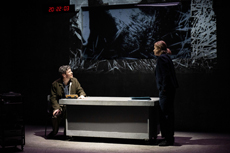
Theatre in Review: Scorched Earth (St. Ann's Warehouse)Scorched Earth doesn't fully come to life until the dead start to talk. Before then, this piece, written, directed, and choreographed by the Irish theatre artist Luke Murphy, is a strange, if intriguing hybrid of crime drama and dance theatre. The text suggests that land disputes are a major contributor to Ireland's violent crime rate, then illustrates the point with the story of William Dean, a developer newly returned to the hometown where, oddly, nobody remembers him. His body is found, badly beaten in the field he had recently purchased at auction. As it happens, Dean isn't at all native to the area. But he is as slick as they come, and he has a familial connection that he uses to convince the locals that his plans to build a housing project on nearby farmland are to everyone's benefit. "I can see you practicing your pitch already," says an unimpressed radio interviewer. Confronted with questions of land exploitation, Dean displays his black belt in whataboutism. "It's just a question of use," he says. "Like, what is good or appropriate use of a resource? Everyone is making use of land in one way or another; everyone has an agenda." Right, and some of them are struggling farmers facing dispossession, while others are carpetbagging businessmen bent on maximize their profits. One of the former group is John McKay, who wanted the acreage in question for himself and was willing to bankrupt himself to get it, but ultimately got outbid by Dean. When Dean turns up dead in the field claimed by McKay, he is, or should be, the prime suspect, until the case is mysteriously ruled an accident. The judgment holds until Alison Kerr, a detective, shows up, freshly interrogating McKay; in a theatre piece filled with choreography, he displays plenty of fancy footwork when it comes to dancing around the implications of her questions. The first part of Scorched Earth combines tense one-on-ones between Kerr and McKay with Dean's radio interview, the land auction, and extended choreographic sequences. Some of the latter are striking, especially when McKay writhes on the floor, apparently reliving the final minutes of his life. Others are distractingly bizarre. When McKay enacts a pas de deux with a piece of the old sod come to life, it seems a little too on-the-nose; it doesn't help that Alyson Cummins' costume design, which wraps a cast member in a carpet of grass, unfortunately recalls Grey Henson's look in Bigfoot! The Musical. There are structural problems; for much of its first half, Scorched Earth plows a circular path, reiterating the same points without moving forward. Then the piece takes an even more surreal turn, much to its benefit. Up to this point, the case against McKay has been largely circumstantial (if highly convincing). Then Dean, back from the other side, appears in the interview booth, bloody, his clothes torn, to recount the grisly details of his killing. Downstage, McKay waves his arms wildly, desperately trying to shoo away Dean's words; soon, he is in a defensive crouch, hiding from a dive bomb of the truth. Gradually, the set -- a concrete bunker that variously represents the police interrogation room, an auction house, a local pub, and a radio station -- is broken down, revealing a steep rise of farmland. Everyone is dancing, but the tone has changed: Earlier, several dancers formed a human link, creating a tableau of community; now we see a violent tangle of bodies, contending for domination. In the stunning climactic passage, the dancers hurl themselves against that towering upstage wall, always falling short, rolling downhill with frightening abandon. It's a corps of Sisyphus, locked in battle with the land they want so badly to possess. Scorched Earth is a much tauter and more pointed contribution from Murphy and his company, Attic Projects, than Volcano, seen at St. Ann's two years ago. It benefits from Murphy's performance as shifty, nervous McKay, prey to the inquisition of Detective Kerr (a probing Sarah Dowling). But the entire company of five performs with remarkable commitment, aided by Cummins' bleak scenic design and Stephen Dodd's film-noir lighting, which makes use of classic dance sidelight to carve the cast out of the moral darkness. Rob Moloney's sound design achieves a fine balance of voices and underscoring. (He also provided the original music.) The audio-visual designer Patricio Cassinoni delivers a series of bleak, black-and-white images, including headlines, official reports, and a corpse seen from various angles. Whatever the awkwardnesses of its first half, Murphy and company lay the ground for a remarkably pure and powerful vision of contemporary Ireland, a country that came to modernity later than most of its European counterparts and, consequently, remains uniquely trapped between past and present. Scorched Earth isn't a perfect piece of work, but I wouldn't have missed it for the world. In his melding of dance and drama, Murphy is onto something, and cheers to St. Ann's for bringing him our way. --David Barbour 
|