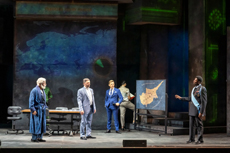
Theatre in Review: Othello (Classical Theatre of Harlem/Richard Rodgers Amphitheater)I saw this Othello the other night at Marcus Garvey Park in conditions best described as challenging. The evening featured occasional bursts of light rain. Certain patrons raised their umbrellas, causing impromptu obstructed views. And the production's projection element was absent due to a malfunctioning system. None of this mattered. I was riveted. Classical Theatre of Harlem has honed an exemplary style -- swift, lean, and purposeful -- that is especially suitable for William Shakespeare's plays. It's an ideal approach for tragedy, and Carl Cofield's direction lays bare Othello play's taut, remorseless structure. Othello can seem unwieldy in performance, a fact with which many have struggled. The cast of Kenny Leon's Broadway revival raced through their lines, aiming for urgency but instead endowing the action with a remote, robotic feeling. The recent Bedlam staging (returning this fall) with a cast of four became an evening devoted to watching actors, not their characters. By contrast, Cofield, working with a streamlined script, focuses on the chain of incidents that lead, without pause, from military triumph and marital joy to a bedchamber littered with bodies. The action, set in the present, is framed with numerous clever touches, for example, the opening sequence, an officer's promotion ceremony in which Cassio outperforms Iago, helping to trigger the latter's revenge plot. Iago plants insinuations about Cassio in Othello's mind while taking part in battle practice with batons. Emilia, Iago's wife and Desdemona's attendant, is a full member of the military, a choice that seemed off in the Leon production but works just fine here thanks to Keren Lugo's tough, fiercely argued characterization. The murder of Desdemona is a messy affair; she fights back, trying to brain Othello before ultimately succumbing. These and other touches feel freshly examined without straining for novelty. The production hinges on four performances that confidently locate the play's action in a contemporary context. James Udom's African-inflected Othello is, despite his grave military bearing, young, virile, and quick to react. His years in the field have made him decisive, unwilling to second-guess his decisions; at the same time, note the delirium with which he sweeps Desdemona in his arms. In many productions, Othello is presented as a monument waiting to be pulled down. Umon makes him quick to love and equally quick to judge, a perfect mark for Iago's manipulations. Even as he rockets toward homicidal madness, he retains a poignant attachment to Desdemona that makes his actions all the more horrifying. Nick Westrate's Iago wastes no time trying to win us over; instead, he gets down to the business of revenge with dispatch, smearing reputations, staging brawls, and poisoning Othello's mind against Desdemona. (Every so often, he turns away from his considerable to-do list and stares at us, daring us to judge his crimes.) He manipulates Othello with masterful ease, pretending to be afflicted with a troubled conscience, yet joining in with gusto to plot Cassio's murder. His delivery of the famous line, "I hate the Moor," rattles the stage with a fury tapped from some deep layer of his psyche. Equally horrifying and magnetic, he drives the action with his whip hand. Desdemona is one of the trickiest roles in the Shakespearean canon, often reduced to a saintly victim but in Isabel Arraiza's striking, thoroughly original take, she is young and vital but also polished and sophisticated, a daughter of wealth who has been given every advantage and knows her way around powerful men. Pleading Cassio's case, she stands her ground against Othello; even when smarting from a stinging slap to her face, she retains a certain self-possession. The final scene between her and Umon is especially wrenching for the clear evidence of the love they still feel for each other. As mentioned previously, Lugo's Emilia is a cool, canny observer of men and their misbehaviors, yet there's also the hint of a powerful sexual connection between her and Iago. Also fine are Orlando Grant as straight-arrow Cassio, baffled to find himself on the outs with the commanding officer he reveres, and Hiram Delgado's Roderigo, a martini-swilling, golf-club-wielding playboy who can't understand why Desdemona isn't wild for him. Christopher Then makes a brief, striking appearance as Montano, who gets unwillingly drawn into Othello's probe of Cassio's drunken misbehavior. The asymmetrical stone slabs of Christopher Swader and Justin Swader's set provide the right background for this pitiless tale of vengeance, and Alan C. Edwards' lighting carves out the actors with a master scalpel, adding color accents that deepen the stage pictures. (The uplighting in Desdemona's boudoir is especially eerie; it's as if she's a guest at her own funeral.) Mika Eubanks' costumes blend authentic military styles with shrewd character observations; check out Roderigo's lounge-lizard ensembles. Frederick Kennedy's sound design is admirably clear; his percussive underscoring and effects (thunderstorms, helicopter, alarms) pace the action. (The projections, which, alas, I missed, are by Brittany Bland.) The fight direction of Rick Sordelet and Christian Sordelet also plays a crucial role both in scenes of street fighting and egregious domestic abuse. Aside from the time frame and setting, there's nothing especially high-concept about this Othello. Instead, it is done with a fine appreciation of the play's language, social background, and emotional dynamics, plotting an unstoppable course toward tragedy. As such, it is one of the best stagings of this difficult play I've ever seen. --David Barbour 
|