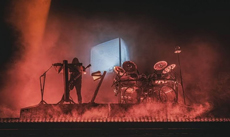
Nico Riot Reflects Power of Perturbator on Tour with CHAUVET ProfessionalLighting designer Nico Riot, and his collaborator Camille from design studio Clair Obscur, were developing set design ideas for dark-synth musician Perturbator's 2025 fall and winter EU tour, which recently concluded at the iconic Le Bataclan, when they saw that their client was doing a photo shoot at the Rudolph Tegner Museum and Statue Park. Viewing the photos from the site, just north of Copenhagen, the designers could see parallels in their client's music and the stark, massive sculptures of Tegner, a pioneer in the early 20th century brutalist school of art and design. Like Perturbator's cyber punk music, the work of the Danish sculptor was big and imposing, but, more than just frightening, it was also reaffirming. "Perturbator did a photoshoot with photographer Andy Julia at Rudolph Tegner's Museum, and when I saw the photos, the direction of the design was basically settled," says Riot, who used 20 (or 28, depending on the venue) CHAUVET Professional COLORado PXL 16 motorized battens from Pan Tilt of Rennes, to translate the mood from sculptures to stage. "The details and gigantism of the sculptures called for a video monolith to recreate that vibe on this tour," says Riot. "There are two musicians on stage -- Perturbator and the drummer, and I wanted them to be close together, centered around a strong central piece. In the museum, there's a glass ceiling with an octagonal shape. This was the perfect direction to tie everything together on stage. The octagonal shape became the riser, and we tried to recreate the look of the glass ceiling." The distinctive riser served as a springboard for transformative looks throughout out the show. At times it glowed with intense light -- at others it disappeared into the darkness and fog. It pulled the artists on stage closer together, then moved to separate them creating a different mood. "The show is divided into acts, so we only used parts of the monolith until the risers opened," recounts Riot. "That's when the monolith was revealed at full size. Opening the risers also revealed new lines of beams, creating a new perspective during the show and multiplying the number of sources and possibilities. The first movement of the risers happened mid-show. It's pretty crazy for the audience to see the two musicians being split apart across the stage. Essentially, the riser allowed me to re-center the audience's attention on a single point whenever needed. The monolith is always present, but not fully revealed at first." To accent the octagon, Riot surrounded the centerpiece structure with 20 COLORado PXL 16 battens. (On the tour's festival stops, he used eight additional units for side lighting. "They gave us a beautiful layering element to create a mask between the band and the audience," he says of the battens. They also interacted with the beams working on the Y axis, while the bars themselves were mostly on the X axis. They're a great tool!" Declaring that he wanted to create something "the opposite of any regular metal and EDM shows," Riot relied on color changes from his fixtures to evoke a sense of movement without relying heavily on moving fixtures. "There are barely any movements, FX or quick position changes," he says. "Perturbator's music can be really intense, so I was looking for ways to keep that intensity without shooting light straight into the audience. I tried to aim the strobes upstage or keep them in their home position for example. "I also used an insane amount of haze and smokes,' adds Riot. "It helped tons to calm the strobe, since they have more haze opacity. Colors helped make them feel a bit smoother as well. Being very cautious while playing with frequencies and dimmer effects at the same time can create great craziness without being overwhelming. Another thing I did was play a lot with dimmer intensities. An element can be running a 1- percent, waiting for the right musical moment to explode in this kind of show." Working with his LX crew chief Lena Marinot, Riot ran his ten-universe show on MIDI. "I'd never had the chance to program an electronic act before, so I called my good friend Pierre-Claude, and he advised me to go with MIDI. I found MIDI to be a better workflow -- easier to move parts around if the artist decides to make changes within songs during the tour. Now, I can't wait to do another one with Perturbator and keep pushing this design further." 
|