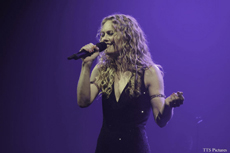
Vanessa Paradis and Her Team put Sennheiser's Spectera Handheld to the Test For Vanessa Paradis' 2026 tour, the audio team around monitor engineer Matthieu Speck adopted Sennheiser's Spectera wireless system, including the new SKM handheld transmitter. The tour plays a mix of arenas, large indoor venues and festivals, so the team was looking for a system that would be reliable, with stable RF and transparent audio. The setup includes two Sennheiser Spectera Base Stations, complemented by a backup unit, and 28 SEK bodypacks. Two Spectera handheld microphones handle the vocals; monitoring is operated at 96kHz. Eight Neumann MCM 114 clip-on microphones pick up percussion and brass, while four MKH 8018 stereo shotgun microphones capture the audience ambience. Alongside Speck at monitors, Paradis' audio team includes Julien Decarne (FOH), Nelly Robert (RF) and Francois Kerjan (sequencing). For Speck, the main challenge was to integrate a new technology into a demanding live production. For Paradis, who usually sings with wired microphones, adopting a wireless microphone represented a significant step. One of Spectera's key advantages lies in its special wideband technology, which allows both bidirectional audio and control data to be carried within a single RF channel using time slots. This replaces the traditional RF coordination approach and significantly simplifies set-up and operation. "The Sennheiser WMAS technology replaces the traditional frequency plan. It is an extremely stable and more intuitive approach," explains Speck. The time savings with wideband are particularly evident when fast setups are required, especially at festivals. Robert benefits from a significantly simplified workflow for RF setup, as well as for deploying packs and preparing the microphones. The absence of repeated manual synchronisation allows the team to focus more on stage control, soundchecks and listening. Speck highlights the range and reliability he has already observed on the road: "Spectera links are even more robust than we imagined before the tour. The range is excellent -- even at the very top of the Zenith arena in Lille, France, we were unable to break the link, no matter whether the SKM handheld or the SEK bodypack was used." The system also works seamlessly with the SK 6000 used for backline communications. Onstage, ease of use plays an important role for the acceptance of a new wireless system. On their SEK bodypacks, the musicians can make the most important settings themselves. This autonomy still has some boundaries thanks to the Remote Lock function that allows Robert to lock critical functions remotely during the show. In-ear monitoring is one of the areas where the change is most noticeable. "Before Spectera, the weakest link in the audio chain was wireless in-ear transmission," Speck says. "We're fortunate to have excellent consoles and high-performance tools across the board, and now we can maintain that quality all the way through. It's a major step forward." The move to digital transmission at 96kHz brings greater definition and a more precise stereo image. Speck compares this evolution to moving from a standard-definition video image to the sharpness and detail of 4K. This transparency, however, introduces an additional demand: the system reveals everything that is sent through it. Precision therefore not only becomes a convenience for the performers, but is also required from the monitor engineer. For Paradis, in-ear monitoring must not isolate her from the energy of her audience. Capturing ambience therefore plays an important role, with four MKH 8018 stereo shotgun microphones on the job. The tiers are captured with two MKH 8018 set to narrow XY stereo, the stalls are picked up by two 8018s set to wide XY stereo. This set up reproduces a coherent and natural sound image of the venue without compromising mix clarity. "I have never before achieved such good coherence in ambient capture; this has improved so much," notes Speck. Instrument capture relies on eight Neumann MCM 114 microphones, used on congas, bongos, saxophones and trombone. These sound sources are very demanding in respect of their dynamics and spectrum, which is why FOH engineer Julien Decarne ran various trials during rehearsals. MPM AUDIOLIGHT is the service provider and rental company for the tour. Vanessa Paradis' tour is part of the Spectera Pioneer Program, which for Speck, has established a direct dialogue between touring engineers and Sennheiser's development teams. "We can communicate with the people writing the code... it has broken down that barrier between the development engineers of a brand and the engineers and technicians on the ground like us," he says. This exchange, notably via Discord, facilitates field feedback, adjustments and a better understanding of real-world operational constraints. The speed of updates, such as version 1.3, which can be installed in a matter of minutes, reinforces the impression of a system designed for the fast pace of live productions. Decarne is also very pleased with the sound quality of Spectera: "Vanessa's voice is remarkably clear and precise. This allows me to maximize intelligibility and ensure that every word is perfectly understood by the audience." 
|