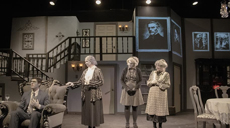
ADJ Fixtures Help Bring Unique Black-and-White Production of Arsenic and Old Lace to Life Henderson County Performing Arts Center (HCPAC), a community theater in Athens, Texas, recently put ADJ lighting fixtures to creative use in a production of Joseph Kesselring's classic comedy Arsenic and Old Lace. With a lighting design built around an unusual black-and-white aesthetic, the production presented a distinctive challenge for technical director Wes Atkin, who served as both lighting designer and programmer for the show. Drawing on the versatility of the venue's in-house ADJ Focus Wash 400 automated luminaires, Atkin developed a carefully controlled lighting scheme that helped bring the director's creative vision to life. For HCPAC's production, director Ethan Herrin proposed an unconventional visual approach that would make the show stand apart from a traditional theatrical presentation. "There's a theatre over in Dallas that has become somewhat famous for doing black and white productions and Ethan wanted to try it," explains Atkin. "I, somewhat naively, was happy to give it a go. However, it turns out that it's much harder to pull off than we initially expected. Not only was it a lighting challenge, but it also required a huge team effort, as it depended on the right makeup, costuming and set design, with the right undertones, to allow a consistent look." The resulting design used a predominantly monochromatic palette, with color reserved for specific dramatic purposes. Red signified poison and death, while a window on the set was illuminated in golden yellow before transitioning to blue to communicate changes in the time of day. This selective use of color made each exception to the black-and-white aesthetic especially significant. The production opened with a vivid display of blue and red illuminating the set as audience members entered the theater. At the beginning of the performance, Wes programmed a carefully timed sequence that progressively transformed the stage. The colored background lighting faded away, beginning with the upstage balcony and moving down the set, before the lights illuminating the furniture were extinguished. Finally, color photographs projected onto the walls faded to black and white. The stage lighting then returned in white, revealing the actors and establishing the production's distinctive monochromatic visual style. "I was really pleased with the effect of transitioning the stage from color to black and white," comments Atkin. "And it generated a great reaction from the audience - plenty of oohs and aahs - especially on the first few nights before word got out!" The primary fixtures used to illuminate the actors, props, and scenery were ADJ's Focus Wash 400 automated luminaires. HCPAC's in-house lighting rig includes 20 of the fixtures, installed in the grid above the stage. The Focus Wash 400 is an automated unit powered by a 400W RGBALC LED engine. Its 6" Fresnel lens and motorized zoom, adjustable from nine to 43 degrees, provide an even field of light with a soft-edged beam. "The Focus Wash 400 was definitely the right choice for HCPAC," Atkin says. "When we upgraded our tech, we evaluated lots of options from ADJ as well as other manufacturers, and this fixture clearly came out on top. It has great light output with excellent color rendering and that nice Fresnel soft-edged beam. Being an automated fixture, with a good zoom range and extensive color mixing, it allows maximum flexibility controlled from the lighting desk, meaning we very rarely have to physically move lights around. This was an important consideration for a community theater that relies on volunteer techs and has a fixed grid with no fly bars! The price point was also very attractive, allowing us to not only purchase very competent luminaires, but the right quantity of fixtures for the space." With color largely removed from the equation, achieving the right appearance for the actors and establishing visual depth across the stage demanded particular attention to detail. "The lighting was very important in delivering our director's creative vision," states Atkin. "We found that if I didn't get the color tones just right, they just looked like a bunch of dead people walking around on stage! We spent several hours playing with the color palette to get just the right tone. After that, it got even more difficult because then I needed to create depth and space, shadows and emotion, and draw focus to certain parts of the stage as the characters move around and interact, but I had to do that without the use of color. Where traditionally I might use one color on the front right of a character and another color for the front left to create a dramatic shadow and then hit them with another color from behind to create depth, I now only had one color to work with. So I had to figure out how to achieve the same result in a different way, which meant intensities and angles and things like that became a lot more important." While most of the production remained in black and white, carefully selected color effects played an important role in communicating the story. One particularly striking moment involved a window seat containing a dead body, for which Atkin used an ADJ Jolt 300 to produce a vivid red glow from within the set piece. In addition to the ADJ fixtures, two Cyber Pak four-channel dimmers from ADJ's sister company Elation were used to power the wall sconces integrated into the scenery and a chandelier suspended above a dining table onstage. These practical light sources helped integrate the set's decorative elements into the overall lighting design. 
|