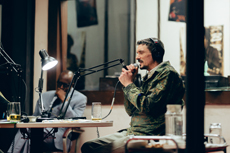
Theatre in Review: Hate Radio (St. Ann's Warehouse) Hate Radio is so far off the map of normal New York theatre that it is almost impossible to describe. So many of the allegedly political works that we get these days involve first-person accounts of personal struggles involving race, ethnicity, and sexual/gender identity. Some are captivating, but even the best of them can feel minor: Larger, more complex issues are left untouched. These my-trauma-and-how-I-solved-it exercises are pretty much guaranteed sympathetic hearings; everyone, on both sides of the footlights, is involved in mutual reassurance. In contrast, Hate Radio is an assault on the audience's sensibilities, an investigation into systemic evil of a sort rarely, if ever, attempted on our stages. It is brutal, relentless, and exhausting. I fought it every step of the way. And yet it may be essential. You may very well hate it, but prepare to be shaken to your core. The Swiss playwright and director Milo Rau sets out to recreate a broadcast of RTLM, or Radio-Television Libres de Mille Collines, a radio station based in Kigali, Rwanda, which, in the early 1990s, preached, to its largely Hutu audience, a steady stream of murderous bile aimed at the Tutsi minority. This is the era when, following the death of the long-running Hutu president Juvenal Habyarimana in an airplane crash, the country descended into civil war -- a term that seems mild considering the slaughter that ensued. As many as six hundred thousand Tutsi men were killed; up to half a million women were raped. Children were brutalized in ways I can't bring myself to write. During the broadcast that makes up the bulk of Hate Radio, a trio of presenters, spelled by a DJ who spins African and US pop hits, offers a steady stream of disinformation, insisting that any success of the part of the RPF, the Tutsi rebel group, is a lie and that the US plans a colonialist intervention. In the event, the US did little or nothing to stop the Tutsi genocide, leaving a permanent black mark on Bill Clinton's record. The French did get involved, with distinctly mixed results, but they are cheered on by RTLM: "The Frenchmen are coming to help us to defeat the rebel! I ask you, girls, to take off your pants and welcome them in your mini-skirts!" Interestingly, some of the ugliest rhetoric is spewed by Valerie Bemeriki, the only woman in the studio: "They raped your wives, they raped your children," she says. "And now, with the help of the Americans and the Belgians, they're planning to wipe us out once and for all. Because they destroy everything they can't seize control of. Like the woman in the Bible who says that the child should be torn in two if it cannot be given to her. Yes, the cockroaches raped God, and they would even rape the Devil if he would let them." In case it isn't clear, the "cockroaches" are Tutsis. The RTLM commentators certainly can't be accused of using dog whistles or speaking in code. Another one, Kantano Habimana, says, "It's a very simple matter: we're dealing with a race here, and Rwanda needs to be rid of them. So, take a good long look at a person, look at how tall they are and their appearance, look at their pretty, fine noses -- and then pound them to pieces." A minute later, he and two colleagues get on their feet and bop around to "I Like to Move It" from the animated film Madagascar. (The juxtaposition of mass murder with an animated DreamWorks romp set off the coast of Africa isn't noted, but it's there.) Another tune is dedicated "to all the cockroaches in Uganda who don't speak French and to you especially, Bill Clinton." It is "Rape Me," by Nirvana. To be sure, it is not easy to spend two hours in this diabolical environment. (The action is bookended by monologues featuring actors playing survivors of the genocide, their unemotional delivery providing a stark contrast to the atrocities committed.) The piece is difficult to experience in other ways: The torrential dialogue is delivered in French, with English subtitles, and keeping up with it is draining. I often felt I was spending most of the show staring at projections rather than actors. (If you go, you may want to sit further back, allowing you to take in the full stage picture and titles in a single glance.) Also, we hear the play through headphones, a plausible recreation of the radio experience, but which -- to me, anyway -- can be increasingly bothersome. For all these reasons, I found my attention slipping in and out, but that may be the best way of dealing with the production's brute-force impact. Possibly, one can only take in small doses the cool professionalism with which the RTLM staff incites murder, rape, and mutilation. And yet, for them, it appears to be just another day on the job. The show's program notes how, over the course of a century, German and Belgian colonizers sowed divisions among the Hutu and Tutsi, setting the stage for discord. But what is one to say about the Adolf Eichmann-style detachment with which they go about their ugly business? At which point does one enthusiastically sell one's soul? And what to make of Georges Ruggiu, a Belgian and the only white man in the room, who serves as the chief Hutu apologist? "Of course," he says, "things went a little overboard on occasion, the population was so enraged that they may have killed people who they thought were RPF collaborators and could have brought harm to the majority of the population. But is that not exactly what the resistance fighters in France did with Nazi collaborators? Did Robespierre not also call on the French to be cautious during the Great Revolution? A man under suspicion was always a condemned man." One struggles to understand the complicity of each participant, but Ruggiu, an outsider to Rwandan history, confounds most of all. Then again, Hate Radio offers no character insights, no plot developments, and little or no historical context. Instead, it confronts us, face-to-face, with the mystery of evil: How ordinary people can preside over extraordinary savagery? This question, of course, has cropped up far too often over the last century or so. The horrors of Rwanda occupy their dedicated circle of hell, but one hears echoes of the Ottoman Empire, the Third Reich, the Middle East, Myanmar, and others. And, sitting in the audience at St. Ann's, one feels a persistent trickle of dread about divisions closer to home. It's cold comfort that Tucker Carlson, Nick Fuentes, and Candace Owens are pikers compared to the perpetrators of Hate Radio. Then again, was the disinformation offered on RTLM any crazier than Owens' insistence that the late Charlie Kirk was a time traveler? Or worse than Fuentes' Holocaust denialism? Once our collective hold on reality begins to slip, anything is possible, and no crime is beyond the pale. The production design of Hate Radio is a strikingly hyperreal exercise, beginning with Anton Lukas' studio set design, featuring such scene-setting details as rusting air-conditioners, foam soundproofing, and a giant poster of MC Hammer. Marcel Bachtiger's video design delivers the prologue and epilogue sequences with assurance. Even if one balks at wearing headphones for two hours, Jens Baudisch, working with sound design consultant Peter Gohler, has delivered an efficient listening system. I'm not a fan of spinach theatre, which subordinates entertainment and intellectual stimulation to moral instruction and right-thinking sermonizing. If that's what you're looking for, there's a church on practically every block. But Hate Radio is something deeper, probing depths that most of us prefer not to consider. It is a hateful experience, intentionally so, but it is also monumental. At the curtain call, the superb cast looked hollow-eyed and haunted. I don't blame them; days later, I can't stop thinking about it. --David Barbour 
|