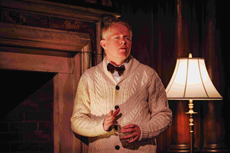
Theatre in Review: Tru (House of the Redeemer) Tru is a Yuletide tale, and the title character, Truman Capote, is its Ghost of Christmas Past, bent on haunting himself. It is 1975, and the best-selling author, ubiquitous talk-show guest, and party animal has crash-landed in his East Side apartment, having committed social suicide with the publication in Esquire of "La Cote Basque, 1965," an excerpt from Answered Prayers, his notorious novel-that-never-was. (The title alludes to a possibly apocryphal comment by Teresa of Avila, noting, "More tears are shed over answered prayers than unanswered ones.") The dishy piece -- which so thinly disguises its characters that it barely qualifies as a roman a clef -- causes a mass exodus among his "swans," the society ladies whose friendship he prizes so highly. The response has left the writer stunned and furious: "Artists belong to no class," he insists. "And people like that who cozy up to artists do so at their own risk." Apparently, he never considered that his sword might have two edges. "My God, you'd think I killed the Lindbergh baby!" Capote says, trying on the victim role for size and finding it surprisingly comfy. But what was he thinking? He has mortally embarrassed his so-called best friend, Babe Paley, building the story around a scurrilous and highly graphic retelling of her husband Bill's adulterous night with a politician's spouse, who leaves behind incriminating evidence in the form of an enormous menstrual stain. Actually, Mrs. Paley, already under treatment for lung cancer, got off relatively easily: The piece also resurrected the story of Ann Woodward, who killed her husband (maybe accidentally, maybe not), escaping prosecution but forever after living under a shadow. She committed suicide just before the Esquire story went to print, leaving some to wonder if she had been tipped off. Such facts undermine playwright Jay Presson Allen's attempts at making Capote an object of pity. Tru finds the writer alone on Christmas Eve, railing against his fate while working the phone lines and planning a big night out with Ava Gardner and her entourage. Turning on a tape recorder, he dictates his thoughts to Gerald Clarke, his biographer. ("I'm the only person in the world who knew Sirhan Sirhan and Robert Kennedy, who also knew Lee Harvey Oswald and Jack Kennedy," he says, tellingly defining his worth based on who he knows rather than what he does.) Over a long night's journey into day, he has a cocktail or four; snorts cocaine; schemes to get a faithless, thieving boytoy beaten up; and defends himself against charges of exploitation. Produced on Broadway in 1989, Tru famously provided Robert Morse with a comeback for the ages; like Capote, Morse also battled the bottle, giving his performance an extra edge of authenticity and danger. Morse also captured Capote's wicked wit, which is largely absent in this revival. Two examples are instructive: Staring at an unwanted poinsettia, Capote dismisses it as "the Bob Goulet of botany." Later, coming to grips with his social exile, he adds, "Mr. Swifty Lazar...first time in fifteen years he didn't invite me to one of his big parties. Well, that ought to bring me to my senses!" Morse got huge laughs with both lines; no such luck at the House of the Redeemer, where the names apparently ring few bells. Others dropped to little effect for anyone under fifty include socialites Carol Matthau and Slim Keith, interior designer Mario Buatta, columnist Liz Smith, and novelist Jack Dunphy (Capote's sometime lover). (The recent FX series Capote and the Swans, which I didn't see, reportedly delivered the story with considerably more context.) Allen's attempts at imitating Capote's waggish manner are surprisingly weak. "I've lived all over the world...I went to Staten Island once. It was like Australia," he cracks. Trying to convince himself that the Cote Basque affair will benefit his career, he snaps at his agent's secretary, "When Irene gets back in, ask her when Norman Mailer stabbed his wife, how much his fee went up." Lamenting what may have been his most potent addiction, he says, "Fame is only good for one thing...they'll cash your check in a small town." You don't build a reputation for a wicked tongue with that kind of material. Tru was written for an audience familiar with the Answered Prayers scandal; aided by Morse's eerily close-to-the-bone performance, it offered a poignant portrait of an artist in free-fall. Seen three-and-a-half decades later, it offers a faint echo of a long-ago literary dustup, although it is piquant to recall a time when a piece of prose could cause such trouble. In Rob Ashford's dark and heavy production, Jesse Tyler Ferguson -- distinctively dressed by Sam Spector in a Norfolk coat, bell-bottom trousers, and (briefly), a floor-length fur coat -- delivers a solid impression of the writer's bizarre manner, especially the eerily childlike voice like that of a toddler on a bourbon bender. (His mirthless chortle is a warning sign of emotional squalls in the offing.) The actor has his moments, jogging across the living room to the cocktail table or, on the phone, dispensing endearments like penny candy ("I adore you, you gorgeous thing. Don't you ever die! Hugs, kiss, kiss"), and talking, talking, talking in a desperate attempt to fend off the "mean reds" that keep him on the edge of a personal abyss. Much of the time, however, Ferguson leans hard on Capote's bitterness and self-pity as he tots up the extensive list of those who have failed to love him, excoriates the elite whose attentions he nevertheless craves, recalls his mother's suicide (a triumph of sorts, because she made it from obscurity to Park Avenue), and toys with following her lead. In the script's most maudlin episode, he recalls a boyish visit to a New Orleans laundress with allegedly magical powers, tearfully confessing his secret wish to be a girl. Ultimately, spending a couple of hours with this bizarre, aggrieved, self-destructive creature is exhausting. Oddly, Ashford has added another presence, a sleek, mysterious beauty in a black evening gown and white feathered mask, played by Charlotte d'Amboise. A living echo of the Black and White Ball, the era-defining celebrity bash that Capote threw in 1966 after the success of his "nonfiction novel" In Cold Blood, she looks great but contributes little to the production. She is finally identified, to no one's surprise. Mike Harrison has gussied up the House of the Redeemer's dark-paneled Edwardian-era library with an array of scenic touches, including a Christmas tree, female portraits, a manual typewriter, and various bits of bric-a-brac, including a paperweight rumored to have been a gift from Colette. Tiny lamps and towering candelabras are scattered about, creating a chiaroscuro effect supported by Emily Schmit's lighting design, which uses a small number of theatrical units cunningly tucked into various corners. In addition to various effects and voiceover sequences, Christopher Darbassie's sound design includes an attractive lineup of jazz recordings featuring Dick Grove, Ella Fitzgerald, and Louis Armstrong. Seen from a distance of three-and-a-half decades, Tru seems little more than a collection of boldface names in search of a drama. Aside from a brief section from Capote's classic story A Christmas Memory, we get little sense of the writer's talent or his ability to enchant the most unlikely people, from corporate CEOs to convicted murderers, the fruit of a personality that paired an aspen-like vulnerability with a lethal eye for others' weaknesses. Capote's prayers were answered, it seems, and that is the pity of it. In the long run, let's hope he is remembered for his evocative prose rather than his spectacular decline. --David Barbour 
|