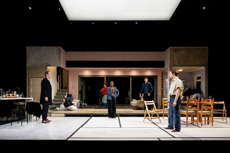
Theatre in Review: The Other Place (National Theatre/The Shed) The Other Place unfolds in an unfinished room, an appropriate setting for a play that remains oddly hesitant in realizing its dark conclusions. We're in the longtime family home of Chris, the unbending protagonist, and it is currently undergoing renovations. In addition to the yard being relandscaped, other signs of change are evident: Chris has a new wife (or partner, it's never clear which), Erica, and a stepson, Leni. And the family, including his niece, Issy, and business associate (and old friend) Terry, has assembled to scatter the ashes of Chris' late brother, Adam. "We need to move on," Chris insists, unaware that he is about to move on right off a cliff. The agent of Chris' ruin in Annie, Adam's daughter, who has long been estranged from the others, very likely living rough, visited only by her sister, Issa, who usually returns home, obviously upset from these encounters. Annie, who is both a tad imperious and scarily fragile, shows up and throws a wrench into Chris' plans, demanding that Adam's ashes be kept on-site. (It was, after all, his home, a notion that doesn't quite track, logically.) This situation quickly descends into a battle of wills, aided by the blackly comic sight of Adam's urn being repeatedly emptied and refilled, its contents subdivided in search of a Solomonic solution. At one point, Annie takes a plastic Ziploc bag containing her father's remains and shoves it down her pants. Where is Joe Orton when you need him? Despite such comically macabre touches (which include Chris asking Terry, "Are you seriously wearing flip flops to the scattering of my brother's ashes?"), playwright Alexander Zeldin is hunting for tragedy. The Other Place is basically a contemporary Antigone, with more than a few psychosexual twists. Among the juicy bits: Adam, who suffered from mental illness -- he was seen "shouting at birds on the high street" -- killed himself, in this house. (This is news to Erica and Leni, who are suddenly looking very differently at their new residence.) Chris suffered from crippling depression following Adam's death. Chris and Annie spent nights in a tent erected on the property; he ultimately sent her away to boarding school, earning her eternal fury. He has also spent considerable sums on psychiatrists and medication, none of which have done her any good. Clearly, something is terribly wrong between Chris and Annie, the truth of which is saved for the play's climax, although don't forget about those nights in the tent. Also adumbrating the play's climactic revelations is the clumsy pass that Terry, who is married, makes at Issy, who is young enough to be his daughter. "I feel like you get me," he says, showing his poor grasp of reality and earning a terrible humiliation. The Other Place exudes an atmosphere of denial and abuse; its seemingly normal surface is alarmingly brittle, and, when it shatters, there will be blood. What isn't in evidence is the pity and terror that tragedy is supposed to generate. Zeldin's characters are too sketchily conceived, the family's history reduced to scattered details; one is hard-pressed to connect the dots. Chris' curt, oppositional personality is so off-putting that one wonders what Erica sees in him; equally mystifying is his friendship with the loutish, epically insensitive Terry. Similarly, Annie is little more than an avatar of suffering, and her secret connection to Chris hardly feels inevitable. Zeldin prejudges his characters, too obviously separating the predators from the victims without sufficiently explaining their motives. Very possibly, an eighty-minute running time isn't enough to lay out this family's complex history. In contrast, Robert Icke's Oedipus, which recently concluded its Broadway run, carefully laid a solid groundwork for its horrifying finale. It also allowed the characters some attractive qualities, intensifying the horror when their downfall arrived. Zeldin's direction is smooth enough in terms of pacing -- the piece is rarely dull -- but the overall effect is anodyne, and the actors struggle with their thinnish, often drably conceived roles. Tobias Menzies can't do much with Chris's grim, supercilious attitude. At least Emma D'Arcy lends a plausible air of mystery to Annie, although she could do with more fleshing out. Jerry Killick's Terry is a too-obvious irritant, the kind of person one avoids inviting into one's home. Ruby Stokes' Issy, Lorna Brown's Erica, and Lee Braithwaite's Leni constitute a one-dimensional chorus, existing to look shocked and upset. The production design, especially Rosanna Vize's spacious, uncluttered set and her character-observant costumes, works well, although the giant lightbox that James Farncombe hangs over the set, repositioning itself from scene to scene, feels like a bit of a gimmick. Josh Anio Grigg's combines discreet amplification of the actors with reliable delivery of Yannis Philippakis' incidental score, with its tense, almost hysterical, mix of strings and electronic instruments. I suppose it is symbolic of our time that, whereas the clash of ethics in Antigone has enormous societal implications, in The Other Place, the troubles, which are of an entirely domestic nature, feel comparatively banal and tawdry. The best tragedies take the audience on a journey of discovery; when it comes to identifying the worst and most pitiable characters, Zeldin chooses for us. He must, because he hasn't provided us with enough evidence to decide for ourselves. --David Barbour 
|