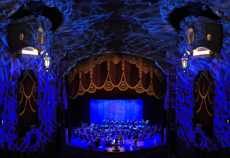
Campfire Audio IEMs Take the Stage with The Dandy Warhols at Portland Symphony Concert Neo-psychedelic rock group The Dandy Warhols, known for hits like "Bohemian Like You" and "We Used to Be Friends," recently fused rock and orchestra at their sold-out hometown performance at Arlene Schnitzer Concert Hall in Portland, Oregon. For this show, The Dandy Warhols and conductor Tamil Rogeon relied on Campfire Audio's natural-sounding in-ear monitors as part of a fully in-ear stage setup with no amplifiers. Leading the monitoring system for the performance was longtime Dandy Warhols monitor engineer Magali Couturier, who has worked with the band since 1998 and has toured with artists such as PJ Harvey, Courtney Barnett, Gary Numan, and My Bloody Valentine. Known for her hands-on, artist-first mixing approach, Magali has helped the Dandies evolve through multiple eras of touring production, including their transition into in-ear monitoring. Merging a rock band with a 56-piece orchestra creates a monitoring environment with little margin for error. Amplifiers were not permitted on stage, and the Dandies needed to follow a shared click track with the conductor to stay aligned with the orchestra's timing. For Magali, this required a fully in-ear monitoring system that provided clarity, consistency, and enough isolation to manage the band's mixes accurately within the orchestral setting. "For this show, there really wasn't a choice," Couturier explains. "There were no amplifiers on stage, so everyone had to be on in-ears, including the conductor. The Dandies had never played with a click before, and there are a lot of rules in classical venues. It was really interesting seeing those two worlds come together." Couturier and the band used custom-fit Campfire Audio Solstice in-ear monitors for the performance. While the Solstice has since been discontinued, its closest successor, the Ponderosa, continues the same approach to isolation, comfort, and natural, uncolored tuning that made the Solstice ideal for demanding live environments. The custom-molded fit gave Magali the isolation she needed to shape the band's mixes with confidence, and its natural tuning ensured the accuracy required across a wide range of venues and performance settings. "I need in-ears that sound natural and have as little coloration as possible," she says. "The Solstice works really well for that. They're well built, and I've never had a failure." Consistency across all performers was essential. Since every band member relied completely on IEMs, Magali needed a system she could trust and one the players would feel comfortable using in an orchestral setting where precision was critical. That reliability mattered to guitarist Peter Holmstrom, who was the first member of the band to adopt in-ear monitors. The clarity and translation of the mix made a dramatic difference to his performance. "At sound check, I popped the IEMs in, and it was amazing," Holmstrom recalls. "All of a sudden, I could hear the band again and actually play with them, as opposed to alongside them. It let me focus on the subtleties of playing instead of constantly trying to find the beat." Holmstrom also notes that his in-ears significantly reduced the physical and mental fatigue he used to feel after a show. "My ears aren't closed up or ringing, and the volume feels normal. I'm not mentally exhausted the way I used to be when coming off stage." 
|