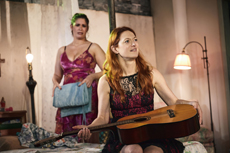
Theatre in Review: Queens (Manhattan Theatre Club/City Center Stage I) These are pugilistic days at Manhattan Theatre Club. On Broadway, the recently closed Punch focuses on the many repercussions following a blow to the head delivered during a gang fight. Queens begins with Renia, a middle-aged Polish woman, walking home at night in the New York borough of the title, being stopped by the much younger (also feral and filthy) Inna, who hurls accusations, then decks her. It tells you plenty about the brutal world inhabited by Martyna Majok's characters that this attack passes with little notice. There's more where that came from: Majok, winner of the Pulitzer Prize for Cost of Living (produced twice by MTC), takes us into the shadow existence of undocumented immigrants, all female, living communally -- off the books and without a shred of support -- in the basement of a New York City apartment house. Queens is a difficult, tricky piece, worrisomely slow to get going, but Majok has a penetrating insight into her characters; for them, America is a casino, and they're betting against the house. Much of the first act unfolds in 2001, when Reina, on the run from her sponsors following an accusation of betrayal, arrives at the basement. Others living there include the coolly observant Pelagiya, from Belarus, and Aamani, from Afghanistan, whose story about her husband is a calculated lie. (Among other things, it is just after 9/11, and the city's climate is particularly hostile for someone who looks like her.) Packing up, trying to fit as many possessions as possible into a single piece of luggage, is Isabela, who is returning to Honduras to face her ailing mother and the daughter she hasn't seen in years. In this lengthy establishing sequence, Majok carefully shapes the contours of the women's pitiless existence. Calculating the cost of clothes she purchased to get by in New York, Isabela notes that "one half year of my daughter's life...that I'm not with her...is here on the floor." Aamani, evoking one particular pain of exile, says, "I followed a man off the train the other night just because I saw he was reading a book in [the Persian language] Dari," telling the others, "You see your alphabet everywhere, all your lines, you probably don't even think about it...I run after a stranger because I need to be heard." Pelagiya contributes the account of a former resident, an elderly Georgian woman who, taken in by a crooked work-at-home scheme involving jewelry making, drove herself into debt. These conversations have the ring of truth, including the grim details of a bureaucracy seemingly designed to thwart those seeking citizenship or visas, but, in this opening stretch, Queens is static and slow-moving, a bill of indictments that, however accurate, becomes wearying in the absence of any meaningful action. (It is also fatiguing to hear so much dialogue delivered with heavy accents and broken syntax, although it gets easier as the play progresses.) Before the scene is over, you may be tempted to dismiss it as an essentially undramatic piece of reportage, truthful yet lacking in theatrical excitement. But Majok is playing a long game, and, roughly thirty minutes in, the play begins to benefit from her puzzle-like construction. The action shifts to 2011, when Reina, now a caretaker for the woman who owns the building, takes in Isabela's daughter, Glenys, an adolescent trying to complete her education in the US. It also jumps ahead to Ukraine, circa 2016, where Inna lives with Lera, a single mother, who spends her nights in bars, tarted up in a tight dress and blonde wig, hoping to attract an American husband. As she sadly notes, "You walk into this club and there's like, hundreds women. Beautiful. Or -- okay. But trying. And there it's maybe twenty guys. From America. Twenty guys what takes plane here, takes bus, what puts cologne in hotel. Twenty guys here looking for what they can't find in home." Initially appalled at such tactics but desperate to find her mother, who moved to America and seemingly vanished, Inna follows Lera's lead, making her way here and ending up in a private hell. Escaping, she makes her way to Reina, who, by now, is the basement's chief resident and enforcer. But Inna's arrival in part leads us to learn how Reina has maneuvered herself into a position of power, exploiting her friends, setting herself up for a tragic revelation that leaves her profoundly alone. Our news feeds and social media are so filled with toxic commentary depicting the undocumented as parasites and a drag on prosperity that a corrective is needed. Majok flips that script, casting a searching light on the cage in which these women find themselves, working lousy jobs for inadequate pay, terrified of being caught, and aching for loved ones who seem less real with each passing day. (More than once, the women assemble in a Greek chorus for anguished phone calls home.) We are often told that our immigration system is "broken." It's broken, all right, and Queens shows how expertly the women's exploitation works. The director, Trip Cullman, can't entirely get around the play's languid start. But he has assembled a powerhouse cast led by Marin Ireland as Reina, who, shaped by her circumstances, is capable of both disarming kindness and stunning cruelty in her pursuit of "something to make it worth all this." After years of "scrubbing other people's floors" and "working double what others work for half," she absorbs the lessons of capitalism all too well, stepping on others while saving her tenderness for the stray cat she adopts. Ireland stuns in the final sequence when the ruthlessly honest Reina reveals exactly how much of her soul she has traded in exchange for a position of relative prosperity. Equally notable is Julia Lester -- a comic demon in recent productions of Into the Woods and I Can Get It For You Wholesale, as well as the campus comedy All-Nighter -- here underplaying, yet not giving an inch, as Inna, who, in her way, is as tough and unforgiving as Reina. Equally fine are Nadine Malouf as Aamani, who, for reasons of her own, is equally unwelcome at home and in the US; Nicole Villamil as Isabela, wistfully wondering if her US sojourn was worth the suffering; Brooke Bloom as the canny, increasingly infirm Pelegiya; Sharlene Cruz as Glenys, for whom Reina is both benefactor and tormentor; and Andrea Syglowski as Lera, who is wearily aware of the game she plays with the Garys and Steves who seek her out in the bar scene: "It's -- trade. We trade for something. And then one takes you away." Making a highly effective pair of appearances is Anna Chlumsky as Agata, Reina's former friend, who delivers the final coup with a devastating revelation about the latter's long-unseen daughter. The production's design ably supports the script's complicated structure. Marsha Ginsberg's basement set, filled with tawdry details, breaks apart, accommodating a living room in Ukraine. Ben Stanton's lighting adds to the distressed atmosphere, using a variety of compositions to track the script's various time frames. Sarah Laux's costumes contrast the women's party dresses with anonymous everyday wear. Mikaal Sulaiman's sound design includes many key effects (cats, traffic) with his melancholy underscoring. Like the women in it, Queens is initially so harsh and adamantine that one resists it, fighting not to shut it out. But give it time. It tells something that needs to be said about an issue that has done so much to poison our political discourse. Majok reminds us that, at its heart, are lives that, day by day, are being eroded until there's little or nothing left. This is the latest panel in the mural, depicting life among the marginalized, that she has been painstakingly assembling for several years. The quality of any individual piece is secondary to its total effect. --David Barbour 
|