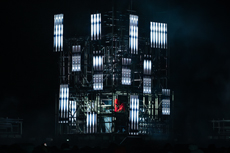
Behind Labrinth's Coachella Production with DX7 and PRGAt Coachella, where spectacle often drives the visual language, the set featuring the British singer, songwriter, and producer Labrinth stood out for its control. Anchored by a central, sculptural structure and framed by four surrounding towers, the design created a cohesive world around the artist. Lighting, video, and architecture worked as a single system, shaping space as much as accenting sound. Nothing felt incidental. Every cue, layer, and moment of stillness was part of a defined visual language. The concept, developed with creative directors Bronski and Amber, of Tawbox, drew from the visual language of space launch infrastructure -- towering forms, structural symmetry, and contained energy building toward release. Influenced by cinematic references and natural phenomena, such as gamma ray bursts, the design balanced scale with precision, creating a world that felt expansive yet tightly controlled. That idea translated into a central "hero" structure surrounded by evenly spaced towers, used as visual pylons. The layout established a clear spatial hierarchy, anchoring Labrinth at the center while allowing his environment to evolve. From there, lighting designer Tom Sutherland, of DX7 Design, focused on sustaining that world over time, not by increasing intensity, but by refining control. "I'm not necessarily always trying to accent every musical cue," Sutherland explains. "I love to start with a scene and then layer element by element on top of that." That philosophy defined the rhythm of the show. Rather than relying on constant movement or high-impact hits, the design established a base environment and built upward. Light was introduced in stages, allowing moments to hold and giving the performance room to breathe. "All the lights going off and on with the beat isn't theatrical," he says. "It's very musical, but it doesn't sustain a space." Instead, the goal was anchoring Labrinth within a visual world that could evolve without losing cohesion. A single backlight, a silhouetted figure, or a graphic composition held just long enough to register became the building blocks of the show. That restraint proved especially effective during standout moments like "Mount Everest," where the design stripped back to just a handful of sources. Using Vari-Lite VLHive fixtures integrated into the tower system, the scene relied on clean alignment with video content and subtle brightness shifts rather than movement. "For the majority of that song, there were four lights on," Sutherland notes. "And that's the thing everybody remembers." The production was supported by PRG, which provided the lighting package under the direction of account executive Burton Tenenbein, working closely with the creative team to realize the show's visual language. Across the rig, a balanced mix of strobes, linear fixtures, and pixel-mapped sources -- including GLP JDC1 strobes, JDC Line 1000, X4 Atoms, and Astera Titan Tubes --provided texture when needed, but always within the logic of the composition. Originally introduced as a practical solution within the tower design, the VLHive fixtures became a defining visual element, bringing a digital, architectural quality to the show. Their ability to function as both light source and graphic surface aligned naturally with Labrinth's layered, cinematic sound. "Everything is very digital, but it tells a story," Sutherland says. "They gave the show a load of extra creativity." That storytelling extended beyond the physical audience. With Coachella's global livestream in mind, the design also accounted for how each moment would translate on camera, balancing subtlety in the room with clarity on screen. "My background is television, so that tends to be at the forefront," Sutherland explains. "When balancing intent between livestream and crowd experience, you do have to consider what's the thing that lives on?" In practice, that meant making real-time adjustments, introducing just enough fill to carry on camera without disrupting the atmosphere in the field, or refining angles so silhouettes read with the intended depth. Despite a condensed rehearsal timeline, the process remained focused and collaborative. Labrinth's trust in the creative team allowed space for refinement, while the clarity of the design ensured each element landed with intention. For Sutherland, the project also marked a return to something more fundamental. "It was nice to have a smaller rig and just go, 'Hang on a minute -- there are four lights on. That looks incredible. Let's do that'." 
|