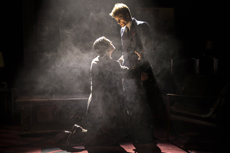
Theatre in Review: Rope (The New Group/Theatre at St. Clement's) Rope is a play loaded with secrets and furnished with psychological closets, and playwright Gordon Greenberg is bent on prying them open and exposing their contents. His rewrite of Patrick Hamilton's venerable thriller makes explicit so many things previously left unsaid that I half-expected somebody to pry open the trunk at center stage, revealing the body of a young man approaching rigor mortis. The theatre, it seems, can't get enough Rope. A London success in 1929, it had an odd career in this country. A modest Broadway performer (under the title Rope's End) in 1929, it was filmed by Alfred Hitchcock in 1948, updated and glossed over with tracking shots lasting for entire reels of film. The 2005 Drama Department revival, directed by David Warren, made a strong case for the play but closed early. More recently, open season has been declared on the original script, now in the public domain: Last season, Jeffrey Hatcher's revision, produced by Hartford Stage, cut a couple of characters and streamlined the three-act structure to an intermission-free 90 minute running time. Greenberg adapts a similar structure and smaller cast list, but he has bigger plans in mind. In all versions, Rope centers on a pair of young, Nietzsche-inspired thrill killers. (Hamilton claimed not to have heard of the Leopold and Loeb case until he began writing Rope; make of that what you will.) In Greenberg's telling, Garrett Stern and Nate Singer, Princeton seniors spending the Christmas holidays in Manhattan, strangle a classmate and stuff the body in a trunk. Their audacious plan involves hosting a small, casual dinner party where the trunk is used as a serving table. It's meant to be an exercise in the will to power, a college prank executed with deadly seriousness; it gives both men an erotic kick. In addition to Americanizing the action, Greenberg moves it to 1957 and explicitly makes Garrett and Nate passionate lovers. Indeed, Garrett's sexual hold keeps Nate, a self-doubting bundle of nerves, under control. Their potted, jejune ideas about Nietzsche are, in fact, rooted in shame: Jewish and gay, they keep their sexuality under wraps and work hard at perfecting WASP-style manners; Garrett, too, hides his relative lack of money. Both are trying to pass in every possible way, and murder is their twisted way of blowing off steam. Greenberg implements other important changes. The sole female character is not the deceased's intended, as Hamilton conceived her, but a madcap socialite who likes hanging out with the boys. And Rupert Cadell, an academic and the young men's philosophical role model, is much more implicated in their crimes than he can bear to admit. Greenberg gets these points across in a series of flashbacks that also reorient the standard view of the characters. Rupert is sexually predatory and given to malicious remarks. Garrett is flagrantly dishonest, keeping secrets from Nate that would most likely destroy their relationship. Greenberg entangles all three men, transforming Rope, a classic thriller with an unusually macabre premise, into something darker and steamier. An atmosphere of corruption hangs over the stage, thicker than the clouds of cigarette smoke that engulf the stage, Often, this sort of revisionist history can destroy a play's fabric; here, it results in a strange but intriguing hybrid. Greenberg's interpolations strike an acrid tone that is sometimes in dialogue with (and sometimes in conflict with) Hamilton's skillful artifice. (Hamilton also wrote Angel Street, aka Gaslight, one of the 1940s blockbuster hits.) Until the final three-way confrontation, the production is fueled less by suspense than by malice and sadistic games-playing. Instead of a satisfying return to order, the play ends in a tableau of ruined lives, with more to come. Most thrillers implicitly endorse conventional morality; Greenberg's Rope remains unremittingly sordid to the last bloody drop. Still, I wasn't bored for a second, thanks in part to a cast with a solid grasp of period style. Cameron Monaghan and Corey Fogelmanis bravely explore the darker, more sadomasochistic aspects of Garrett and Nick's relationship. Monaghan makes Garret slick, alive with anger, and almost frighteningly opportunistic; Fogelmanis stages a slow-burning, evening-long meltdown that is highly convincing. If Jason Butler Harmer flirts with hamminess as Rupert, it is surely because the character is a fraud on many levels, given to role-playing with unseemly zest. Also fine are Elizabeth Gillies as Garrett and Nick's almost-too-perceptive friend, Graham Phillips as an empty-headed classmate who drops by for a drink, and James Waterston as the victim's innocent, increasingly worried father. Working on what must be a fraction of his Broadway budgets, Derek McLane creates a slightly worn, but obviously expensive apartment interior with impressive paintings and a few Danish modern touches. It's a thoughtful and attractive piece of work. Jeff Croiter's lighting creates distinctively noirish looks, pairing cold sidelight coming through the set's windows with incandescent lamplit washes. Catherine Zuber's costumes are meticulously tailored and period accurate. Leah Gelpe's sound design includes several apt musical selections and well-judged effects. The production occasionally suffers from affectations, most notably the characters' tendency to step out of the action to deliver dollops of exposition. They did this last season in The New Group's revival of The Adding Machine, and I wish they'd cut it out. Still, this is a striking attempt at pushing a fairly well-known genre piece into more meaningful territory. If it isn't totally successful, the effort is fascinating. --David Barbour 
|