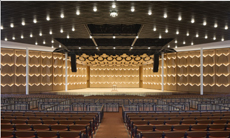
Wenger Corporation Builds Acoustical Shell for Ravinia Festival's Hunter PavilionFirst opened in 1904, Ravinia in Highland Park, Illinois, is North America's longest-running outdoor music festival. Wenger Corporation has contributed to the renovation of the festival's Hunter Pavilion by designing, manufacturing, and installing what Wenger says is the largest, heaviest and one of the most visually striking acoustical shells in the company's history. The Pavilion renovation officially debuted July 11, the first major phase of Ravinia's $75 million "Setting the Stages" campaign. "Ravinia challenged us to create a shell unlike anything Wenger has built before," says Nick Grossmann, acoustics product manager at Wenger Corporation. "Inventive engineering, stringent acoustical requirements and dramatic architectural expression come together beautifully. We are honored to help enhance this historic venue that has been cherished for generations." Each of the two motorized, pivoting walls of the shell weighs 7.5 tons, roughly equal to three Ford F-150 pickup trucks, and is 29 feet tall by 32' wide. Two narrower, non-motorized pivoting walls each weigh 1.75 tons and span 8'. Additional fixed walls bring the total acoustic surface to 5,500 sq. ft., greater than eight standard highway billboards. The giant pivoting walls open and close like a book: the larger pair moves by motorized trolley while the narrower pair is moved manually. They pivot inward for orchestral performances, including the annual summer residency of the Chicago Symphony Orchestra (CSO), and pivot outward for touring shows and rock/pop concerts, when they are masked by black curtains. The shell's distinctive appearance was designed by Michael C. Barnes, AIA, LEED AP, principal architect with Lohan Architecture, who was inspired by the art glass windows of Ravinia's historic Martin Theatre. LED illumination and metallic accents emphasize the varied geometry of the chevron-patterned walls that demanded highly complex fabrication. "Wenger's knowledge of construction materials played a key role in the acoustical shell's success," Barnes says. "The panels needed to be lightweight enough to move, yet substantial enough to reflect sound properly. Wenger understood which materials could meet those requirements." The Pavilion is an open-air venue, so the shell must also withstand extreme weather variations. The walls were built from steel tubing, urethane foam, exterior-grade plywood and a vinyl architectural finish. Construction took nearly a year and transportation required more than 30 semi-truck deliveries. Threshold Acoustics engineered the shell's acoustic performance to improve musical presence for performers and facilitate onstage communication. The shell combines significant mass with reflective lower sections, diffusive upper surfaces and ceiling panels that balance sound and control loudness. "A moving shell only earns its complexity if it serves the sound," says John Strong, principal at Threshold Acoustics. "The pivoting walls and folding ceilings each move easily on command, yet provide the mass and reflection needed for musicians to hear each other clearly and carry sound cleanly to the lawn. Solving that kind of problem is why we keep working with Wenger." The unique winged ceiling panels that fold and store compactly to maximize limited rigging space include Wenger Lieto lights in the fixed center sections; lights remain stage-facing and usable for all programming. "Wenger really has the capability of a specialty shop," says Todd Hensley, director at Schuler Shook Theatre Planners. "They balanced the need for a durable, deployable shell with the acoustician's need for mass and the architect's vision for beauty." Ravinia sought improved flexibility for CSO concerts and touring shows, replacing an aging, difficult-to-move shell. Wenger rigging solutions include PowerLift and Titan hoists in a new configuration redirecting lift lines overhead to improve catwalk operations. Wenger's Vantis controller manages the ceiling panels and other motorized rigging. 
|