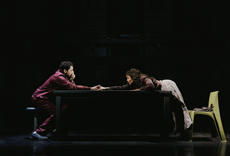
Theatre in Review: The Fear of 13 (James Earl Jones Theatre)Maybe truth really is stranger than fiction: Consider the case of The Fear of 13, a real-life story that, onstage, repeatedly fails to convince. The horrific prison journey of Nick Yarris has been recounted in a memoir and acclaimed documentary film, and perhaps they do a better job of explaining the Dostoyevskian twists and turns that led to his unjust incarceration for more than two decades. Lindsey Ferrentino's dramatic adaptation aims to convey the full sweep of Yarris' history, but it skimps on the crucial points that would ground it in recognizable reality, often failing to provide crucial context as well as emotional engagement and suspense. The devil is in the details, and here the details are often missing. The script, which is top-heavy with exposition, lays out how Yarris, a meth-addicted Philadelphia youth, ends up on Death Row, the result of some catastrophically bad decisions combined with near-fatal misunderstandings. Caught joyriding by the cops, he tries to work a plea deal by pinning a random rape/murder -- he read about it in a newspaper -- on an acquaintance he believes is dead. When it turns out the accused is still alive -- it's his brother who passed -- Yarris is instead charged and convicted for the killing, never mind that he never met the victim. Not helping his case is his decision to take it on the lam while being transported to an appeals hearing. (Even worse, his escape involves a messy tussle with the law.) After a few weeks in hiding, he ends up in Florida, where, attempting to pawn a stolen mink coat (which he boosted from a chic restaurant -- don't ask), he is blackmailed into robbing a coin collector. The plan goes south, and he is quickly rearrested. Waiting to be remanded in Pennsylvania, he gets to know a fellow prisoner named -- wait for it -- Ted Bundy. This picaresque tale of misfortune is conveyed to Jacki Miles, a doctoral candidate in poetry, who visits Nick's prison, acting as a sounding board and possible advocate. She also functions as the audience's interlocutor, offering the comments that are surely running through everyone's mind: "Nick, is all this true??? Why would you run on the way to your own appeal?" Later, she says, "The more ludicrous your stories are, the more I find out they're true." She disbelieves Nick, so we don't have to. Jacki puts her finger on the problem: Nick's story is barely credible, especially as told by the charming figure embodied by Adrien Brody, making a rare theatrical appearance. Damagingly, the play skips many of the key steps on Nick's via dolorosa. We never hear about his withdrawal from drugs, which must have been harrowing, and not nearly enough about his redemptive discovery of literature. ("You've read a thousand books?," Jacki asks, staggered.) The trailer for the documentary, also known as The Fear of 13, notes that Nick received a college education behind bars, something never mentioned here. In any case, Nick and Jacki soon form a two-person book club, debating the relative merits of Lolita and War and Peace. Emotional sparks are struck, despite the obvious barriers. And when stories appear in the news about the transformative effects of DNA technology, Nick sees a chance to be exonerated once and for all. Little does he know that his troubles are just getting started. This is equally true for The Fear of 13, which fails to explicate how Nick's false murder accusation boomerangs on him, leading to his conviction. As he tells the stunned Jacki, no evidence was presented linking him to the crime scene. He signed no confession. "I did share a blood type with the murderer," he allows. "A blood type is meaningless. It ties you to millions, that's all," she replies. Anyone who follows the news knows that miscarriages of justice happen far too often, but more specifics -- and a broader view of the justice system's selective functioning -- are needed for us to understand exactly what happened. Nick's DNA initiative cues the play's most gripping passage, when what should be a simple scientific test is repeatedly derailed by glacial bureaucracy and procedural incompetence. (It should give pause to every audience member; for all his bad behavior, what happened to him could happen to anyone.) Bafflingly, when all appears lost, the case is resolved by the surprise discovery of a heretofore unknown pair of gloves, causing a judge, seemingly on a whim, to order a new DNA test. Apparently, life occasionally comes with a deus ex machina, too. I'm not questioning the factual nature of The Fear of 13, but when life imitates bad fiction, a playwright must work double time to make a case. This is especially true of Nick and Jacki's romance and marriage, which never seems like a good idea -- what would their post-prison life together be like? - and which, anyway, ends in heartbreak. In a moment of direct address, Jacki assures us that she is not one of those sad, prison pen-pal types, but we know so little about her -- she seems to have little or no life outside of her visits to Nick --- that their love affair never acquires any dramatic weight. At other times, The Fear of 13 kills time dwelling on side issues. Trying to give us a sense of prison life, Nick tells the tale of two gay lovers who, after one of them is arrested, conspire to end up in prison together, somehow getting booked into the same cell. In addition to being off-topic, this sequence brings additional credibility problems, although it at least allows Ephraim Sykes, formerly of the musical Ain't Too Proud, the opportunity to deliver The Temptations' hits "I Wish It Would Rain" and "Just My Imagination." An eleventh-hour revelation about a sexual abuse incident in Nick's childhood is certainly upsetting, but no real attempt is made to tie it to the play's dramatic argument. It remains a random incident of trauma. (He is nine when the incident occurs, although his tormentor says he looks thirteen; this is, apparently, the source of the play's title.) David Cromer's direction provides many moments that underline the brutality of prison life, often involving guards who wield their insults and batons with impunity. But, perhaps trying to avoid melodrama, he keeps the most emotional passages on a low boil, and the actors follow his lead. Brody's performance is meticulous and thoughtful but strangely lacking in the gnawing desperation and rage that anyone in his situation might feel; Tessa Thompson is thoroughly professional as Jacki, but she can't transcend her underwritten character. Tellingly, the moment when Nick and Jacki reach their decisive moment should be wrenching, but it passes without much impact. Arnulfo Maldonado's set design, featuring towering black walls at left and right and, upstage, several tiers of cells, is appropriately tomb-like; oddly, he includes a pair of detailed inserts, depicting a pawnshop and Jacki's living room, which feel out of place in this otherwise stark conception. Heather Gilbert's lighting goes a long way to keeping the action fluid as it moves between locations and time frames. Sarah Laux's costumes, necessarily heavy on prison and police uniforms, are solid. Lee Kinney's atmospheric sound design does the most to suggest the tenor of life behind bars. Nick Yarris' story should be told, not least for the appalling light it casts on a legal system that is administered differently depending on one's class and financial status. Still, one wishes the point could be made more forcefully and with a greater understanding of its social context. It's no spoiler to report that The Fear of 13 ends with the satisfactory resolution of Nick's case. (The advertising outside the theatre suggests as much.) But it's hard not to feel that the more compelling drama starts just when the play is ending. Following his decades-long nightmare, how does he adapt to life on the outside? What happens to a man in his forties who has never held a job, owned a bank account, or had a social life? Somebody ought to write a play about that. --David Barbour 
|