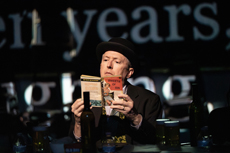
Theatre in Review: Ulysses (Elevator Repair Service/The Public Theater) At the beginning of Elevator Repair Service's latest piece, presented as part of the Under the Radar Festival, Scott Shepherd enters and says, "Hello, and welcome to Ulysses. Get ready." Ready for what? In this case, the actors are more challenged than the audience. What follows is less James Joyce's novel than the spectacle of this theatre troupe wrestling with it. Guess who wins. Elevator Repair Service has long conducted a great-books seminar, offering stylized theatrical takes on William Faulkner's The Sound and the Fury and Ernest Hemingway's The Sun Also Rises, among others. Each has been more memorable for bits of stage business than for having anything incisive to say about their source materials. Arguably, the company's most famous offering, Gatz, features the entirety of F. Scott Fitzgerald's The Great Gatsby, puzzlingly delivered by actors on a set that looked like a construction-project shed furnished with office machines from the 1980s. (Thanks to Shepherd's gorgeous reading of certain passages, at times, it conveyed some of the novel's power. But still.) It's one thing to take on relatively slim works like Gatsby or The Sun Also Rises; to tackle the epically long and sometimes impenetrable Ulysses suggests a level of megalomania not seen since Captain Ahab was dispatched to the vasty deep. But Elevator Repair Service is not alone: Time and again, Joyce's work has been wrangled for the stage. A half-century ago, Zero Mostel had dual triumphs, on and Off Broadway, with Ulysses in Nighttown. More recently, the Irish Repertory Theatre presented Yes! Reflections of Molly Bloom, featuring Aedin Moloney fluently delivering Ulysses' famous final monologue. Anthony Burgess' novel Earthly Powers (which I cannot recommend enough) features excerpts, with samplings of lyrics, from a fictitious Broadway musical, Blooms of Dublin. The passage reads like an audition, and for good reason: a couple of years later, he debuted Blooms of Dublin, for which he provided words and music, on Irish radio. It has languished in obscurity ever since. A targeted approach may be best: The Nighttown sequence is written like a play, and Molly's speech has the makings of a juicy one-act. Earlier this season, the Irish Arts Center presented The United States vs. Ulysses, which focused on the famous censorship trial that brought the book to the US but also dramatized bits of the Nighttown sequence. Interestingly, this fragmented approach, contrasted with the legal shenanigans of the main action, strongly suggested that, rather than anything sexually explicit, what early readers must have found so upsetting was the book's stream-of-consciousness point of view, which rendered, almost too faithfully, the chaotic, weirdly associative ways our minds usually work. In contrast, the Elevator Repair Service approach, co-directed by John Collins and Shepherd, is to dip in and out of the book, offering up a series of arbitrarily chosen passages, linked by fast-forward sequences featuring rapidly scrolling text and the sound of a tape recorder in overdrive. (The main focus is the triangle of Leopold Bloom, his unfaithful wife Molly, and her lover Blazes Boylan, with the frustrated litterateur Stephen Dedalus weaving in and out of the action.) It's a hit-or-miss approach: Some actors finesse Joyce's alternately terse and clotted prose; others have little facility with it. While one needn't necessarily expect a brace of brogues, there is virtually no sense of Irishness, and even less of the polite manners of 1904 Dublin, which contrast starkly with the characters' rampaging inner lives. It's all about watching these actors wrestling with this supremely difficult text, a modernist take on modernist literature: self-referential, sometimes too cute, and often remarkably literal-minded. The latter quality is the most evident. The actors are seated at a long table outfitted with papers, looking like attendees at an academic conference. (The set is by the design collective dots.) When we are told, "Stephen handed him the key. Buck Mulligan laid it across his heaped clothes. And twopence," they pass those objects among themselves, a needless bit of illustration. When it is reported that Mr. Deasy, the ranting, antisemitic schoolmaster, "raised his forefinger and beat the air oldly before his voice spoke," the actor Vin Knight waves his hand and makes faces suggestive of an oncoming seizure. Bloom's arrival at Burton's restaurant for lunch features the cast frantically gorging themselves and licking their plates like starved prisoners. Shepherd -- admittedly solid in several roles, including the "stately, plump" Buck Mulligan (one of the great literary descriptions) -- impersonates Blazes with a weird bandy-legged lope seemingly borrowed from the Ministry of Silly Walks. Shepherd does make a debonair narrator, helping to clear things up from time to time. Christopher Rashee-Stevenson is a solid Stephen Dedalus, bonding with Bloom in the bawdy houses of Nighttown and cringing in fear at the sight of his dead mother (a scene right out of an old Hammer horror film). Knight is a fine Bloom, a perennial sad sack making his way through the crowded streets of Dublin, grappling with loss and unfulfilled desire: an adulterous spouse, an absent daughter, and a pen-pal mistress who never delivers. The women are much less impressive. Stephanie Weeks grossly overplays as Martha, Bloom's erotic correspondent, making her squeal and tease like the Irish Jayne Mansfield. Maggie Hoffman rushes through Molly's climactic aria, offering a version utterly free of nuance and untouched by bawdy wit. On the design side, Enver Chakartash's costumes are solid enough, although I'm unsure why Rashee-Stevenson is in shorts, and Knight is in a skirt. (Is it because Bloom is a cuckold?) Marika Kent provides some attractive lighting looks, including some strong color washes (red for Nighttown, naturally) and a beautifully carved-out tableau for Molly's solo spot. Matthew Deinhart's projections include the novel's text, a clock on the upstage wall, and most importantly, a street map of Dublin. The production is a symphony of sound effects, skillfully rendered by Ben Williams; his work is outstanding, with one reservation: The use of reverb, especially in the Nighttown sequence, does nothing for the actors' intelligibility. Elevator Repair Service has been around long enough to have a following, and its work is admired by many. Some of its non-Book-of-the-Month-Club offerings, such as Baldwin and Buckley at Cambridge, a recreation of the famous debate, have been very good. (It is also responsible for Fondly, Collette Richland, which caused the most massive audience walkout of my half-century of theatergoing.) Even when things go awry, they are skilled artists, but they are no match for the mandarin, willful, authoritative James Joyce, whose novel continues to fascinate and confound a century after its publication. --David Barbour 
|