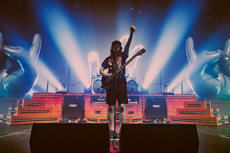
ChamSys Helps Gregory "Gru" Dutein Keep Pace with Ultra VomitDesigner and programmer Gregory "Gru" Dutein, from Chirac Design, has been reflecting the French metal band Ultra Vomit's multi-faceted music and stage persona in light since 2017. "An Ultra Vomit show should be seen as a true burlesque performance," he says. "Each song is essentially a tribute to a specific style or artist from the metal, hardcore, punk, or even mainstream scene. Visually, every track has a very distinct identity, reflecting the codes of the style being parodied. At the same time, the show remains very "alive," with constant improvisation and audience interaction. That's why I always keep live faders ready." Although the band plays to a click track with some pre-programmed sequences, Dutein runs the lighting manually without timecode. He explains that he does this to preserve an organic feel. Doing so requires maintaining tight synchronization between lighting, video, and music. To help him, Dutein relies on his ChamSys MagicQ MQ70 Compact console. "We actually started with a ChamSys MQ80, but we were immediately drawn to its compactness and efficiency," he explains. That philosophy still holds true today -- the MQ70 remains a powerful, reliable, and tour-friendly solution." There are many reasons why Dutein is so devoted to his console. First is the matter of time savings. He values the fan mode (no toggle), switch, which, when combined with Sub select Pair, allows X-axis positioning. There is also the offset patch, which is essential for fast position programming, and the expand palette, which he "uses constantly." Dutein organizes his show files carefully to account for his client's fast-paced shows. In his first layer, all groups and patterns are organized vertically with a clear hierarchy (for example, spots, spot back, spot front), using color tags in the patch for clarity. Layer two is the programming layer, with extended group views and color/beam patterns. The third layer is divided into four sections: 1. The top left is devoted to song pages for instant access. 2. The bottom left covers the main cues stack. 3. The top right is the execute page. 4. The bottom right is the full group master access. Dutein also maintains a dedicated programming page to test rigs and rebuild presets quickly, again using playback. "All of these features allow me to adapt very quickly to different rigs, whether in venues or festivals," he says. 
|