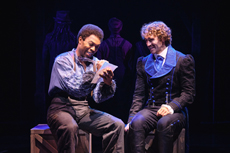
Theatre in Review: Midnight (Daryl Roth Theatre) Credit where it's due: For his first original stage vehicle, the multi-hyphenate Todrick Hall could have taken the lazy-artist's route, ginning up a jukebox musical or a glorified concert -- which might have pleased his millions of online fans. Instead, he created Midnight, easily one of the most ambitious musicals of this season. But writing the book, music, and lyrics for Midnight, and directing, choreographing, and starring in it, he hasn't just bitten off more than he can chew; he nearly asphyxiates himself. He is also the lead producer of this fascinating misfire, which is packed with talent (not least a creative production design). But it makes too many points, too loudly and often all at once, and it struggles to sort minor details from significant revelations. It also hinges on a huge twist that delivers less than it promises. Hall stars as Rail, born a slave in the Deep South under horrendous circumstances that involve the murder of his parents. In the early 1860s, he is taken up by young, wealthy Richard, who is building a plantation along highly unusual lines (more about that in a minute). Brought in as a laborer, Rail becomes Richard's invaluable right hand. A clear affection grows between them, a perilous development for the obvious reasons. Also, Richard is engaged to Scarlet, a brainless Southern belle raised only to bag a rich husband, and Rail is partnered with Lily Rose, who is carrying his child. After the briefest hesitation, however, the men are meeting clandestinely at midnight. In musical theatre terms: They kiss in a shadow; they hide from the moon. This is more than enough plot for a full-length musical of considerable seriousness. (It's interesting how Midnight and Broadway's Wanted opened so close together, signifying an eagerness to tackle slavery and its aftermath in a musical-theatre format.) But the first act is packed with questionable developments. Rail and Richard meet when the former behaves insultingly while serving at a social event. It's kind of behavior that would, in that place and time, automatically cue a whipping; instead, it leads to male bonding. The Rail-Richard affair progresses with unseemly speed; astonishingly, neither character fully grapples with the sheer number of taboos being broken. (In one bizarre sequence, the men jump into a body of water fully clothed; this is especially strange because Rail is wearing his deeply prized shoes.) When Lily Rose announces her pregnancy, nobody is more surprised than the audience, since she and Raily have barely had any contact. Also, as the action moves from 1863 to 1865, one wonders: Why isn't Richard in the rebel army? Why does nobody ever mention the war? Or the Emancipation Proclamation? Since Richard's circle of friends and family consists entirely of racists and slaveholders, does nobody have any thoughts about his plan to build "a new house integrated"? (Scarlet demurs but is quickly ignored.) The later scenes take place only days before the war's end; do none of the white characters notice that things aren't going their way? In the musical's boldest gesture, the second act begins with the white and black characters changing places: Suddenly, Richard is the slave, and Rail is in charge. Lily Rose is the lady of the house, and Scarlet is a slave. This condition is temporary, set to expire at midnight on the day it happens. It's a daring idea, to say the least, but I'm not clear that it does much beyond adding to the onstage confusion. And confusion abounds: Midnight, which is through-composed, is overloaded with exposition, much of it delivered in large gobs by a trio of narrators or a busy, busy chorus, often backed up by even busier dancers. It's an exercise in sensory overload, exacerbated by shatteringly high sound levels. Sound designer Lawrence Schober, whose work on Titanique was a model of intelligibility, is hampered by overbearing orchestrations and too many numbers cranked up to finale level. Here's a small, but telling, example: The trio of narrators sings, "Two households, both alike in indignity," a twist on the opening of Romeo and Juliet. Clever, but I heard Shakespeare's version ("alike in dignity") because the music (and the actors' delivery) was too overpowering for such a subtle distinction. It's an example of the writer-composer undermining himself, and, applied to larger matters, it makes Midnight hard to follow. When it is allowed to pause and take a breath, the score yields some lovely things. In "The Dancing One," Ethel, Rail's maternal figure (Ayana George, effortlessly owning the stage), carefully intimates why this young man is different. "More Than a House" is an extended musical sequence tracking Richard's building project and his growing friendship with Rail while keeping tabs on several other characters. "A Rose" is Lily Rose's sad admission that in matters of love she is the odd woman out. Hall is a solid-enough leading man, but Rail is oddly passive and hard to know; surprisingly, he lacks an establishing song. As Richard, Jeremy Beloate, a former contestant on The Voice has a nice presence, fine voice, and ardent manner; the script does him no favors, however, giving him so many anachronistic lines, for example, singing about being "on the wrong side of history" or telling Rail, "Let me take you on a date." ("What's a date?" asks Rail, an excellent question when posed roughly concurrent with the Battle of Gettysburg.) Charlotte Odusanya is touching as Lily Rose, as is Kolbi Jordan as Happy, Lily Rose's friend, who scorns Rail but struggles with a same-sex attraction of her own. The rest of the cast is solid, pouring alarming energy into everything they do. In Morgan Large's striking scenic design, a giant clock face hovers over the action, surrounded by a dozen mannequins that lower in so the company can suit up during the opening number. Those costumes, designed by Beck Jones, draw a strong contrast between the freed characters and slaves; in keeping with the second-act reversal, several characters don attention-getting black-and-white finery. Jake DeGroot's complex, mood-shifting lighting design takes in shadow play, lightning effects, strobes, ballyhoos, and strongly articulated sidelight looks. There's never a dull moment in Midnight, but there are plenty of muddled, overwrought ones. It has something but desperately needs cutting and clarifying. To his credit, Hall doesn't try to gloss over matters with a fake, ahistorical happy ending. But he does allow a strangely irresolute finale that includes a lecture updating us on 150 years of racial and gay progress. And when the company sings, "One day, twenty-four hours as each other/Black and white is now in color/Is my enemy my brother?/You changed me," you'll have to take their word for it. --David Barbour 
|