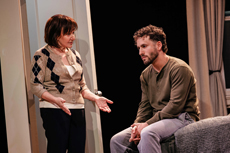
Theatre in Review: Aftermath (A.R.T. New York/Mezzanine Theatre) An entire flock of chickens comes home to roost in Aftermath, a bombshell-packed family drama plagued by rookie errors. Playwright David Zax, a journalist with a couple of film and television projects in development, offers compelling points about America's disastrous post 9/11 occupation of Afghanistan, but he is still mastering playwrighting basics. His dramatic construction, if old-fashioned, is potentially satisfying, but it wants smoother execution. Its carpentry is often glaringly obvious. It keeps reminding one of other, better well-made plays. The trouble-plagued protagonist, Josh Goldman, is a journalist who, only in his late twenties, has racked up impressive clips (The Nation, The Atlantic, Rolling Stone). But he is back in the Kalorama bedroom of his youth, having escaped a gang of Taliban kidnappers while reporting in Kabul. (It is 2011, and the US occupation of Afghanistan has dragged on, pointlessly, into the Obama Administration.) Josh's parents, Allan and Linda, are frantic about their son and desperate not to show it. Linda, the kind of woman who would reorganize her kitchen on the planet's last day, has worked out a ten-week recovery plan with Josh's therapist, designed to keep him safe from "potential triggers." She adds, like a mantra, "Kidnapping -- it's a Category A trauma in the DSM-IV." Linda had better get ready because the triggers are aimed and ready to fire. She and Allan worry that Josh is growing a beard -- to them, a sure sign he wants to return to Afghanistan. Adding to their dismay is an unexpected houseguest: Mina, a Guardian reporter, whose beloved cousin, Josh's translator, was killed on the same assignment that left Josh a hostage. Josh also has a thing for Mina, who isn't exactly indifferent, either, but she is on a mission to find out how her cousin died. Meanwhile, Allan insists to Linda that the time is nigh to "tell him the whole story, our side of it." As it happens, everyone is busy keeping secrets from everyone else, leading to revelations dropping with the steady pace of an IV drip. The first big twist, delivered by Allan, is good enough to shake up the play, casting Josh's escape from his kidnappers in an upsettingly new light and forcing him to rethink his relationship to the parents he dismisses as too rich and cocooned to understand the poverty and chaos he has witnessed. (Allan, once a civil rights activist, has made millions lobbying for agribusiness, making him a less-than-ideal role model; Linda has a thing for fifty-thousand-dollar rugs.) But Allan doesn't tell Josh the whole story, Linda is hiding something enormous from Allan and Josh, and Josh is nurturing a secret that is eating him alive. The characters struggle to keep their heads above this flood of breaking news; this is especially true of Josh, whose anguished, eleventh-hour confession has little to do with the character we've seen for the previous ninety minutes. It's a case of overkill: One big shocker is fine, and two are often acceptable. But too many twists push the drama into sudser territory, causing snickers in the audience at the performance I attended. Zax's dialogue is literate -- evoking Silvio Berlusconi, John Ashcroft, and the Australian utilitarian philosopher Peter Singer, the latter a major influence on Josh's thinking - and his concerns are vital. In more confident hands, this tale of a distant war's effect on an American family might illuminate how the Bush Administration's misadventure set the stage for today's appalling politics. But the script's contrivances are too blatant, its characters too subservient to the plot. It's also unfortunate that Aftermath has opened so close to the Broadway revival of Other Desert Cities, which, whatever one thinks about the current production, brilliantly details an entitled family imploding in the shadow of foreign wars. Colton Pometta's direction is solid enough without papering over the script's weaknesses. At least he has the great Steven Skybell as Allan, percolating with suppressed fury over a life spent making money in a job he loathes; his confrontations with Danny Kornfeld's Josh (a tormented soul given to lecturing others as a way of avoiding his own guilt) provide most of the production's crackle. (Their relationship -- bitter, wage-slave parent versus rebellious, mixed-up son -- has a faint Death of a Salesman vibe, a comparison that does Aftermath no favors.) Jill Stern and Awesta Zarif both feel a little stiff, perhaps because of the large gobs of exposition they are required to disburse. It's unusual to see an Off-Off-Broadway production looking so slick, but Chen-Wei Liao's two-level set design testifies to Allan and Linda's well-heeled existence. Lucrecia Briceno's lighting and Rayya Gracy's costumes add to the atmosphere of understated wealth. It's mind-boggling that, in a theatre with a maximum capacity of 149, actors should be miked, but that's today's theatre, I guess. Anyway, Stan Mathabane's reinforcement is discreet, and his effects, including Afghani music, birdsong, and a Weekend Edition broadcast, are all well done. Also, any designer who chooses Bill Evans' "Waltz for Debby" for preshow music is all right by me. But Aftermath delivers more than its promises. Where it cries out for nuance and psychological acuity, it piles on the twists. It's a dramatic contraption that sometimes works, but sometimes sputters and coughs. --David Barbour 
|