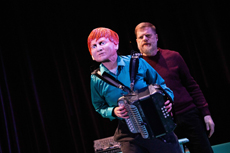
Theatre in Review: Bellow (Irish Arts Center/Under the Radar) Bellow is a tricky one, all right. Ostensibly a celebration of Irish folk music, as played on the accordion by the musician Danny O'Mahony, it is, apparently, exactly the kind of show one expects from the Irish Arts Center -- charming, folkloric, a cultural celebration. But before you descend into a warm bath of nostalgia for the Auld Sod, look again: This production of the Dublin-based theatre company Brokentalkers, presented as part of the Under the Radar festival, is a self-conscious look at the process of constructing a theatre piece on the above subject. As it happens, that isn't as easy as it sounds. The piece begins with the amusing, odd-couple pairing of O'Mahony and theatre artist Feidlim Cannon. (The two men wrote Bellow with Gary Keegan.) O'Mahony, who eventually wears a sign saying "Tradition is the Future," hardly seems ideally paired with Cannon, who, we are told, "deconstructed Brian Friel's Philadelphia Here I Come...At certain moments in his piece, Feidlim ripped out the pages from the playbook, ate the pages, and vomited onstage." Well, that's one approach to the oeuvre of Brian Friel. For his part, Cannon worries that too much of the staging involves O'Mahony sitting in a chair, telling his story. "It's unoriginal. Done to death," Cannon complains. "What's wrong with sitting in a chair, telling a story?" wonders O'Mahony. "It works. If it didn't, it probably wouldn't have become a tradition." He's run circles around you logically, Feidlim. Frustrated and looking to change things up, Cannon tries to drag the phlegmatic O'Mahony into experimenting with theatre games. Whether taking part in free-association exercises or imagining the contents of an imaginary box, this idea is a nonstarter, especially when acted out in front of the paying patrons. "Performer is performing," Cannon argues, adding, slightly defensively, "I know you're very used to being in front of a very large audience." "Usually bigger than this," O'Mahony says, looking out and dolefully counting the house. All this creative wrangling provides plenty of droll, deadpan fun, but even in these early passages, there are hints of something darker. "The accordion is a heavy instrument, and it requires strength, particularly on the left-hand side, to push and pull the bellows," Cannon notes. "Whereas, on the right-hand side, that is where O'Mahony needs the dexterity and speed. So, in his musical life, this imbalance has its benefits, but in his day-to-day life, it can be challenging." O'Mahony adds, "It's an excellent way to design an accordion player, just not a person." Thus, the brief yet bountiful Bellows runs along two tracks, detailing Cannon's attempts at innovatively showcasing O'Mahony's story while revealing the price O'Mahony has paid to serve his muse. To be sure, the script could be clearer about some of the details, including O'Mahony's exploitative relationship with a manager of sorts known in the script as "The Wedge;" his fraught relationship with his parents, which includes running away from home; and a maniacal devotion to his career, expressed in a frantic, nonstop touring schedule that brings him to the edge of physical and psychological ruin. Much of this information comes out following the introduction of the dancer Emily Kilkenny Roddy, whose kindly, yet probing, investigation into O'Mahony's past proves especially fruitful. Among other things, it yields the image of him as a young boy, already an accordion prodigy, ensconced in a noisy, smoky pub with a roomful of aging musicians, soaking up the tradition that will be his north star. Roddy extracts from him a vivid account of what music-making feels like: "I have this internal rattling...It's like an engine running. It's a bit unsettling. The vibration I feel from the instrument chimes with that. Settles that. So it's like me and the box are one. I need it." At the same time, he feels "the weight of tradition, the weight of expectancy, of responsibility. To my community. To the past generation. The current one. To the future generation." As Roddy notes, that load is enough to make a strong man buckle. O'Mahony's conversation with Roddy cues a remarkable movement sequence that conveys both the agony and ecstasy of his art; later, Roddy, in a mask, will stand in for young O'Mahony in scenes that reveal how the accordion became as central to his life as his beating heart. Even as we learn about the crack-up that nearly destroyed him, both O'Mahony and Roddy are moved to ponder the day when neither of them can physically pursue the work they crave. The clock is ticking, and, sooner or later, a lurking emptiness must be faced. For a show running less than ninety minutes, Bellow contains multitudes, not least when Cannon lays out the long provenance of a tune played by O'Mahony, passed down through several generations of his family, or when O'Mahony details the history of each of his accordions. In this paradoxical piece, new-style storytelling collides with the burden of history in the story of a man whose life is sustained and tormented by the weight of the past. It's such a nifty trick that you might not immediately notice how deftly it has been pulled off. Bellow, the direction of which is credited to Brokentalkers, rarely, if ever, puts a foot wrong. Cannon amusingly spoofs the pretensions of his creative ilk, who can never leave a good piece of material alone without "improving" it; Roddy provides a fine counterbalance, speaking with touching realism about the coming end of her career, even as she dances with remarkable skill and emotional urgency. O'Mahony's modest, throwaway manner is always compelling, and it goes without saying that his musicianship borders on the celestial. In this country, we often think of the accordion as a glittering piece of kitsch; in O'Mahony's hands, it is an instrument of the soul. Sabine Dargent's simple set design provides a display case for the several accordions used during the show. Valgeir Sigurosson provides some contrasting electronic compositions as well as well-rendered voiceover sequences. The most striking design element is Sarah Jane Shiels' lighting, which unobtrusively yet authoritatively shifts the mood onstage. There's a lot to like about Bellow, but the thing you are most likely to remember is the sound of O'Mahony's playing; it's sweet and sad, and it carries an ache that signals a universe of sorrows. He pours everything of himself into his music, and it's a privilege to hear it. --David Barbour 
|