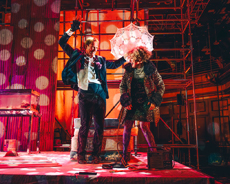
Theatre in Review: Delirium (Arlekin Players Theatre at The Space at Irondale)Delirium is Eugene Ionesco's end-of-the-world party, a battle of the sexes staged against a background of catastrophic war. It is adapted -- how faithfully, I cannot say -- by the director, Igor Golyak, from Frenzy for Two, a work so obscure that only a few weeks ago I was unaware of its existence. Then again, there may be a reason for that: The playwright has hardly gone out of fashion, a fact demonstrated by the recent high-profile revival of Rhinoceros at American Repertory Theatre and a current Off-Off-Broadway staging of The Bald Soprano with a notably fine cast. But Delirium, at least in this version, feels copied out of some absurdist theatre guidebook. It has the form of the great postwar absurdist works but not the spark of mad genius. The air it breathes is slightly stale. The characters, known only as He and She, are holed up in a tumbledown apartment, locked in seemingly endless rounds of slapstick conflict. He seduced her away from rural married life seventeen years earlier, and it's putting it mildly to say that the bloom is off the rose. Outside their building, the world is on a glide path to hell, thanks to gunfire, bombs, and the sounds of innocents being abducted by the authorities. He first arrives in a barrage of audio chaos: radio broadcasts, air raid sirens, bits of Swan Lake, car alarms, and explosions. He hurls himself onto a pile of mattresses, only to discover her nestled among them. It's a princess-and-the-pea moment in reverse, and it's a sure sign of the craziness to come. Indeed, he, in his ratty, dusty suit, his hair askew in various directions, and she, in her tacky leopard coat, sporting a blonde wig that suggests a cross between Dolly Parton and Medusa, constitute a mixed-gender version of Beckett's Didi and Gogo, frittering away their lives while darkness closes in around them. Finding her comatose, he tries mouth-to-mouth resuscitation, which makes her legs kick wildly. Frustrated, he pulls out a pair of jumper cables, hoping to shock her into consciousness. Soon she is up and about. They make comic use of a door, staging various breaking-and-entering scenarios, and a window frame, which, stepped into, instantly becomes a boxing ring. When all else fails, the radio produces a Latin tune, and it's time to mambo. Everything onstage is up for grabs: A Styrofoam head becomes, in succession, the Venus de Milo, a telephone, and a piece of cheese. Golyak and his cast insistently dole out bits of business that match the text's decided lack of logic. But Delirium has two big problems, each of which feels insurmountable. The stars, Andrey Burkovskiy and Chulpan Khamatova, are, by any standard, remarkable. Their commitment is irrefutable, their physical dexterity exemplary. He is unafraid of humiliation, whether grabbing fistfuls of food fish while feeding the denizens of an aquarium or spitting out a mouthful of teeth after a knock-down-drag-out fight. She proves her mastery of the spit take and the old invisible staircase routine, in which, standing behind the door, she appears to be headed downstairs by dropping her knees as she walks. The sight of the pair, having fled the stage, pinned against the auditorium wall, trapped in a hard-edged white spotlight, looking like prisoners on the run, is an indelible image of the nameless fears lurking under all this roistering about. But for all their accomplishments, neither performer is a clown; they dutifully, efficiently execute whatever whimsical stage business is required, and they inflate their characters' emotions to the point of absurdity, rather like blowing up balloons, yet the laughs don't come. Is it because we have seen many of these bits before? Is it because the juxtaposition of such hijinks with bursts of wartime violence in the streets seems too obvious? Or is it that the language is so wearily, insistently nonsensical? Consider the following passage: "A turtle is a snail that doesn't show its horns. What does a turtle eat? Lettuce. So does a snail. So, it's the same animal. Tell me what you eat, and I'll tell you who you are." One can only listen to this for a very, very short time before ennui sets in. The production has plenty to admire, including Jan Pappelbaum's set, a rickety, rattletrap contraption, made of scaffolding and corrugated metal, that feels ready to fall apart long before destruction comes. Jeff Adelberg's lighting switches moods with manic glee, clinical one moment, then filled with tatty colors and movement the next. Denis Zabiyaka's's sound design is a protean achievement, with an effect for every occasion. Sasha Ageeva's costumes have the unmistakable look of outfits worn for too many days in a row. In the current climate of pointless wars and nonsense-spouting politicians, we should be primed for works like Delirium. Somehow, however, it fails to resonate. For all the talent expended on this production, it feels like a faded bulletin from another era. Its laughter and its terrors are surprisingly muted. --David Barbour 
|