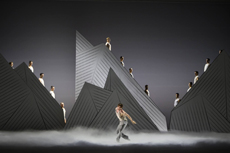
Samuel Thery Shapes Dance at Les Ballets de Monte Carlo with Elation's Paragon Platform For Samuel Thery, lighting manager and tour technical manager for Les Ballets de Monte Carlo, light is a subtle storytelling tool, one that demands precision, consistency, and restraint. This philosophy has shaped Thery's work throughout his 17 years with the company and is why Les Ballets de Monte Carlo recently adopted Elation's complete Paragon platform across its productions. Based in Monaco and performing throughout the year on stages around the world, the classical ballet company is renowned for its contemporary repertoire under artistic director and choreographer Jean-Christophe Maillot. "Lighting for dance is very different from lighting a concert," explains Thery, who previously worked in concert touring. "On a concert tour, you have the artist's show, and then you have the lighting show. In ballet, there is no lighting show. It's more minimalistic. We don't want people to notice the fixtures or see beams moving around the stage. The purpose of the light is to direct the audience's attention to a particular action or something onstage, a dancer or dancers. You may have 50 dancers on stage, but for the audience you need to tell them, 'Look here. This moment is important'." The company uses a remarkably compact lighting package. "Our current production uses about 50 moving lights and some conventional fixtures, but everything fits into one truck," says Thery. "That means every moving light has to do many different jobs. "I use movement, but it's very subtle," he adds. "Sometimes it's simply following a dancer or slowly moving a shutter to follow the action. During a pas de deux [dance duet], for example, I can even use the fixture as a followspot. The audience shouldn't notice the movement; they should simply feel that the light is supporting the dance." The need for versatility drew Thery to the Paragon. "I can do so many different things with one fixture," he says.. "Sometimes I need a wash, sometimes a profile with shutters, or a lot of gobos on stage. I can use the same fixture as a spot or as a wash and switch back and forth very easily." Today the ballet uses 24 Paragon S, 28 Paragon M, and 14 Paragon LT fixtures, along with eight Artiste Rembrandt luminaires. The fixtures, rented through Dushow since December 2025, have replaced an earlier Elation rig consisting of Elation Fuze Series fixtures. The three Paragon models work together as a single creative platform to bring consistency to every production. "Having the S, M, and LT is a huge advantage," Thery says. "Everything is consistent -- the color, the shutters, the beam quality -- which is very convenient. It's very fast to make everything precise, and it's easy to copy from one fixture to another. That saves me a lot of time." That consistency is especially valuable during rehearsal, when there is limited stage time to fine-tune the lighting. "The stage is for the dancers, so we may only have a few hours here and there, so I need to make lots of adjustments very quickly. Being able to copy settings between Paragon fixtures makes that much easier. "I use the S model for many things," says Thery. "For me it's like a 2K Fresnel or PC fixture. The M is like a powerful backlight or something similar, and the LT is more like a large profile. I love the LT because it's like having a 5K Fresnel, and for me it opens up a lot of possibilities. "On our last production, the stage was 22m [72.1'] wide and 19m [62.3'] deep with very high trim heights," he explains. "The LT was perfect for the front because it has the power I need. When you close the zoom, it becomes incredibly bright." Thery says that moving from conventional fixtures to moving lights can be a difficult transition in ballet because choreographers often prefer a certain lamp or a certain color. "They know exactly how conventional fixtures look, so it's not always easy to replace them," he explains. "It's hard to find that same look in a moving light, but Paragon helped bridge that gap. I was able to change step by step. Now some of our latest productions use only moving lights on stage. It's unique. That would have been very difficult before." Also, Thery says, "The choreographers are so happy now because the fixtures are so quiet. Before, you always knew when the lamps turned on. Now we hear almost nothing. And if I need complete silence, I can simply change the fan mode. That's very important for solos or pas de deux without music." While touring in Costa Mesa, California, he visited Elation headquarters, where he spent time discussing optical requirements with Eric Loader, Elation's global vice president of sales and marketing. "We talked a lot about the different frosts I needed, and he came to see the production," Thery recalls. "One challenge unique to ballet is creating frost effects that completely soften and even eliminate projected gobos when required. That requires a heavy frost that isn't easy to find in a moving light. After seeing the production, Eric understood our needs, and I can see that reflected in the Paragon." 
|