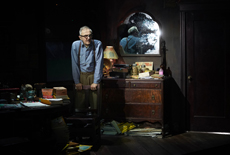
Theatre in Review: Bughouse (Vineyard Theatre)Bughouse resurrects the strange case of Henry Darger, janitor, recluse, and, in the opinion of many, one of the all-time great outsider artists. Darger lived a marginal, almost friendless, existence in and around Chicago, yet, after he died in 1973 at the age of 81, his landlord discovered an extensive oeuvre that included a novel running to 15,145 pages (among other literary efforts) and hundreds of illustrations. One can only speculate what a man who, with few exceptions, could barely relate to others, would make of what came next: the critical acclaim, six-figure auction prices, and Natalie Merchant, Anna Sui, and John Ashbery all claiming his influence. Darger is also the subject of a fascinating 2004 documentary, In the Realm of the Unreal, which details a childhood that would give Charles Dickens the willies: Darger's mother died heartbreakingly young, his sister was given up for adoption (disappearing from his life), and he was left to care for his disabled father. "The bed was large enough for both father and I," he says in Bughouse, offering one of many worrying details. A loner and a magnet for bullies, young Darger was sent to an asylum and branded "feeble-minded." As an adult, he worked in a series of jobs, washing dishes and cleaning, mostly in hospitals. He also formed a single sustaining friendship with William Schloeder, an immigrant from Luxembourg. He dreamed of adopting children, but you can imagine what the authorities thought of that idea. In Bughouse, the aging Darger, holed up in a rented room, takes us on a tour of his life and obsessions. Playwright Beth Henley, who, in her previous works, has shown she knows a thing or two about mental illness, has constructed a kind of fantasia, essentially arguing that trauma is his muse: The lingering agony over his sister fuels his writings, in which young girls lead armies into battle against evil forces. Quite possibly a homosexual, he is tormented by this relationship to the Roman Catholic Church: "In my younger days," he says. "I forgot to mention [that] when angry over something, I burned holy pictures and hit the face of Christ in pictures with my fist." Later, he develops a feverish routine: "Read Bible every evening, say seven rosaries every day, three litanies per day, offer novena prayers every day, and receive Holy Communion every Sunday." And yet he rails against God for not answering his prayers. Meanwhile, he is driven by visions, which may be what attracted Martha Clarke, who conceived and directed the production. Neil Patel's effectively seedy scenic design, supported by Faye Armon-Troncoso's cornucopia of props -- check out the books in the fireplace -- is also a vehicle for John Narun's projection design. The windows, a large mirror, indeed the entire set take images of birds, flowers, storms, historical footage of Chicago street life, Elsie Paroubek (the murdered girl whose case haunted him), and drawings of the Vivian Girls, the militant heroines of his fiction. Bughouse is a strangely conventional piece for such a bizarre subject; it's a cross between the sort of notable-person-of-history solo show that has been with us since The Belle of Amherst and the bitter fulminations of Krapp's Last Tape. It's a compact evening, and, I fear, if you don't know anything about Darger, a confusing one. In the Realm of the Unreal, a much more sympathetic portrait of the artist, emphasizes the wild fertility of his imagination; with all its theatrical effects, Bughouse remains a largely outside view; it risks pathologizing him, reducing his weirdly original art to decor, and his story to an unsurprising essay on the corrosive effects of loneliness. As Darger, John Kelly stalks the stage, shouting to God, falling to his knees, tapping away at this typewriter, and reacting to the voices that assault him. "People say I have fire in my eyes," he notes, and one can only agree. His Darger is a psychological wraith, consumed with unfulfilled desires, obsessed with conspiracies, his soul shaped by cruelty and abandonment. Working with a script that has little to say about the consolations of his singular art, he nevertheless molds Darger into an intensely pitiable figure. The design also includes Christopher Akerlind's norish lighting, Arthur Solari's spatialized sound (which sends birdsong and young girls' giggles moving through the room), and Donna Zakowska's solid costume design. Narun's projections are supported by Fred Murphy's cinematography and Ruth Lingford's animation. Many hands have contributed to a piece filled with artful touches, but they somehow seem beside the point. The production chases Darger down many dark mental corridors, but in the end, it never really finds him. Surprisingly, given its subject, Bughouse isn't all that buggy. --David Barbour 
|