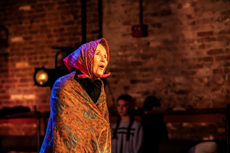
Theatre in Review: Oklahoma Samovar (La MaMa) There are four or five plays, all of them interesting, or perhaps a multigenerational novel in the mold of Edna Ferber or Belva Plain, rattling around inside Oklahoma Samovar. Crammed into two hours or so, the result is a highlights edition of the sweeping saga envisioned by playwright Alice Eve Cohen, drawing on her family's history. It's an evening of intriguing characters and dangling plot points, forever intriguing and rarely satisfying. The story begins with Jake, a Latvian Jew, who, in 1887, flees persecution in his homeland, landing first in New York, where he drives a streetcar, then Hartford for a brief interlude, before moving on to a career as a farmer in Kansas. His intended, Hattie, follows his trail, toting the featherbed and samovar that constitute her dowry -- although, thanks to long lag times in mail delivery, she is always at least one location behind. How she finally catches up with Jake isn't entirely clear, but that's par for the course in this busy epic. As per the title, Hannah and Jake end up in Oklahoma, where observant Jews are thin on the ground, and they begin the process of assimilation, Jake doing it with rather more gusto than his wife. By the time they are raising two daughters, the aspirational Rose and the rough-and-ready Sylvia, the narrative carries faint echoes of Ferber's Giant: These include Hattie, who has trouble adjusting to an entirely new culture, and Sylvia, whose unladylike attachment to the land makes her something of an outlier in the early twentieth century. An equally accurate title for the play could be Brooklyn Samovar, since that is where most of the second act takes place. Rose, on a visit to New York, falls for Ben, a former rabbinical student (booted from the seminary for spouting Marxist doctrine) turned doctor. Marriage follows, but Ben's mother, who chose Ben over her abusive spouse, is not about to loosen her grasp on the young man. The trio exists in a stalemate for years, up until the onset of World War II, when Rose's health begins to fail, and poignant dispatches arrive from Oklahoma, where Hattie carries on after Jake's death, and Latvia, where Hattie's mother will end up in front of a Nazi firing squad. It's all fascinating stuff, too often obscured by nagging questions. The Jake-and-Hattie story offers a striking contrast: He quickly learns to speak in a Sooner accent while she chafes at the absence of the old familiar rituals. (Arriving in Kansas, she is not thrilled at the prospect of living in a dugout.) Jake, defending his land, kills an interloper, an event that he turns into a sanitized anecdote for his little girls. (One of Cohen's abiding interests is the stories families tell about themselves, which shape the perceptions of succeeding generations.) In an especially telling moment, the thoroughly Americanized Rose learns the meaning of "pogrom," quickly assuring a skeptical Ben that antisemitism doesn't exist in Oklahoma. But just when we're getting invested in the family's fate -- Is this marriage destined to survive? -- Cohen shifts the action to Brooklyn, where more issues remain unaddressed, especially the case of Ben's sister, Maxine, a hell-raising flapper, who runs around with men and women, and, when last seen, is headed with her rich husband for Paris, not too long before the Germans move in. (Maxine seems to have a thing for Rose, who returns the favor, although nothing happens; what is that all about?) And I haven't even gotten to Emily, Rose's granddaughter, who, in 1987, shows up in Oklahoma with the ashes of her mother, Clara. Emily, who knows nothing about her forbears, including the farm and the existence of the now-elderly Sylvia, is a college student haunted by the unhappiness of her mother, an accomplished lawyer. The sources of that unhappiness remain obscure, as does any information about Emily's father. Cohen has no time for any of that; she can barely manage the characters she has put onstage. I hate to go around urging playwrights to pen vast dramatic cycles, but if anybody has the material, it is Cohen. The director, Eric Nightengale, has assembled an appealing and skillful cast, and he does a fluid job of ushering us down the decades. But Oklahoma Samovar is always on the cusp of becoming emotionally binding without quite getting there. If Sahar Lev-Shomer's boyish Jake feels a tad too contemporary, Sarah Chalfie pulls off a neat trick as radiant Hattie and troubled Maxine. Nadia Diamond nicely contrasts the ingenuous Emily with Rose, whose promising marriage takes a tragic turn. Joyce Cohen is solid as the countrified Sylvia and positively frightening as Ben's icy, possessive mother. The standout is Alex J. Gould's Ben, a man of real intellectual accomplishment and cultivation caught in a suffocating family triangle. Anna Kiraly's sensible set design employs panels hung on metal frames to suggest different locations; she is also responsible for the production's modest puppet aspect. Barbara Erin Delo's costumes help us keep track of the show's constantly changing timeframe. Federico Restrepo's lighting makes fine use of sidelight to carve out the actors. (Some of the upstage LED units aren't up to the task of fluid dimming, resulting in some unnecessary steppy fade-ups and fade-outs.) Nightengale's sound design -- street sounds, ships' horns, train whistles, chickens, a hurdy-gurdy-- is an invaluable scene-setting aid. It's never fun to report that a play needs more work, but, in a way, it's a compliment to Oklahoma Samovar to note that it would benefit from radical expansion. Hattie, Ben, Rose, Emily, Sylvia, Jake, Maxine, and the others are worth a longer, deeper look. --David Barbour 
|