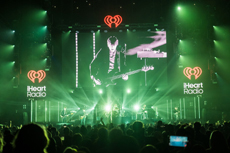
Patrick Dierson's Rig at iHeartRadio ALTer Ego Uses CHAUVET Professional iHeartRadio's ALTer Ego festival at the Kia Forum in January, featuring a rig, designed by Patrick Dierson, that delivered seamless support to visiting lighting designers for a diverse group of artists, including Green Day, Twenty One Pilots, Cage the Elephant, Almost Monday, and Mt. Joy. Diversified Production Services produced the event. For Dierson, president of the design and production services firm The Activity, the key to creating such a rig begins with a focused fixture selection. "When it comes to festivals, we really try to not have an overabundance of different fixture models, meaning that we don't want three different types of wash lights, four different beam fixtures, etc., etc.," he says. "That being said, the thing that we do strive to achieve with every design is to have all of the various qualities of light accounted for so that our guests have as many creative options as possible. This ultimately provides creative tools whilst not bogging the design teams down with an overly complicated cloning process as they bring their show files to the event." Helping to fill this role at the ALTer Ego festival were 32 COLORado PXL Bar 16 motorized, pixel-mappable battens and 24 Color STRIKE M strobe-washes, which, like the rest of the rig, were supplied by 4Wall Entertainment. "Our PXL Bar16s were a part of the more defined portion of the design and played a critical visual role," says Dierson, who worked with co-designer Zack Guthimiller, of The Activity, and lighting director David "Fuji" Convertino. "This year we had eight vertical trusses that were spread from the stage out past the audio arrays and staggard at different trim heights. This ultimately gave a smaller production on a tight budget a very large look, just in its architecture alone. "The PXLs were subsequently mounted vertically on the onstage and offstage cords of the trusses," Dierson adds. "The ability to pixel-map, zoom, and tilt the units from one side of the arena to the other gave a ton of visual opportunities where you rarely were subjected to the same look more than once." Mounted on the top and bottom of the same truss structures as the PXL battens, as well as along the line of the upstage back truss, the rig's 24 Color STRIKE Ms also added to the visual options open to designers, while at the same time increasing the overall brightness in the arena. "They produced an evenly distributed burst of light throughout the entire arena while still giving a lot of staggered depth to the look," Dierson says. "Couple that with their intense power and very broad beam, and the Strike Ms could be used for looks all by themselves. They're such an impressive tool to have in the rig." Aside from carefully curating the lighting rig, Dierson and his team also paid close attention to the arrangement of the gear on the 60'-wide stage with a 48' turntable from All Access. All floor packages had to fit on this turntable and be turned into position. "Things such as the low trim heights of the LED wall and lower hanging lighting trusses can start to limit the guest's creativity in augmenting the system with their floor packages, so we try to take those things into account and make sure that everyone understands the limitations up front while we also try to be as accommodating as possible," Dierson says. "One of the first things that we decided upon for this design was to go with a double-sided lower LED wall that was simply mirrored imagery on both sides. "In the past, we've often used an automated wall to fly it in and out for each of the set changes, but this year we really wanted to maintain the LED visual during the set changes so that we could also run video packages on the flown wall without the disruption of it flying up and down constantly," Dierson says. "The video wall is always a challenging topic on this show, and, at the end of every design battle, we traditionally get pushed into having a 16:9 hero wall." This year, to maintain the 16:9 flown wall, Dierson added the lower, double-sided element and then installed a visual separator between the two with a truss full of lighting elements. "This gave us enough visual 'disruption' so that it didn't just look like a monolith of a video wall," he says, adding that this configuration "made everybody happy," and, in the end, those are the best words that can be said about a festival rig. 
|