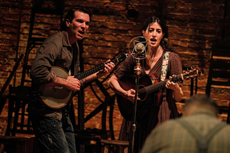
Theatre in Review: Waiting for Lefty (Classic Stage Company) Talk about populism: In addition to the Democratic electoral wipeout last week, Clifford Odets is suddenly the playwright of the moment; not bad for a guy who died in 1963. Still, few of his successors have offered a tougher critique of capitalism, and it is probably no coincidence that in our current age of economic anxiety and looming fascism, he once again seems au courant. In any case, productions are sprouting up everywhere: A well-received National Theatre staging of Golden Boy has been streaming in US cinemas. Coming in January is a starry Broadway revival of his masterpiece, Awake and Sing! Right now, CSC is giving us Waiting for Lefty, the trickiest of these, in a heavily revised format. Waiting for Lefty is a one-act with a typical running time of about forty-five minutes. To make a full evening of it, director Steven Pasquale, choreographer Susan Misner, and composer/arranger Yeller Tooth have dressed it up with songs (both period and of today) and movement sequences that fill in certain story gaps. It's a sincere effort, to be sure, but it gets hung up on a uniquely American paradox: Making Waiting for Lefty bigger isn't the same thing as making it better. The play is pure 1930s agit-prop, a syllabus of lessons on economic inequality and greedy bosses, an argument broadly defined and baldly presented. It is angry, simplistic, and embarrassingly starry-eyed about Soviet Russia. It is also written with enormous verve. Nobody penned dialogue like Odets, who transmuted the voices of his Bronx boyhood into a bitter, wisecracking New York patois that hones sarcasm into a switchblade. In Odetspeak, a guy doesn't say he isn't welcome; instead, he snaps, "I'm rat poison around here." Approaching his ticked-off girlfriend, a worried suitor murmurs, "What's on your mind?" "The French and Indian War!" she sneers. A fed-up wife tells her husband that his employer is "making a jellyfish outa you and putting wrinkles in my face." When an Odets character speaks, everyone else knows where they stand. No matter what one thinks of the playwright's Manichean politics (dividing the world into workers and oppressors), Waiting for Lefty is a true document of its time, written in fury and anguish at a moment when many Americans felt in their guts that capitalism was a racket designed to fleece the working class. The action unfolds at a meeting of a taxi drivers' union where a strike vote is on the agenda. Emotions on both sides are red-hot. Fatt, who wants to cut a deal with management, plays his red card, portraying the pro-strike crowd as a bunch of Communist dupes: "Give those birds a chance, and they'll have your sisters and wives in the whore houses, like they done in Russia," he roars, not entirely convincingly. He also waxes sentimental about "the man in the White House," warning the insurrectionists they should be grateful that "we workers got a good man behind us now" -- a sentiment that finds few takers. While the argument rages, Odets cuts to a series of vignettes, making clear the vote's life-or-death importance. A cab driver's wife, noting that their kids "look like little ghosts" thanks to malnutrition, tells her husband to fight for more money or she'll make other arrangements. Another cabbie reluctantly sets free the girl he loves, seeing no plausible path to marriage. The playwright broadens his argument to take in other workers. A chemist is pressed by his boss to work full-time on developing a new poison gas for the government war machine; refusal means unemployment. A brilliant young doctor, his hospital facing budget cuts, is let go because a) he is a Jew and b) his incompetent replacement is the nephew of a senator. Meanwhile, a patient is allowed to die on the table. Each episode bristles with indignation, offering another bit of evidence in the universal case for standing up to management. Even now, the script's passion is palpable. Waiting for Lefty is utterly dated, yet an authentic mirror of its time, and, when I've seen it before, it ended with the audience joining in and calling for a strike. But in supersizing it, Pasquale and his collaborators have also undermined it. They constantly interrupt the action with songs ranging from Wilco's "Union Prayer" to Woody Guthrie's "Which Side Are You On?", Jack Lawrence's "If I Didn't Care" (popularized by The Ink Spots), and the Jay Gorney/E. Y. Harburg classic, "Brother, Can You Spare a Dime?" Misner's contributions include a pas de deux and a lengthy mime sequence explaining the ugly reason why the title character, the union's chairman, hasn't arrived. (The script dispenses with this news in a couple of lines; Misner's slow-moving rumble only adds to the running time.) Such artfully done bits are impressive individually; collectively, they are acts of sabotage: Trying to amplify Odets' message, Pasquale and company drain it of tension and excitement. (As an aside, this version of the text leaves out the frequently omitted episode in which a starving actor, desperate to provide for his pregnant wife, is turned away by a callous producer more interested in his ailing wolfhound. The scene ends with the producer's stenographer slipping the actor a dollar, saying, "One dollar buys ten loaves of bread, Mister. Or one dollar buys nine loaves of bread and one copy of The Communist Manifesto. Learn while you eat. Read while you run." It is as tangy as anything else in the script but, these days, nobody wants to touch it. Decades after he named names to the HUAC, Odets' brief flirtation with Marxism continues to haunt him. Pasquale's cast, which includes fine talents like Tala Ashe, Greg Hildreth, Adam Kantor, Cameron Scoggins, and Henry Stram, only intermittently catches the rattling, cynical tone of Odets' dialogue, a teletype machine spitting out nothing but bad news. The director effectively sets the union-meeting scenes at a low boiling point but, because the vignettes can't build on each other, the result is disjointed, a hodgepodge of staging ideas. A rousing, tense, compact one-act becomes a halting Off-Broadway revue. Scott Adam Davis' set design, utilizing dozens of chairs and hanging globe lamps, nicely evokes a union hall atmosphere. Marion Talan de la Rosa's costumes are solid examples of period working-class wear. Palmer Hefferan sound design hauntingly sends the word "Strike!" around the room, reverberating like in a cathedral. Mextly Couzin, who increasingly seems like one of the most talented lighting designers of the new crop to emerge in the last few seasons, works the space with infinite subtlety and invention. Speaking of revues, but has anyone considered reviving Pins and Needles? This labor-themed entertainment, put on by the International Ladies Garment Workers Union in 1937, was a blockbuster hit. God only knows what the sketches are like at this late date, but Harold Rome's songs - "Doing the Reactionary," "It's Better with a Union Man," "Not Cricket to Picket," and "Sing Me a Song of Social Significance" -- are honeys. ("Four Little Angels of Peace," about Hitler, Mussolini, and Anthony Eden, is still a slashing piece of political satire.) Rather than trying to make Waiting for Lefty into something it isn't, it might offer a better way into an era of political tumult and global violence that often seems to echo in the present day. --David Barbour 
|