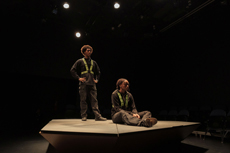
Theatre in Review: The Vessel (59E59)Drake, Missy, and Viggo, the trio who populate Brendan George's play, don't have the worst jobs in New York, but they might have the strangest. All three are employed as "park ambassadors" at the Hudson Yards tourist attraction known as the Vessel. As the script notes, the Vessel "is 150' tall and has eight levels, 80 landings, 154 flights of stairs, and 2,500 interconnected steps, which resemble a honeycomb-like beehive structure." Or, as someone in the play describes it: "this upside-down-pineapple-honeycomb-spaceship-shawarma-Eiffel Tower-Rockefeller-Christmas-Tree-thing." That's more like it! The Vessel instantly wins points for tackling this bizarre feature of New York City life. Whether you find the structure a charming architectural original or an M.C. Escher nightmare-cum-tourist trap, it has, in real life, become a magnet for the suicidal; at least four people have plunged to their deaths from it. Thus Drake, Missy, and Viggo are charged with eyeballing the guests, butting in nicely if someone looks suspiciously distraught, literally talking them off the ledge. The work is spiritually debilitating, and success is far from guaranteed. It's a living, but just barely. Although this is not clear without consulting the script, the three scenes of The Vessel unfold on days when actual deaths occurred. (The action unfolds in 2020 and 2021.) Indeed, George shies away from depicting these dire events, which slightly blunts their impact. Let's also note that nothing much happens during the play's ninety-minute running time. Still, this is no empty Vessel: Each of the characters is, as they say in the security business, a person of interest: Drake, the trio's de facto leader, is burned out from too many nights spent in Reddit rabbit holes, seeking answers about the shooting he failed to avert when working as a school security guard. Missy, the cagiest of the three, is painfully aware, having witnessed one of the deaths, that she and her fellow ambassadors are ineffective; later, she will exhibit signs of mental distress. Viggo is a walking anxiety attack, loudly dispensing unwanted opinions about assisted suicide (here, of all places) and given to boundary-crossing antics that keep his colleagues on edge. As it happens, he is on the lam from a family situation he'd rather not discuss; we will only note that he is a minor Internet celebrity with a GoFundMe he didn't start and a subreddit devoted to him. George is a gifted writer, and many of the play's best passages focus on the absurdity of Hudson Yards, an excruciatingly expensive, yet strangely anonymous, enclave, its face resolutely turned away from the rest of Manhattan. As Drake notes, the Vessel is "a stairwell to nowhere. And it's not a park. A plaza, maybe, but there's no nature. It's copper and glass on concrete -- or really, if we're being honest, it's an arts-and-crafts project for millionaires. They could've planted trees and flowers, which everyone would have loved. But, no...something shiny to look at from their empty investment property." And, treating these three bright, damaged, flailing young people with equal parts perception, sympathy, and humor, George gets at something that few of his colleagues have succeeded at doing, plausibly evoking what it feels like to come of age in a twenty-first century marked by random violence and creeping uncertainty; faced with few opportunities and lacking anything larger than themselves to believe in, his characters are often paralyzed at the thought of their cloudy futures. For them, moving forward with their lives requires a massive effort and a faith that none of them really feels. Peter Charney's production has a nice, offhand quality, as if we are eavesdropping on the ambassadors during work hours. If Will Ingram does little to rein in Viggo's more alarming qualities, he nevertheless keeps him sympathetic, especially in an eleventh-hour about-face that finds him learning to take responsibility. Anastasia Locke has the toughest assignment, as Missy is the most underwritten character; still, she makes clear that Missy thinks and feels much more than she lets on. The mononymic actor Sofonyas presides with authority over the action as Drake, who draws on a deep well of pessimism, especially when noting that the Vessel is little more than "a Trojan Horse for the citizens of Troy, except nothing's inside. Just the void." The production, in 59E59's tiny Theatre C, has been sensibly designed, beginning with Tony DiBernardo's bare platform set, which is frequently transformed by Yiyuan Li's lighting. Emma Hasselbach's sound design suggests the wind-blown environment on the plaza at Hudson Yards. More a character sketch than a fully realized drama, The Vessel nevertheless introduces a writer with something to say about a distinctive aspect of New York life and a canny eye for his generation's challenges. The sight of Drake, Missy, and Viggo standing on the edge of this bizarre contraption is a telling metaphor of a generation looking into the future and finding -- what? It's a fine calling card for everyone involved, and I'll be surprised if they don't all turn up again, and soon. --David Barbour 
|