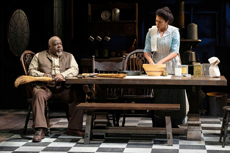
Theatre in Review: Joe Turner's Come and Gone (Ethel Barrymore Theatre)Joe Turner's Come and Gone was the third August Wilson play to be seen on Broadway, but it was the first to reveal the full scope of his ambition. Ma Rainey's Black Bottom, his debut work, centers around a tightly focused dramatic situation, a tense recording session featuring the blues singer of the title. (It is also the only Wilson play to feature a real-life character.) Fences, which turned him overnight into the leading American playwright of the day, is a gorgeously written but otherwise conventional family drama. Joe Turner places its characters against a broader historical canvas and introduces a spiritual element that turns this tale of boardinghouse comings and goings into something much more profound. (The mystical element is further developed in subsequent Wilson plays featuring Aunt Ester, the mysterious three-hundred-year-old figure whom the playwright called "the embodiment of African wisdom and tradition.") With Ma Rainey, Wilson got the world's attention. With Fences, he won the Tony Award and Pulitzer Prize. With Joe Turner, his grand design finally became clear. You can sense it as soon as the lights come up on David Gallo's stunning set design, which places a living room/kitchen interior against a vast mural in the style of Thomas Hart Benton or Reginald Marsh, of a Pittsburgh streetscape, backed by towering smokestacks and an overhead iron bridge. It's a bold, muscular portrait of profound social transformation. The play is set in 1911, as the city is being reshaped by a burgeoning manufacturing economy and the Great Migration, which, over several decades, saw six million Black citizens flee the South for the industrial North; Wilson's characters pursue their destinies against a world of tumult. Debbie Allen's production finds plenty of comedy in the life of the boardinghouse run by Seth and Bertha Holly, inhabited with effortless fun by Cedric the Entertainer and Taraji P. Henson. Both better known for their work in other media, they take the stage as if born to it -- he pointedly dropping a bucket on the floor to interrupt a loquacious border, or, sizing up an mysterious stranger, saying, "This fellow here look like he owe the devil a day's work and he's trying to figure out how he gonna pay him;" she, by serving up tasty meals, cheerfully hectoring Seth out of his grumpy moods, and generally acting as the in-house voice of reason whenever conflicts arise. Wilson puts onstage a rare thing, a long-lasting and thoroughly happy marriage, and the production's stars function as its anchors. Adding plenty of local color are Tripp Taylor as Jeremy, a country boy new to the city, fond of his guitar and the ladies, not necessarily in that order; Nimene Sierra Wureh as Mattie Campbell, patiently awaiting the return of her vanished lover after the loss of two babies; and Maya Boyd as the free-living, free-loving Molly Cunningham, who doesn't take on any man without numerous stipulations ("Molly ain't goin' South"). Dropping in from time to time is Bradley Stryker as Rutherford Selig, the white "people finder" who does business with Seth, reducing the room to horrified silence with chatty memories of his daddy's career as a hunter of runaway slaves. Despite Cedric and Henson's top billing, the play's main event centers on Seth and Bertha's longtime boarder Bynum Walker, a "conjure man" who helps others with their problems using a mix of concoctions and advice, and Herald Loomis, the haunted, world-wandering ex-deacon, who, accompanied by his little daughter Zonia, seeks the wife who left him behind. Bynum's existence has been marked by his long-ago encounter with a "shiny man" who guided him into a hidden Eden in search of the secret of life. Loomis, his life derailed thanks to a savage intrusion by a trader in indentured servants, burns with memories both real and fantastical. Bynum and Loomis are pitched opposite yet brothers under the skin: each recognizes that the other has seen things that nobody else in the house can understand. Tension brims between them, but only Bynum can talk Loomis down from his soul-searing vision of bones rising out of water, returning to their fleshly state. And it falls to Bynum to put a capper on the wrenching confrontation between Loomis and his wife Martha, which lays bare the truth of his seven lost years and her agonizing, yet necessary, decision to move on without him. ("I killed you in my heart...I couldn't drag you behind me like a sack of cotton.") As Martha, Abigail Onwunali aces the difficult test of making an eleventh-hour appearance and confidently taking a decisive role in the play's denouement. Wilson's previous plays touched on fresh dramatic material -- the "race music" industry in Ma Rainey and Negro League baseball in Fences -- but here one finds the full expression of the ideas that would inform the rest of his American Century Cycle, pitting the demands of a modernizing, mechanizing century against a historical-spiritual tradition that reaches past slavery to the African continent. No fan of Christianity, Wilson insists that salvation of a sort is found in embracing one's story in all its pain and contradictions; this includes connecting with the unexpurgated narrative of Black Americans, including slavery, the original sin that scars the republic to this day. Ruben Santiago Hudson brings Bynum's arias to roaring life, whether speaking of his late father with a strangled sob, or, turning avuncular, warning Mattie that using magic to bring back her man might have unintended consequences. ("It'll come up with him that he's in the wrong place. That he's lost outside of time from his place that he's supposed to be in.") So otherworldly is he that it is little wonder that Loomis, looking at him clinically, says, "You one of them bones people." At first, Joshua Boone's Loomis lacks a certain mystery and menace; I wonder if any actor will ever top Delroy Lindo, who so memorably created the role, his face sculpted with pain and loss. But near the end of Act I, Boone rises to an impressive frenzy, as Loomis is physically possessed by a terrifying vision of bodily resurrection (a speech that seemingly alludes to the horrors of the Middle Passage) and in the climactic confrontation with Martha, which ends in a kind of bloody baptism/absolution. Allen's staging puts more of an accent on comedy than usual. The Jeremy-Mattie-Molly triangle is drawn a little on the light side (although the reaction of Wureh's Mattie to an overture from Loomis is priceless), and the two scenes between Zonia and Reuben, a neighbor boy, are a little dull. (This is Wilson's fault, not the director's; these scenes are a bit too cute and top-heavy with exposition.) But the set pieces have lost none of their revelatory power. Wilson was busy building a universe, and the more one spends time in it, the more one realizes what a splendid place it is. In addition to Gallo, the rest of Allen's design team is first class: Paul Tazewell's costumes help delineate each character, especially Molly's gorgeously tended gowns. (Mia Neal's hair and wig designs complete each look.) Stacey Derosier's lighting is attentive to the play's shifting moods. Justin Ellington's sound design is one of his most subtle achievements, working various ambient effects into the onstage environment and providing solid reinforcement for Steve Bargonetti's original music. As always with Wilson, the music -- especially the blues -- is of paramount importance. Seeing Joe Turner again, one can only marvel at how early in his career Wilson staked claim to a much more expansive dramatic framework than anything his contemporaries were attempting. Among American playwrights, only Eugene O'Neill rivals him in ambition and scope. Wilson would top himself again, certainly with The Piano Lesson, but see Joe Turner to experience what happens when a writer reaches to scoop up the entire world and put it onstage. --David Barbour 
|