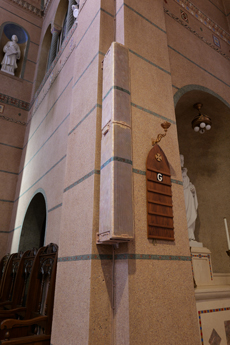
dBTechnologies Provides New Sound System for Houston Chapel Long before amplification became a necessity, the Villa de Matel Chapel was designed to carry the human voice through reverberation alone. Completed in 1927, the chapel sits at the heart of the Sisters of Charity of the Incarnate Word's Motherhouse campus in Houston, Texas -- an architectural and spiritual anchor for a congregation founded in 1866 with a mission rooted in service to the most vulnerable. The chapel's construction reflects those values with marble floors, granite walls, and a stone-tiled ceiling form a space of formidable acoustics. Every surface reflects sound. Every spoken word lingers. For generations, this natural reverberance supported prayer without technological intervention. The audio system design and integration were led by AV Design Pros, a Houston-based firm serving clients across 42 states, known for navigating acoustically and architecturally sensitive environments with restraint and precision. From an acoustic perspective, Villa de Matel presents nearly every challenge system designers are trained to avoid. The room is constructed almost entirely of reflective materials. There is no absorptive treatment. No architectural allowance for loudspeaker placement. No visual tolerance for equipment that draws attention. Spoken word further complicates the equation. Unlike music, speech demands precision without excess energy. In highly reverberant environments, even small increases in level can reduce intelligibility rather than improve it. But as the Sisters aged, and spoken word became increasingly difficult to hear -- particularly for a congregation where many speak softly -- the room's greatest strength became its primary challenge. The task was never to make the chapel louder. It was to make it intelligible. By the time AV Design Pros was engaged to evaluate the space, the chapel already carried the scars of compromise. A previous system, installed in 2012, relied on front-stacked loudspeakers positioned stage-left, struggling to provide even coverage while drawing visual attention away from the architecture itself. Worse still, the highly reflective room meant spoken-word reinforcement -- particularly from the ambo -- was prone to feedback. With podium microphones needing to be run "very hot" to accommodate quiet speakers, the margin for error was razor thin. "The room was never designed to have speakers," recalls Isaiah Stark, system designer at AV Design Pros. "Everything about it works against modern reinforcement if you approach it the wrong way." Early in the process, concern from the sisters was significant. There was hesitation -- even resistance -- to introducing additional loudspeakers into the space. At one point, the project was delayed and nearly cancelled altogether out of fear that the system would overwhelm the room rather than support it. That concern became the guiding principle of the design. Rather than forcing a conventional solution into an unconventional room, Stark approached the chapel as an acoustic organism -- one that needed to be guided, not controlled. Instead of relying on sheer output, the design uses precision delay timing and distribution to work with the room's natural acoustics. "Even coverage was essential -- but the speakers had to stay out of the way of the beauty of the room. And that's exactly what we did." The final system design combined INGENIA IG4T column loudspeakers at the front of the room with VIO X206 compact loudspeakers distributed along the rear arches. The choice of INGENIA IG4T was deliberate: its ultra-slim profile and exceptional performance in the vocal frequency range allowed the front system to act as subtle acoustic support rather than a dominant sound source. Mounted discretely and finished to blend seamlessly into the architecture -- each enclosure custom hand-painted by artist Vanessa Bright -- the system is effectively invisible to congregants. "The biggest obstacle we faced was finding a solution that worked, but didn't distract from the grand architectural beauty of the chapel," says Matthew Sellers, solutions engineer at AV Design Pros. "Now, the room sounds like the definition of sound reinforcement -- with speakers you can't even see." "The echo actually helped us," Stark notes. "It allowed us to keep the front speakers low enough to avoid feedback, while still reaching all the way to the back of the room. The goal was for it to sound like everything was coming from the front -- even when it wasn't." The result is a system that maintains the illusion of unamplified speech, while delivering consistent clarity across all 150 seats -- no small feat in a room built entirely of stone. "The room sounds incredibly delicate," Stark explains. "Our intention was to keep the tonality and reverberance that already existed, while adding clarity. The goal wasn't to change the room. It was to respect it." For lead technician David Romero, the success of the project lay as much in product design as system tuning. "The standout quality of dBTechnologies on this deployment was the unique engineering," he says. "The products were designed in a way that allowed them to integrate seamlessly into our architecture. That made all the difference in a space like this." The decision to move from X205 to X206 during the design phase reflected this balance. While fairly similar in size, the X206's larger drivers provided a more suitable tonal profile for the room, supporting spoken word with greater authority without introducing excess energy. Behind the scenes, design and verification tools including EASE Focus 3 and Smaart were used to model coverage, fine-tune delay relationships, and validate intelligibility -- ensuring that every technical decision served the larger goal of restraint, the company says. In addition to in-room reinforcement, the project addressed long-standing livestream issues. Previously, audio for remote services had been sent wirelessly, resulting in poor intelligibility for remote viewers. The new installation introduced hard-wired audio connections tied directly into the chapel's upgraded mixer, allowing for proper EQ and signal control. A parallel camera system upgrade -- implemented both in the chapel and an adjacent building -- now ensures that the chapel's services can be shared clearly with those unable to attend in person. "The attention to detail in both the design and artwork in this room is immense," Sellers reflects. "The Sisters who live here have given their lives in service of others. We wanted to honor that by bringing the same level of care and intention to the sound -- 100 years later." The dBTechnologies brand and product lines were introduced to AV Design Pros through Felix Pacheco of Highway Marketing, an independent professional audio and video manufacturers' representative firm serving Texas, Louisiana, Oklahoma, and Arkansas. Highway Marketing supported the system selection process by aligning product capabilities with the project's architectural, acoustic, and visual requirements. 
|