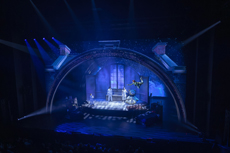
Luz Studio, Robe on Montreal Production of Peter Pan Montreal-based Luz Studio, headed by Matthieu Larivee, was asked by producing entity Entourage to create a visual design, including scenery, lighting, and video, for the musical Peter Pan at the city's Espace St-Denis. It was the first time that the famed musical had been presented in Quebec, and the challenge was to ensure that all the adventure and charm of the original story were replicated in a more contemporary setting. Robe was picked as the main lighting brand chosen by Larviee, with 28 FORTES, 42 Tetra2s, and eight LEDBeam 150s in the rig, supplied to the St-Denis production by SoftBox Integration. Peter Pan obviously requires flying effects, and a key mandate was to keep the flying tracks as concealed as possible. Then, with an LED proscenium arch and an LED screen upstage plus projection onto a downstage scrim and the scenic rim of the proscenium arch, it was vital that all the lighting could be tightly controlled, accurately focused, and shuttered. Another major consideration was that the projections, beamed from two 40K machines positioned at the front of house, were used to texture many of the set pieces onstage, so it was essential that light could be precisely targeted. With the front and rear LED screens positioned around 115' apart, the lighting elements needed to be rigged into a tight semicircular wrap-around space above the stage. Robe is a regular go-to moving light choice for Larivee for specific shows and applications, and the FORTE/iFORTE series is his current favorite for key lighting and producing skin tones. Here, the FORTES were rigged on side torms left and right of the stage and on the front-of-house positions. Six FORTES ran on RoboSpot controllers. LEDBeam 150s were rigged on the downstage most torms and placed around the front of the stage to assist with lighting faces. The output is subtle and gentle enough to be a great foreground light for illuminating the dancers. "They produced a nice layer of focused light from these positions," Larivee notes. LEDBeam 150s were also use for highlighting props. "They can be super directional even without snoots, so specific objects can be picked out, and it's possible to get great effects without washing out everything else," he confirms. While there were only eight LEDBeam 150 fixtures in this show, they played a prominent and vital role. Robe's Tetra2 moving LED battens were used as a main wash light for this show, to bathe the stage in color and help merge scenery, lighting, and video into a harmonious, relatable visual environment. The Tetra2s were also useful for adding layers of shimmering and twinkling trickery during the flying scenes. The team had some fun lighting these, and the fairy character Tinkerbell, represented by a pulsing LED light. The villainous Captain Hook and his boat also offered plenty of scope for imagination and lighting treatments. Speaking about his colleagues at Luz Sutio, Larivee says, "I have an overall perspective and will take the first brief and set the tone for a project like this, then leave it to the team of lighting and video designers and programmers to develop the piece -- it's important to give them room to create." Team members on this project included lighting programmers Charles Morin and Pierre-Luc Bedard; video designers Sebastien Deschenes and Laurence Payette, and video programmer Philippe Marquis. Charles Morin was also responsible for previsualization. The video content also included a lot of virtual lighting, which had to be mixed and matched with the real lumens onstage, another advantage of producing all the visual aspects together. 
|