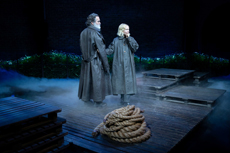
Theatre in Review: "Anna Christie" (St. Ann's Warehouse) One doesn't direct a Eugene O'Neill play; one wrestles with it, and, let me assure you, as writers go, he has a mean half-nelson. The problem is clear: No other playwright is as resistant to high-concept approaches or showy theatrical flourishes. Fortunately, most directors are straightforward in their handling of the late-career masterpieces. (I've seen a couple of attempts at picking up the pace of Long Day's Journey into Night; I will draw a veil over them.) But when one gets to the groundbreaking, often experimental, works of the 1920s, fasten your seatbelts: Recent years have seen an iffy (if fascinating) solo version of Strange Interlude and jaw-droppingly bad (if strenuously creative) takes on Desire Under the Elms and Mourning Becomes Electra. (I harbor a secret desire for a revival of Dynamo, a hope that I suspect will never be rewarded.) Directors, beware: You must take O'Neill as you find him and hope for the best. I'm not going to pretend that Thomas Kail's staging of "Anna Christie" is a total success -- I'm not even sure what that would look like -- but the director plays fair with a difficult script, getting directly at O'Neill's tragic vision. (It was originally dismissed in some quarters as the O'Neill play with a happy ending; Kail makes clear that it is nothing of the kind.) A few staging issues apart, he has a sense of respect for the playwright's work and a fearless need to investigate it. He also has three accomplished stars at his command. The combination makes for a generally riveting experience. About those stars: Michelle Williams enters, weary, disheveled from a long trip, and weakened by illness, putting on a brave face in her worn overcoat and tattered dress. Her reading of Anna's famous first line ("Gimme a whiskey -- ginger ale on the side. And don't be stingy, baby") makes clear that, for her, "Johnny the Priest's" bar, her destination, is the last chance saloon. Like most O'Neill characters, she is torn between conflicting impulses, feigning a respectable past as a farmgirl and governess or lashing out at her father, Chris, baring the sordid details of her sex-worker career. She finds a potential soulmate in Tom Sturridge's Mat Burke, a sailor rescued from drowning, driven by a passionate hunger for carnal love that rivals anything in the Tennessee Williams canon. A feral creature, speaking in a rasp, stooped in posture with a gorilla-like lope, he is the personification of animal need. Anxiously keeping watch on them is Brian d'Arcy James as Chris, a weathered, Swedish-accented rumpot who sent away Anna as a child, farming her out to relatives and unwittingly consigning her to perdition. (A rape, at the hands of a cousin, kicked off her downward spiral to a brothel.) Chris wants to keep Anna and Mat (really, any sailor) apart by any means possible: In one of the production's more commanding passages, he ticks off the extensive list of family members killed while working on the oceans, as well as the women who suffered from those deaths. Her fear mounts as he realizes he is helpless to stop history from repeating itself. Confining all three characters to a coal barge on a run from New York to Boston, O'Neill sets to cooking them in their own juices. When the truth about Anna's past comes out, both men are roused to fury and threats of violence. But Chris is forced, bitterly, to face his responsibility for her fate, his fantasy of her wholesome upbringing getting brutally shattered. Mat, an unreconstructed Irish Catholic despite his drinking, roistering ways -- note how he reverentially kisses the Marian medal around his neck -- is equally enraged and terrified, a little boy faced with the agonizing loss of an ideal. (He is one of many O'Neill characters to reduce women to either Madonnas or whores.) Anna, fed up with living up to men's expectations, fiercely disabuses them of their illusions: "You're just like all the rest of them -- you two! Gawd, you'd think I was a piece of furniture! I'll show you!" What follows is a remarkably brutal, self-administered dismantling, a burst of candor that leaves them all ravage and spent. Working with his design team, Kail uses contemporary ideas to frame O'Neill's ideas on his own terms. Entering the theatre, one sees a pileup of wooden decking, cane-back chairs, and a girder suspended from two rigging chains (designed by Christine Jones and Brett J. Banakis). It's as if "Johnny-the-Priest's" joint has been wiped out by a hurricane. Before the play begins, however, the actors assemble the barroom set for Act I; later, they transform it into Chris' barge. A mass of bottles on the upstage wall stands in for the Atlantic Ocean. Everything is shaped and transformed by Natasha Katz's angular, highly directional lighting and judicious use of color. Nevin Steinberg's sound design tickles one's imagination with ships' horns and lapping waves, along with Nicholas Britell's sometimes melancholy, sometimes urgent incidental music. Special effects, including rolling banks of fog, add to the nautical atmosphere. The transitions are choreographed by Steven Hoggett, who uses a chorus of longshoremen as witnesses to the action, rearranging the scenery and sometimes carrying the actors offstage. When Anna confesses to her career as a prostitute, they prowl around the edges of the stage, a potent symbol of her memories coming back to haunt her. All these elements combine with the savagely expressed emotions of the play's climax to frame "Anna Christie" not as a romance (although it is that, in part, if a notably dark one) but as a story of lives irrevocably claimed by the sea. Ultimately, Anna's choice is a terrible one: a life of loneliness and bitter regret or marriage to Mat, which comes with long separations and the ever-present specter of death. For all its successes, the production has its awkward moments. The set is often angled on a bias, surrounded by the audience on three sides; in this configuration, and in a play that hinges two- and three-person confrontations, Kail hasn't found a way to block the scenes so that one sees both actors' faces; too often, long exchanges are played out with one actor facing away to another part of the theatre. In any play, this is not desirable; in one about men and women clawing through layers of lies to reach their authentic selves, it is an active problem. Also, there are patches of awkward writing and a couple of plot coincidences, which, at the performance I attended, caused laughter in one sector of the audience; for modern viewers accustomed to today's sexual politics, O'Neill's characters, working-class stiffs worn down by constant labor and bottomless amounts of booze, may be off-putting or at least hard to credit. (To be clear, I find "Anna Christie" to be a surprisingly feminist piece of work.) Are audiences shying away from characters so beaten down that they almost belong to a lower evolutionary level? Or by the all-enveloping tragedy that shapes their cloudy futures? Maybe even at St. Ann's Warehouse, the viewers are closer to the 1920s' patrons of the "Show Shop" that O'Neill despised; maybe the essential darkness of "Anna Christie" isn't for everybody. In any case, this is a first-class voyage, also thanks to Paul Tazewell's costumes (check out the red jacket chosen by Anna after her past is exposed), and an incisive cameo by Mare Winningham as Marthy, boozer, wharf rat, and bedmate of any available dock worker, who gets the heave-ho from Chris' bed when Anna arrives. ("I got your number the minute you stepped in the door," Marthy snarls. "Ain't you smart!" Anna claps back. "Well, I got yours, too, without no trouble. You're me forty years from now." In an evening of ugly truths, this one is aimed squarely below the belt.) Whatever its missteps, this production leaves no doubt that "Anna Christie" is a monumental work. It's one of many that O'Neill seemingly pulled from his guts, converting his personal torment into a vivid picture of a world shaped like a beartrap, catching his characters in its claws with no escape possible. If his conclusions are bleak, his clarity is invigorating. O'Neill rushes in where few playwrights dare to go; we could use more of that. --David Barbour 
|